
WHY
WOODS
WORKERS?

The caribou pin of the Newfoundland Regiment and Newfoundland Forestry Companies uniform.
Courtesy of Archives and Special Collections, Memorial University Libraries, 23.03.012
In both world wars, the men of the United Kingdom (UK) who signed up for the armed services created labour shortages in their industries. This was certainly true for forestry, even though wood was an essential wartime commodity.
Across the Atlantic in Newfoundland (its own dominion and not yet a province of Canada), a strong historic connection to the UK existed. Not surprisingly, many men there were also eager to enlist to support the cause, and in any way that they could.
Among the hundreds of Newfoundlanders and Labradorians who answered the call to serve the “mother country” was a group of men who left their homes not to fight, but to work as lumberjacks in a critical industry. They belonged to two distinctive units: the Newfoundland Forestry Companies (NFC) in the First World War, a military unit, and the Newfoundland Forestry Unit, a civilian unit—better known as the Newfoundland Overseas Forestry Unit (NOFU)—in the Second.
These men had experiences and formed connections overseas that affected the rest of their lives. Hundreds married women from the UK and travelled home with their new wives. Lives were changed in large and small ways—and all of these events and changes are reflected in their songs and stories. It is this little-known cultural legacy that our website celebrates.
You’ll find the experiences of the NFC and NOFU woods workers organized into two wartime portals on this site. Explore them through these six themes.
Look & Listen
GODSPEED TO OUR FORESTERS
The video is a sequence of historic photographs paralleling the narrative. They include a scene of forested hills surrounding a loch, a man working a bucksaw and men stacking logs, men walking through a bombed-out landscape over a wooden pathway, convoy ships in St. John’s harbour, a coastal Newfoundland village, and images of railway stations, coastal ships, steam trains, and people travelling.
Narrator:
Wood is now a weapon of war and the pressing demand for it is making more changes in our lives. Since men of Newfoundland are among the best when it comes to cutting and milling timber, hundreds are heading to Scotland to share their expertise and support the mother country in her time of need.
The lumber they will produce will help the Allies win this long conflict. Their pit props will keep coal mines open and their posts will hold trenches in place. Their duckboards will give all our soldiers a steady path over dangerous ground.
Most of our foresters will leave by ship from St. John’s. We know that the good people of our capital city will provide a glorious send-off—but it will be the last of many. Most of our men will start their journey in a coastal outport or interior town, where families and friends are right now bidding their loved ones “bon voyage” in fine fashion.
Today, one of the trains carrying dozens of woodsmen to St. John’s came through our local station. It was greeted by loud cheers from the crowd that had come out to see the boys off. A piper added a fitting Scottish air to the tribute, with strains of “Barren Rocks of Aden,” “Mackenzie’s Highlanders,” and “Highland Laddie”—all tunes our boys will no doubt soon know well. As the train pulled to a stop, a lone fiddler began to play “The Road to the Isles,” especially poignant today.
[fiddle playing]
It was quite a busy scene! The music, the final handshakes and hugs as the waiting lads stepped on board to join the others doing their special bit for the homeland and the Empire.
Too soon the engine steamed slowly out of the station, pulling the crowded cars past a sea of waving hands and hankies. The engineer lay long on the whistle, to mournful effect. Those of us left behind turned away from the platform, knowing that train was taking from us such good and patriotic Newfoundlanders. Every one. We wish them “Godspeed” and a safe return.
[fiddle playing]
Credits:
Produced by Ursula A. Kelly & Meghan C. Forsyth
Video by Diego Pani
Narrated by Andrew Hawthorne
“The Road to the Isles” (by Pipe Major John McLellan DCM) performed by Paul D. Anderson.
Photos courtesy of The Rooms Provincial Archives Division, Archives and Special Collections (Memorial University Libraries), and the Inverness, Ross and Skye Forest District
2023
Logos:Grand Falls-Windsor Heritage Society, Memorial University and Digital Museums Canada
“We were born in Britain’s oldest colony and when they called for volunteers for the forestry—well, that’s why we volunteered.”
– Lewis Jenkins (NOFU #158) in “Newfoundland Overseas Forestry Service,” East Lothian at War
WOODS WORKERS FOR THE WARS
Wood was in high demand during both world wars. It was needed to build ships, bridges, trenches and railcars, and to make mine pit props, railway ties, telegraph and fence poles, as well as anti-landing defences. War at sea severely disrupted the UK’s access to imports, however, so it was soon critical to identify both a supply of timber and a source of skilled woods workers to replace the men who’d gone to war.
AU REVOIR AND A SAFE RETURN
In the eras of both wars, travel within Newfoundland and Labrador was challenging. Few roads existed, so boats were commonly used. Recruits and volunteers heading for St. John’s often started by journeying long distances overland, sometimes by horse-drawn sled or dog sled or on foot. They then boarded coastal boats and/or trains to reach their port of departure. Travelling from the far reaches of Labrador and northern Newfoundland, where weather conditions could be severe, was particularly arduous. All of this effort was followed by a North Atlantic sea voyage. And the long process was reversed when the war work was done.
HARD WORK AND DANGER
Overseas war service was the first time many of the Newfoundland and Labrador foresters had ventured beyond their homeland. Most were eager to do a good job and to adapt to new circumstances. They soon proved their skill, speed and innovation in harvesting timber, and introduced their hosts to new work-related words, such as “chute,” “scow” and “go-devil.” But the work was demanding and some men died—from accidents, illness or the misfortunes of war.
IT WASN’T ALL WORK
Overseas life offered many experiences when the long days of lumbering were done. Off-duty in the camps, the men did chores, relaxed and wrote letters home. To liven things up, they sang songs, told stories and played games. Diversions nearby included hunting, fishing and the attractions of the closest villages. There were also community concerts and teas to enjoy, and music and more at public houses, cinemas and dance halls. For many of the men, much of this was new and appealing.
POSTWAR TRANSITIONS AND STRUGGLES
The Newfoundland foresters’ innovations and work ethic impressed the people they met in the UK. Despite successes overseas, however, integrating back into life at home was not easy. Foresters of both wars were not honoured or celebrated like the men who enlisted in the combat services. The postwar struggle for parity in allowances and pensions lasted for years. And the “home” to which the foresters returned had also changed, and continued to change, adding new challenges for those who had served overseas.
MIGRATIONS, MARRIAGES AND MEMORIES
Relationships that formed during wartime migrations lifted morale and created ties that last to this day. Many foresters returned home with wives (called “war brides”) and children. Particularly after the Second World War, some foresters never returned, choosing instead to stay overseas. In Newfoundland, Labrador and the UK, these foresters and war brides made deep and lasting impressions on their new communities.
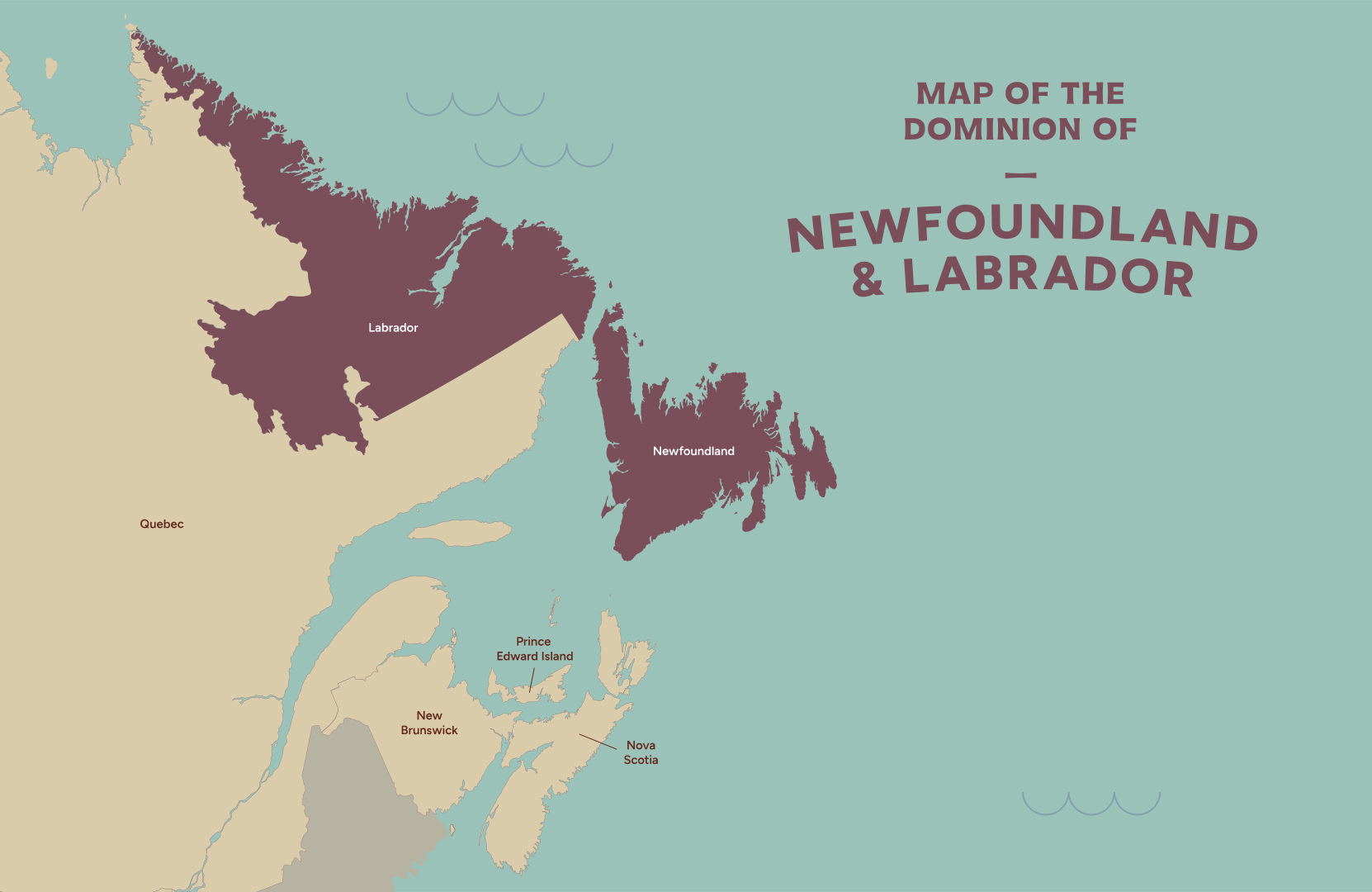
This map shows the ports that the foresters left from and disembarked in, when travelling overseas in both world wars.
NFC AND NOFU CAMPS IN THE UK
Click the dots on the map or filter the locations to discover where the Newfoundland and Labrador foresters were based during their time overseas. Note that all locations marked are approximations.
ACCESSIBILITY NOTE: Screen readers will not be able to access the map. Please use the link below to see a list of locations indicated on the map.
✼ Lists of UK camps, towns, and cities shown on the map.
✼ Lists of UK camps, towns, and cities shown on the map.
THE ALL-’ROUND NEWFOUNDLANDER (excerpt)
As a logger, he’s a princeling; he can drive a stream as well
And, often, when he blasts the jam, he takes a chance on hell
He’s a devil in white water when the logs go racing by
And he revels in the danger for he’s not afraid to die.
To build a house from sill to roof, he needs no college pass
He’s a handy man with axe and saw; there’s no one in his class
He saws his lumber, cuts his stone, and oft-times bakes his brick
Where another would be daunted, he simply works the trick.
This poem by P.C. Mars first appeared in The Veteran magazine, 1924.

The 1924 wreath-laying at the National War Memorial in St. John’s, Newfoundland.
Courtesy of The Rooms Provincial Archives Division, VA 28-153
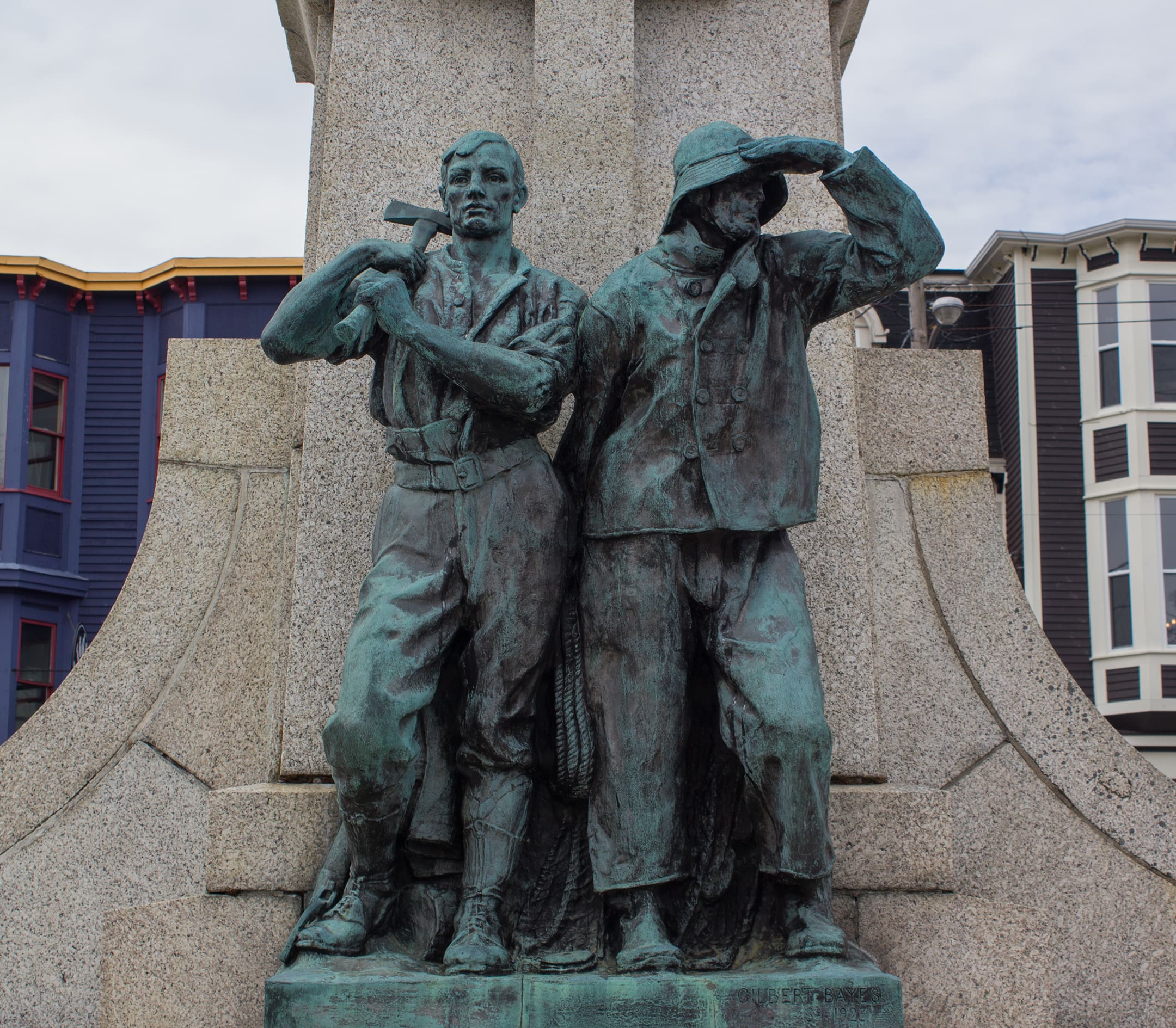
Two figures are mounted at the base of the War Memorial in St. John’s: a logger and a fisher, representing those who served as foresters and merchant mariners during wartime.
Courtesy of Diego Pani
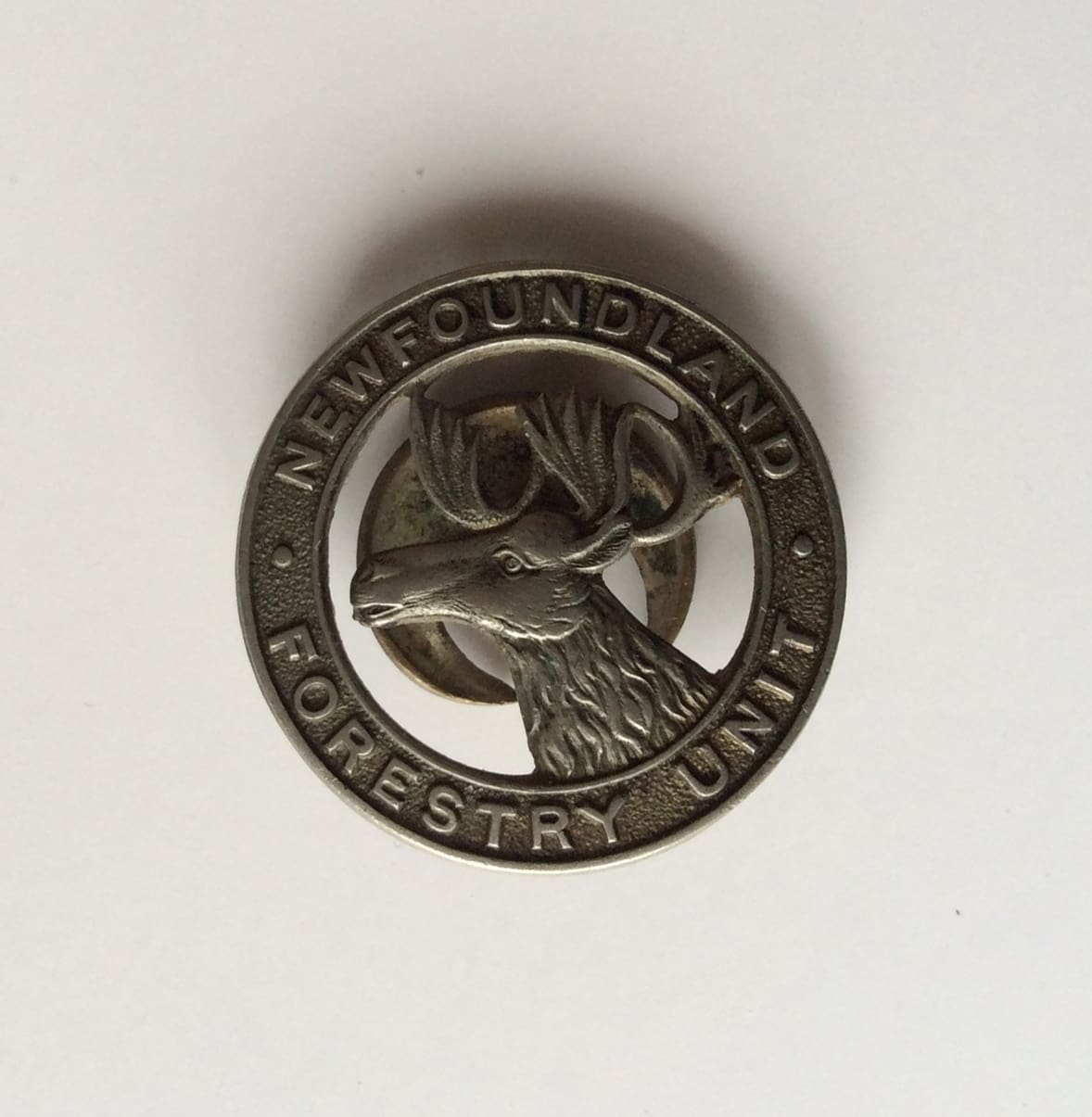
The uniform lapel badge of the Newfoundland Forestry Unit.
Courtesy of Wilco van Eikeren

The uniform shoulder badge of the Newfoundland Forestry Companies.
Courtesy of Archives and Special Collections, Memorial University Libraries, 04.03.007