

Second
World
War
MIGRATIONS,
MARRIAGES,
AND MEMORIES
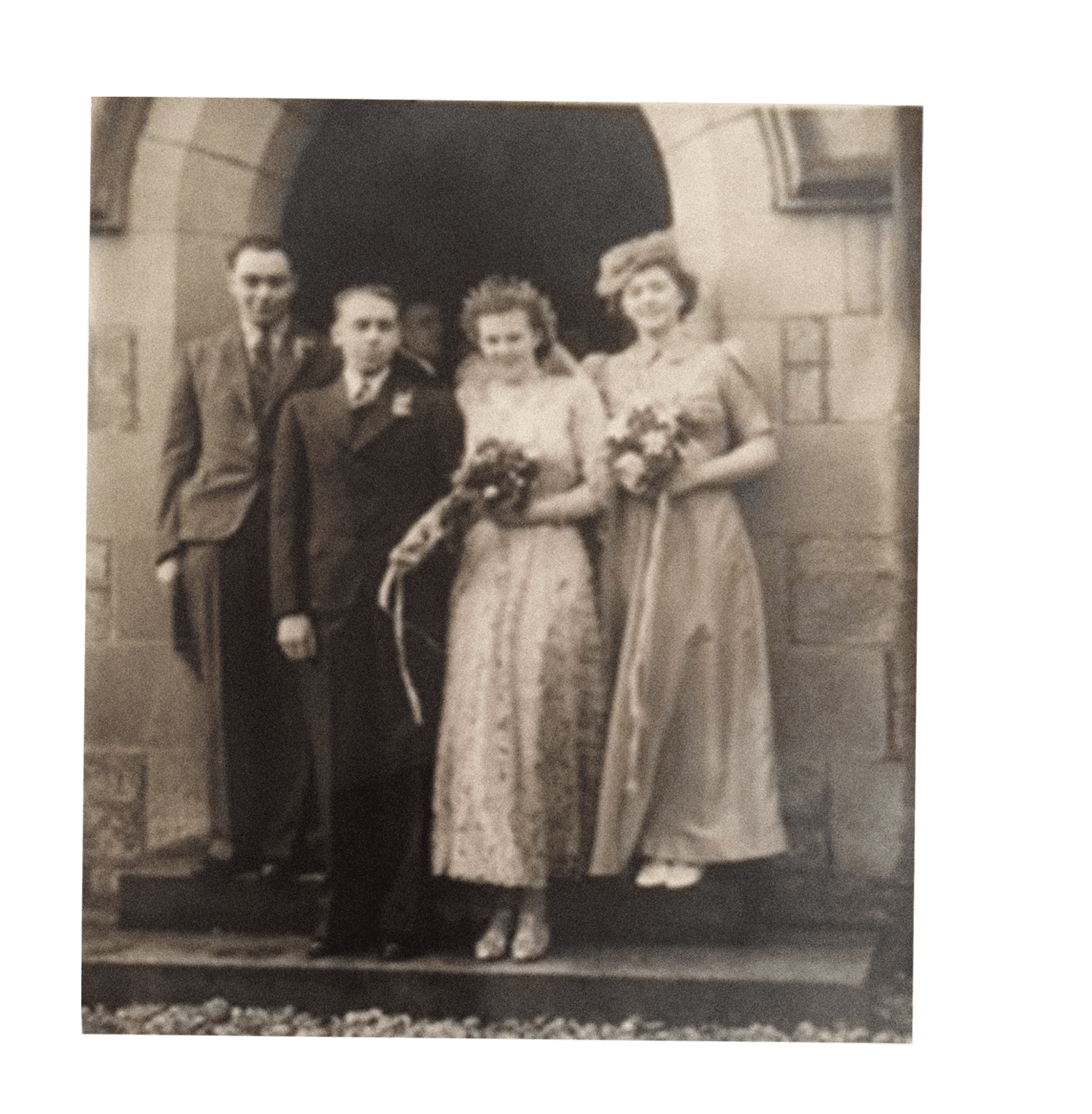
AN INFLUX OF BRIDES
Many NOFU members spent more than six years in the UK. During that time, there were hundreds of marriages. Some foresters married local Scottish women and became citizens of the UK, making a life for themselves in a country they had come to love. But most returned home with their brides, and often with young families, sailing from Liverpool or Southampton.
It is estimated that as many as 800 war brides left the UK for Newfoundland and Labrador. Many were the wives of foresters. Not all of them stayed for good, however. Some found their new lives had more challenges than they wished—or were able—to face. Those who did stay created a remarkable collective legacy in their new homeland.
ARRIVAL BY SEA
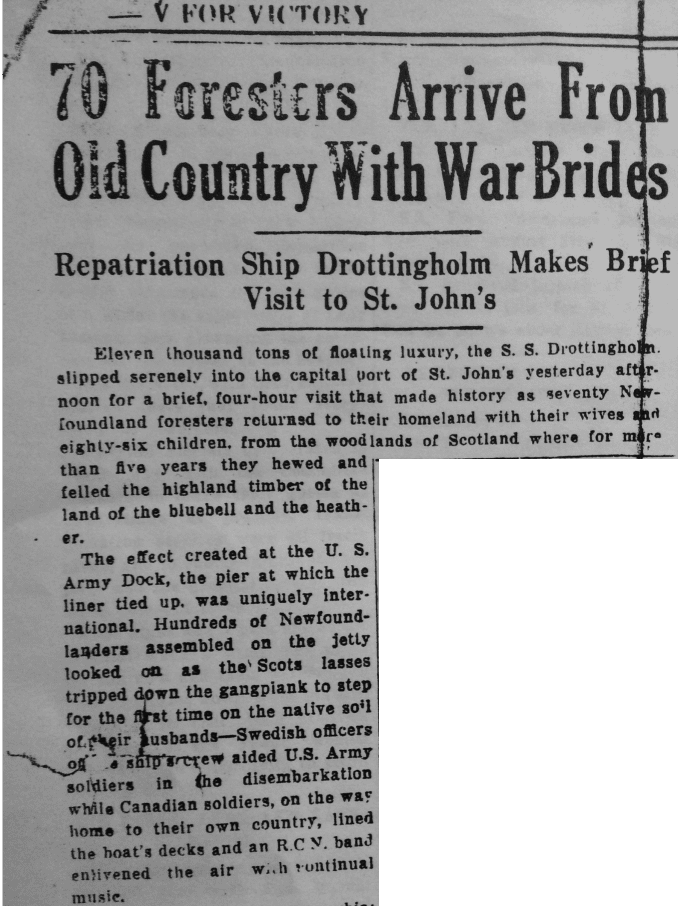
70 Foresters Arrive From Old Country With War Brides
Repatriation Ship Drottingholm [sic] Makes Brief Visit to St. John’s
Eleven thousand tons of floating luxury, the S.S. Drottingholm slipped serenely into the capital port of St. John’s yesterday afternoon for a brief, four-hour visit that made history as seventy Newfoundland foresters returned to their homeland with their wives and eighty-six children, from the woodlands of Scotland where for more than five years they hewed and felled the highland timber of the land of the bluebell and the heather.
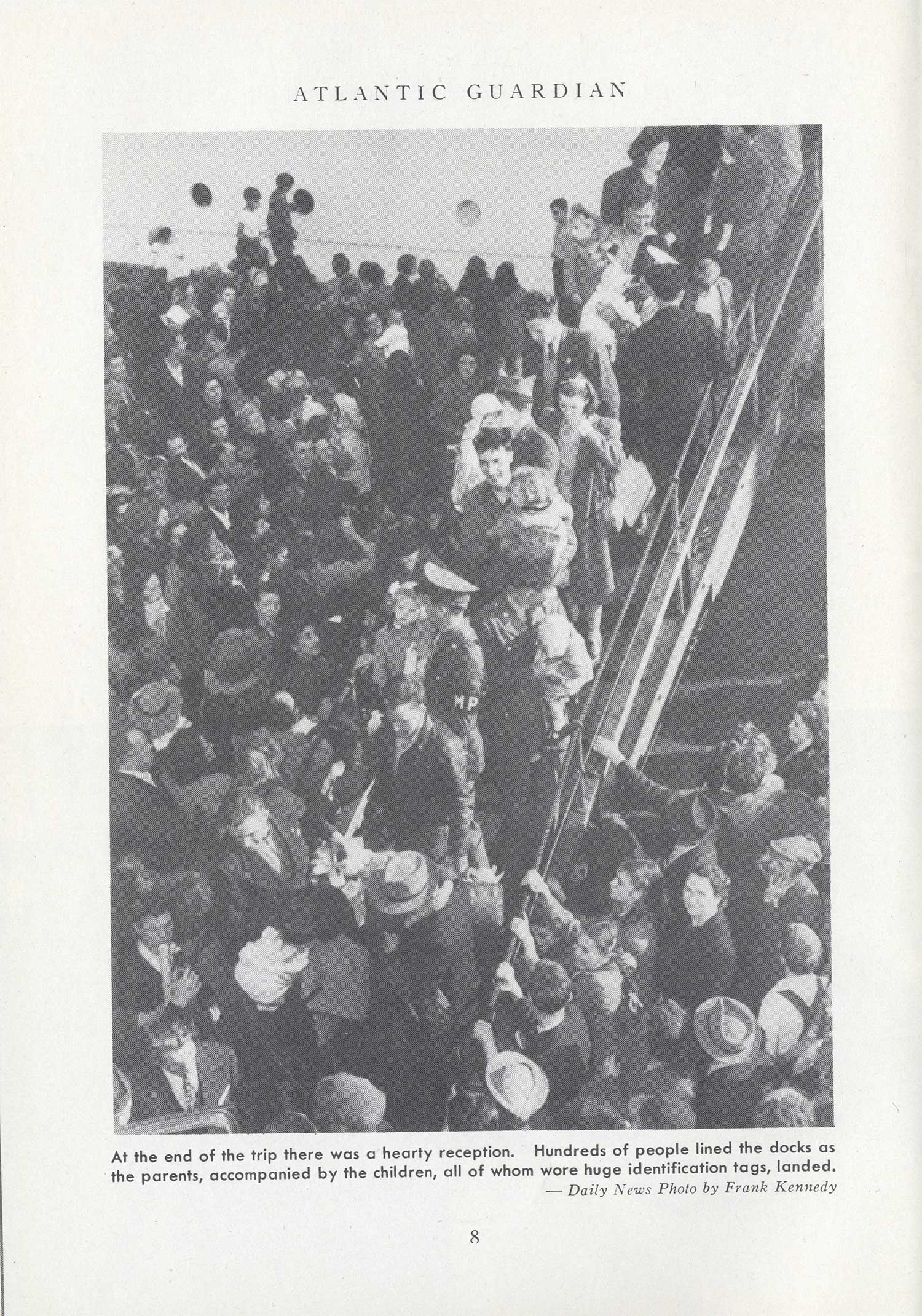
The effect created at the U. S. Army Dock, the pier at which the liner tied up, was uniquely international. Hundreds of Newfoundlanders assembled on the jetty looked on as the Scots lasses tripped down the gangplank to step for the first time on the native soil of their husbands—Swedish officers of the ship’s crew aided U. S. Army soldiers in the disembarkation while Canadian soldiers, on the way home to their own country, lined the boat’s decks and an R. C. N. band enlivened the air with continual music.
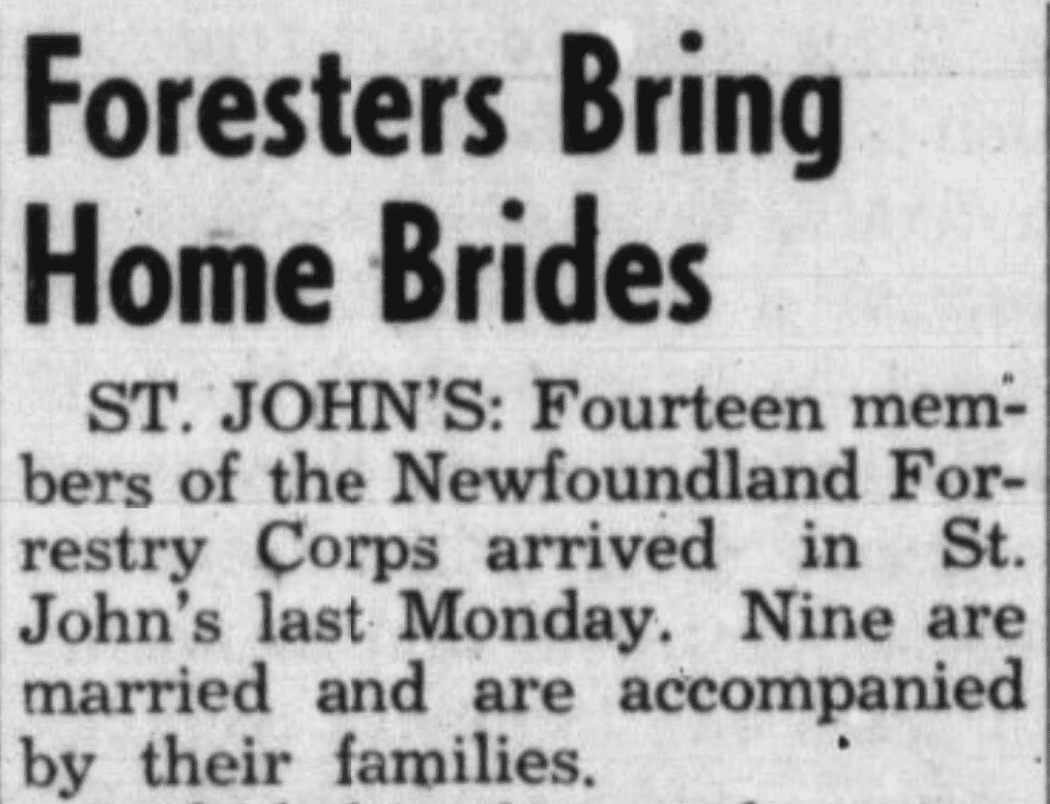
Foresters Bring Home Brides
St. John’s: Fourteen members of the Newfoundland Forestry Corps arrived in St. John’s last Monday. Nine are married and are accompanied by their families.
Look & Listen
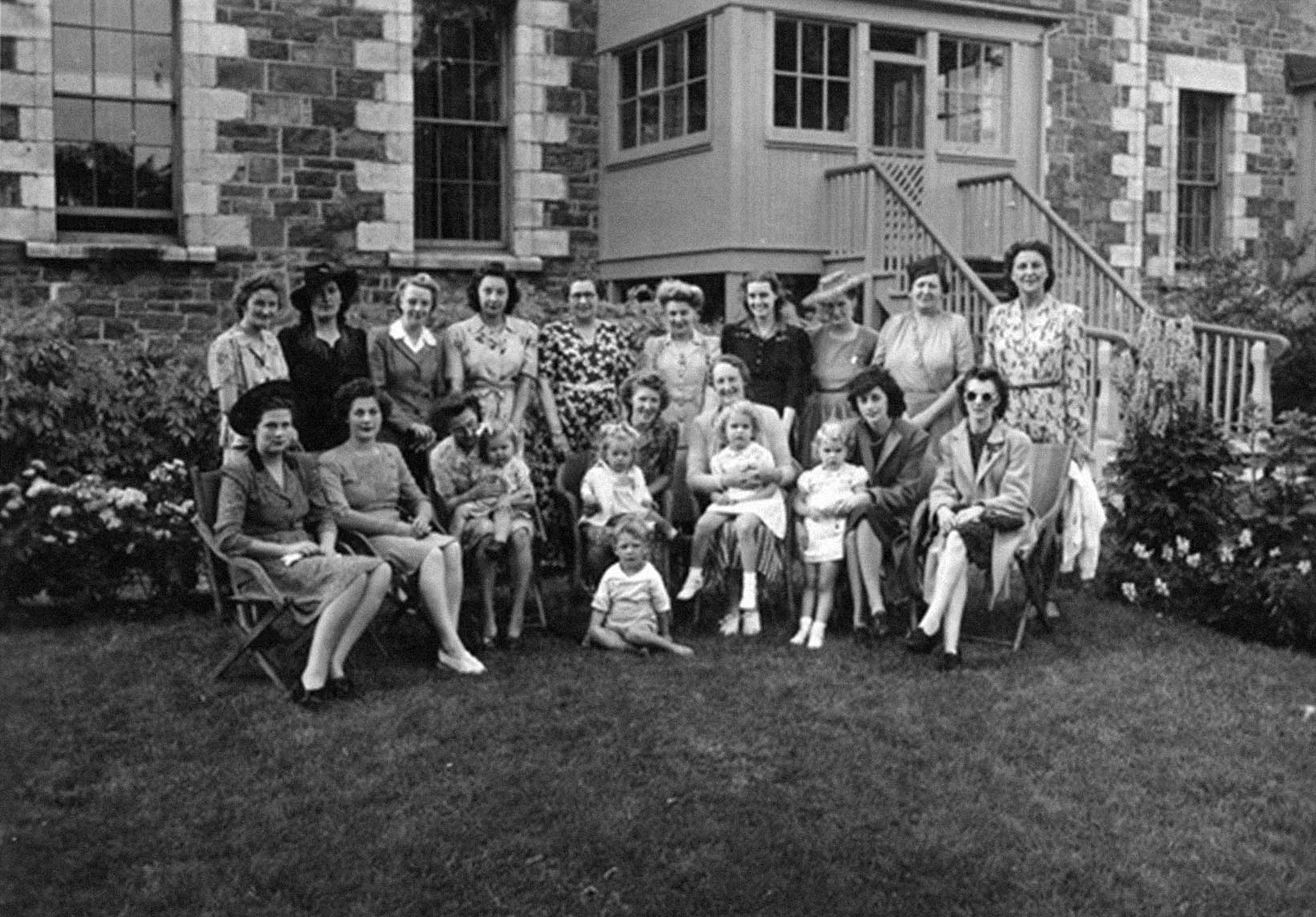
This video features a sequence of historic photographs and documents that illustrate the points in the narrative. In the introductory narrative, the images are of soldiers carrying children down the ramp of a ship to a waiting crowd, a wedding photo of Bill and Mary Sooley, the SS Drottningholm, the railway track in Heart’s Delight, a sawmill in Heart’s Delight, Bill Sooley’s derelict lumbermill, and a group photo of 17 British war brides and 5 children in front of Government House in St. John’s. In the song that follows, the images are of a sawmill in Botwood, men standing by a sawmill, a sawmill with a backdrop of a forest, and men peeling wood.
Title: Mary & Bill
Image of a newspaper headline with the words “70 Foresters Arrive From Old Country With War Brides. Repatriation Ship Drottingholm Makes Brief Visit to St. John’s”
Image of a newspaper headline with the words “Foresters Bring Home Brides. St. John’s: Fourteen members of the Newfoundland Forestry Corps Arrived in St….”
Narrator: Approximately eight hundred war brides immigrated to Newfoundland from the UK at the end of the war. Among them was Mary Gardner. She met William B. Sooley, a forester from Heart’s Delight, Trinity Bay, at a Fun Fair in Edinburgh in May 1943. They married in February 1945 and, that August, sailed from Liverpool to Newfoundland to begin their married life in Heart’s Delight. Mary sometimes joked that she was the prize Bill won at the fair.
Bill Sooley operated a lumbermill that employed several family members. When misfortune befell the mill in the 1960s, Leander Peach wrote a song about the incident and Mary an honourable mention. Mary is one of the war brides of Newfoundland featured in a CBC Land and Sea episode entitled “The Women Who Crossed an Ocean.”
Title: “Billy the Lumberman,” written and performed by Leander Peach
[man singing]
Oh, there’s Billy the lumberman, the first time in his life
Hasn’t cut many logs to help Mary his wife
When he walks in the kitchen, she says, “You’re early now, Bill”
Then he breaks down and tells her, “Sure, the wind ruined the mill.”
Then in comes poor Vince, boy, the worst of them all
He hasn’t done a thing since he was laid off last fall
He hasn’t done a thing for to try to help Bill
But he’s sure to want his part when they starts in the mill.
Then in comes Eddie John and he looks mad right now
Then he hauls off his cap, wipes the sweat from his brow
He turns around to Lizzie, she was standing quite still
He said, “The boys they are ruined ’cause they got ne’er sawmill.”
It happened in their little place under the hill
Place that Stan Vivian sold over to Bill
I’ll tell you now, friends, it would give you a thrill
Just to see the mill flattened in under the hill.
Credits:
Produced by Ursula A Kelly & Meghan C. Forsyth
Narrated by Fiona Miller
Audio recorded by Keith Miller
Photos courtesy of the Sooley family, The Rooms Provincial Archives, The Evening Telegram, The Western Star, Atlantic Guardian, Memorial University of Newfoundland Digital Archive Initiative, and the Swedish American Line (via Wikimedia Commons).
“Billy the Lumberman” (Leander Peach, 1968) was recorded by Kim (Sooley) Welsh in 1988 and included on Mentioned in Song: Song Traditions of the Loggers of Newfoundland and Labrador (U. Kelly, 2014)
2024
Logos: Grand Falls-Windsor Heritage Society, Memorial University and Digital Museums Canada
Look & Listen
ONE’S HEART’S DELIGHT
Mary (Gardner) Sooley is one of the war brides of Newfoundland featured in a 2013 CBC Land and Sea episode entitled “The Women Who Crossed an Ocean.” Here’s an excerpt from it.
[Sea birds]
Video footage of a rocky ocean beach with houses along the bank in the distance
Narrator: Heart’s Delight is a few communities away from Whiteway and on a beautiful day you can see how this place would be one’s Heart’s Delight.
Black-and-white photo of a young man with short dark hair
But it was Bill Sooley, a son of this outport, who became the heart’s delight of another Scottish girl: Mary Gardner, from a place just outside the city of Edinburgh.
Black-and-white photo of a smiling young man and woman in their wedding attire
Mary was 18 years old when she and Bill married. Six months later she was living in Newfoundland.
Two older women are seated at a round table with mugs and some food. Behind them is a small kitchen and doors to other rooms are closed.
Jenny: Do you want some crackers and cheese, my dear?
Mary: Yes, I’ll have some, please.
Narrator: Mary is 85 now, living in a retirement home in Heart’s Delight. Her husband Bill is gone but one of Mary’s best friends, Jenny, spends a lot of time here and still marvels over the Scottish accent that never completely went away.
Jenny: Well, I just didn’t know what to think of it. Sometimes I understood her, more times I didn’t. Just sometimes I understands her now, sometimes I don’t. [Jenny laughs]
Mary: Well, it was a problem at first. When I knew Bill first I couldn’t understand he very good and he couldn’t understand me very good. [Mary laughs] So but when I come over here after a lot of people couldn’t understand me.
[soft piano music]
Sequence of black-and-white video clips of logging camps, men working in the forest with axes and saws, and a Garron pony and a tractor pulling logs
Narrator: During the war, Bill Sooley was enlisted with the Newfoundland Forestry Unit, contingents of Newfoundlanders who signed on for the lumber camps of Scotland to feed wood into the Allied war machine.
[sawing wood] [tree falling] [Axe chopping]
It was brutal work but work the Newfoundlanders were used to. Back-breaking woods work was part of survival in outport Newfoundland back then. These men were just doing the same job in a different country for a different cause. [footsteps]
Black-and-white photo of a smiling young man and woman; the video zooms in on the image of Mary and then transitions to the contemporary video of Mary sitting at the table in her house
Bill met his Mary while on leave one day at a Scottish summer fair. He never looked back. And, when it came time to follow her husband to Newfoundland, neither did she.
Mary: Well, it was a big thought to tell the truth because I didn’t know what to think about me, Mom and them all the crowd, eh? Anyway, I took a chance, say, anyway, so I never regret that part but I mean, tell you the truth, Pauline, my life over here is… I don’t regret it.
Video shows Jenny speaking at the table in Mary’s house
Jenny: Uh, I could never understand it. She got no nerve but I think then she must have had a great big nerve, you know? That’s what I I thought. She had to have a big nerve for to leave Scotland and come over here. Yeah, I don’t think I could do it. No. I went to Brampton, Ontario last year and I didn’t even want to leave home to go there. [Jenny laughs] First time ever I was on a plane.
Video shows Mary drinking from a mug at her table
Narrator: Mary’s never been on one, or another big boat, not since the first and only time she crossed an ocean.

NEW CITIZENS FOR NEWFOUNDLAND
Ted Meaney wrote an article for the Atlantic Guardian (published November 1945) describing the widespread excitement when returning foresters and their families arrived home. Two excerpts from his article follow.
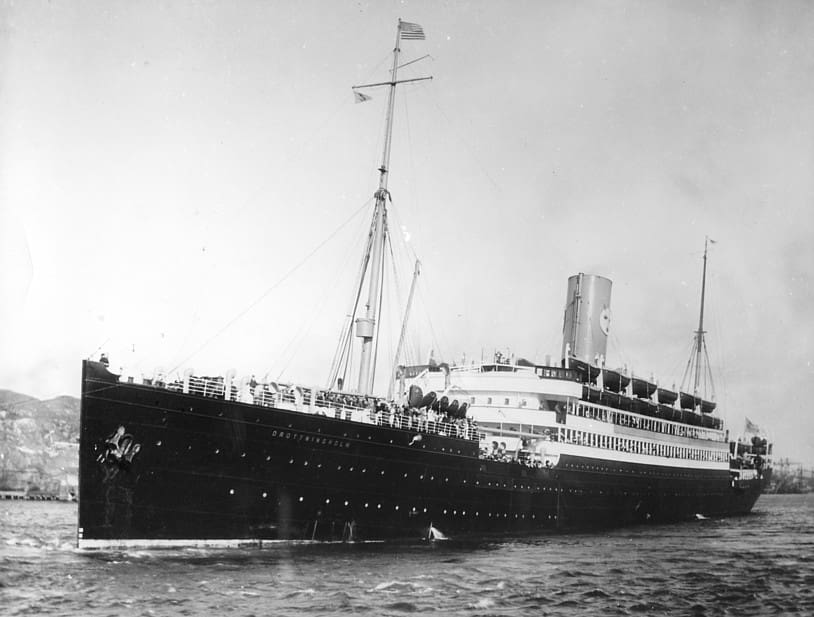
As the great white mercy-ship, which has found home for thousands of war-exiles, docked within the ancient gateway of St. John’s Harbor, curious city-folk lined the Battery Road and squeezed onto the U.S. Army Pier below. Eager relatives who swarmed half-way up the gangway were eased back and a long line of MPs, Customs officers, Nurses, and even a couple of Colonels, filed ashore each carrying a baby wearing a ridiculously large name-tag.
The Canadian Naval Band played “Annie Laurie,” the babies bawled and spectators gaped, laughed, chattered and cheered with the feeling that here was one happy ending in a war in which happy endings are so few.
That evening I saw them all in a vacant Naval hospital where they were quartered to await transport to new homes all over the island . . . . In-laws from nearby towns were there to meet their new Scottish daughters and see the babies. Nearly everyone was eating fruit and chocolate for which they had starved for five years.
LISTEN
THE CHILDREN TOOK OVER
The mothers, I learned, were inured to noise after that trip across. The children took possession of the ship and it needed a police force of stewards to prevent mutiny and keep the youngsters from falling overboard or getting lost in the engine room . . . .
I found the kitchen where the War Brides Committee had prepared three hundred suppers. They said that eyes, long accustomed to meagre British rations, popped at the fruit and butter on the tables. There was a row of bottles with milk formulas heating on an electric stove . . . .
“The family wing” was once a convalescent section for the Navy. It was a warm night and heavy sleeping suits, special for the sea trip, added nothing to the good humour of the children . . . .
HAVE MUCH IN COMMON
Newfoundland had a prior affection for Scotland which dates back to the First World War when our famous Newfoundland Regiment trained near Inverness and did garrison duty in Edinburgh Castle. They went back to Scotland on furlough, Scottish mothers wrote to Newfoundland mothers and told them news about the boys and how much everybody loved them.
At the beginning of World War II, another army of our boys went to Scotland for a different but still vital mission—this time to cut pit props for Britain’s coal mines. They were billeted all over the West Counties and places like Aberdeen, Inverness, Dumfries and Lockerbie were second homes to boys from Twillingate, Corner Brook, Flowers Cove and Bonne Bay.
HOW ROMANCE BEGAN
The timber output of the Newfoundland Unit was far ahead of all others—Canadians and British—but they had time to meet the Scotch lassies at Red Cross affairs, in church, on the bus, in the usual wartime way and sometimes in ways not so usual.
Several matches were made in the centuries-old Castle O’er, with fifty rooms, where our men were billeted for nearly two years. Square dances in storied halls, and nagged courtyards with ivy vines will be a romantic background for many a Newfoundland story that will end with “and that’s how I met your mother.”
START NEW LIFE HERE
Foresters are not eligible for any of the benefits of the Government’s Civil Re-establishment Plan which applies only to uniformed men. But they worked hard—twelve to fourteen hours a day—and earned good wages during the war, and most of the men have sizable stakes saved for a fresh start at earning a living in fishing, logging and farming. Scotland taught them a lot about farming and trades and this country will be the better for it in years to come. At any rate, Newfoundland owes the Foresters a square deal for the vital war-job they have done.
After a couple of days in St. John’s, most of the families were loaded aboard a special train to take them to their new homes throughout the Island. A tight little group gathered on the rear platform waiting, a little self-consciously, to wave goodbye. There was nothing spectacular about it—nothing except the quiet, good-humoured courage of these young women, far from home, facing a stern new life which they knew, as well as we did, wouldn’t be all plain sailing.
LISTEN
Portrait of a War Bride
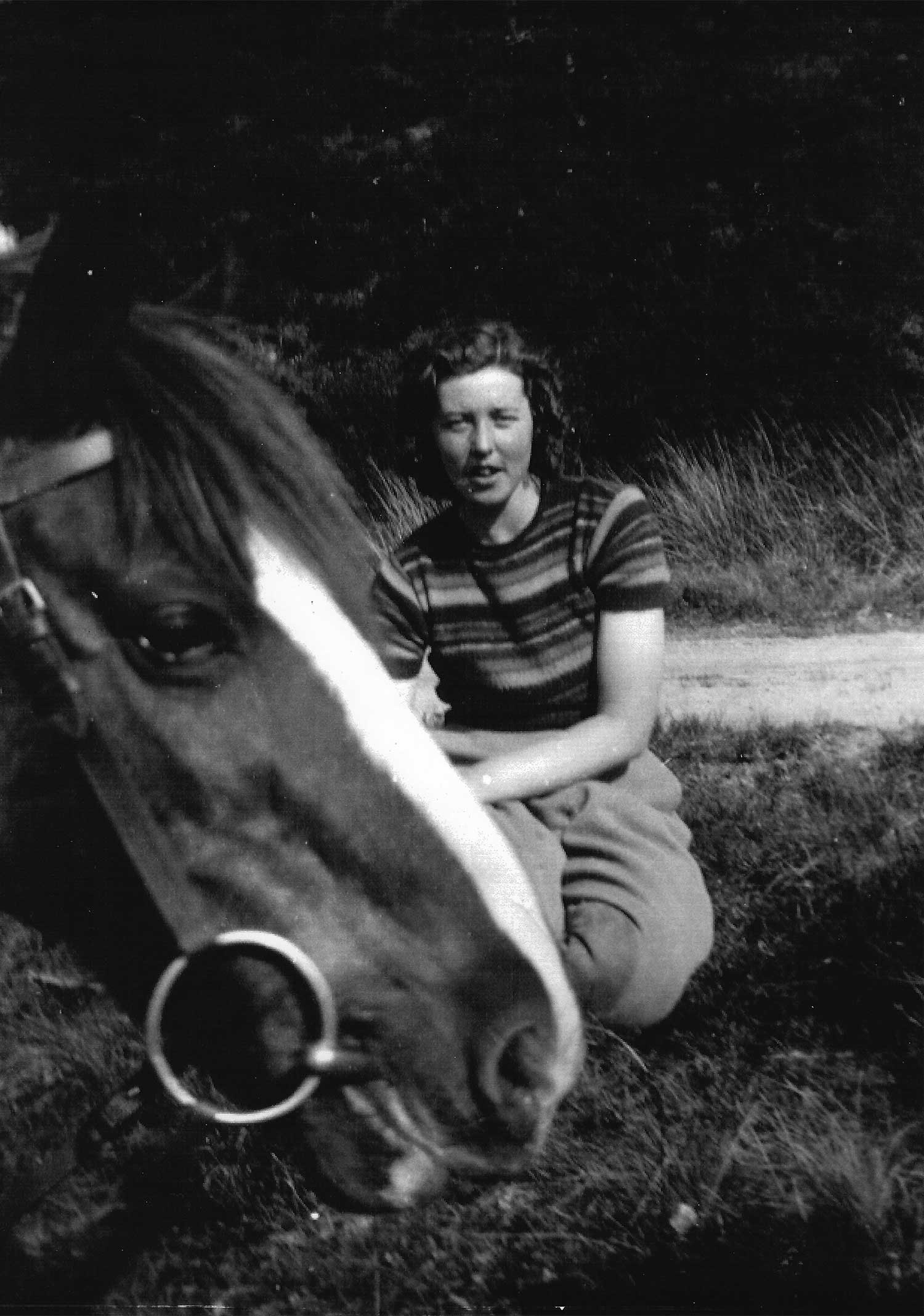
Elizabeth Ormiston Kelly of Newtonmore, Scotland—called “Mulliadh” or “little darling” by her grandfather—grew up on a family farm where Highland ponies and cattle were raised. She married Daniel F. Kelly (NOFU #1448) of Gambo and moved to Newfoundland after the war. In 2002, in a speech at the Newfoundland Overseas Forestry Association Reunion, she gave an account of her life in Scotland during the war and in Newfoundland afterwards. Here are a few of her recollections from that speech. Mulliadh Kelly died in 2011.
ONE WAR BRIDE’S LIFE
The Newfoundlanders arrived in February 1940. There were six camps and a sawmill camp at Laggan, about ten miles from us. Once they got settled, they started to come to the village. The first two I met were Joe Mackay and Tom White. They used to go to dances, etc. We had card games and teas and entertainment for them. I met Danny in 1940. We started dating on the sly. Newfoundlanders were out of bounds to us. I told you dad was strict. But I think it was love at first sight for us.
We were allowed to ask some of them to Christmas dinner at our house in 1940. Of course, knowing Danny, it was mostly Gambo boys. I can’t remember all the names. There were about a dozen, Patrick Kelly (Danny’s cousin), Tom Leo Kelly, Jim Dooley, I think Kevin Hawco and Jim’s brother Jack Power (Salmonier), to mention a few. We were allowed to go to the dance in the village that night, Bunty and I, and Mary Leslie (one of the servants) had to go as a chaperone. We soon gave her the slip that night!
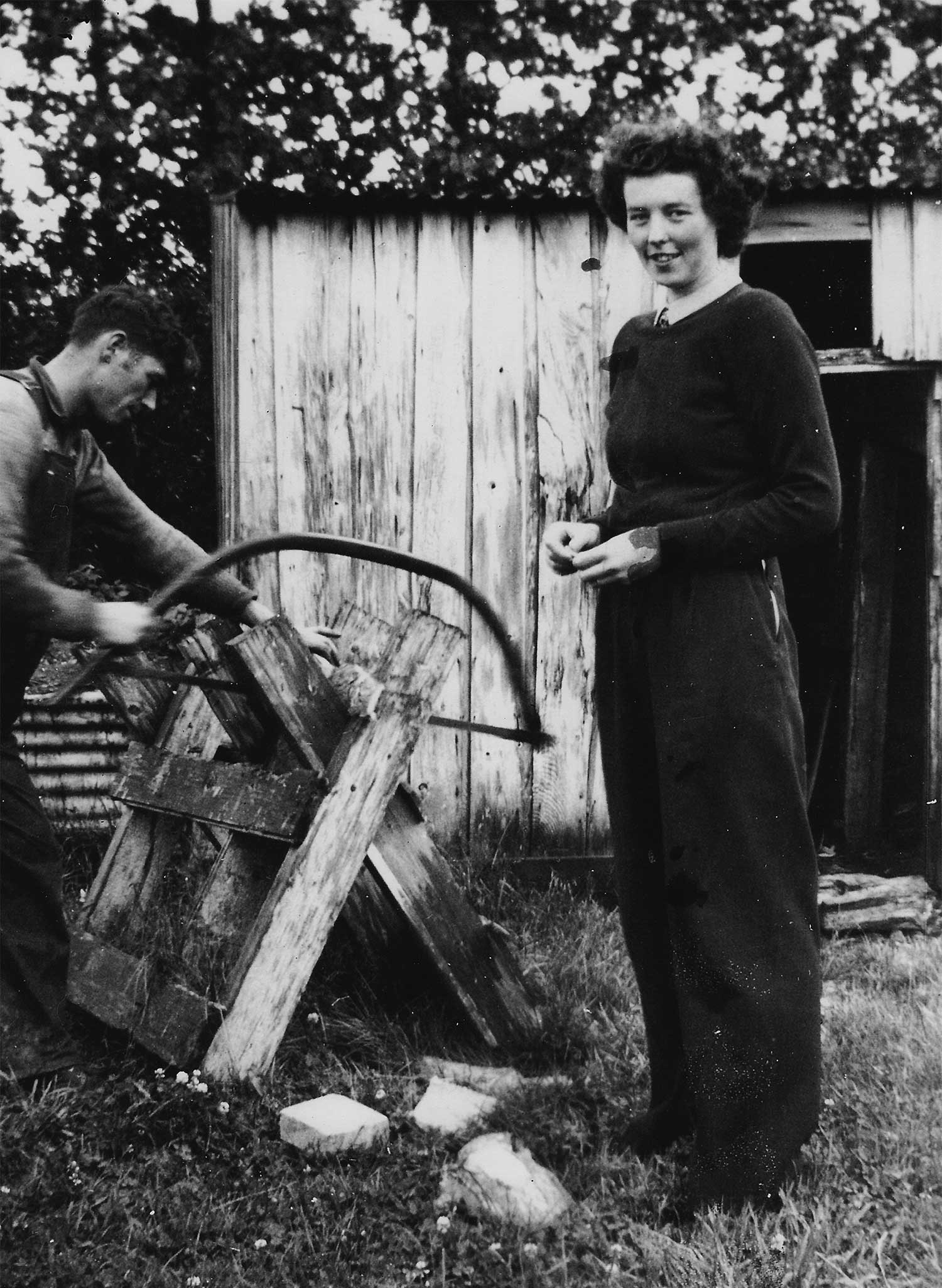
That same spring, the Newfoundland Forestry Unit took over our house, GlenBanchor Lodge, for offices and residence for office staff. It is now called Lodge Hotel. I have many happy memories of it.
Then we moved to Clune House in the village. Any excuse I could get to see Danny, I used. I would take horses up to the camps. They used them to haul wood. I had dinner there one day at camp 2 Laggan, waiting for dad to pick me up in the car. Uncle Jim Patrick Kelly from Gambo was in charge of the camps there. It was the first time I ate salt beef, or even seen it. I love it now with peas pudding, bread pudding, vegetables, etc.
Love prevailed. Danny and I were married in the Roman Catholic Church in Kingussie in 1941. War continued. We all thought it would be over in no time, but it was not to be. The Yanks (as we called them) came late but we managed to land in France again on June 6th, 1944, with the help of the Canadians and commandos. The bombing was much worse and everyone was involved with war.
The war was over in 1945. Oh boy! Were we ever glad and happy. We had bonfires, dancing in the streets, lots of bagpipe music and singing and parties to celebrate. All the surviving prisoners of war and soldiers, air force and sailors came home and very quickly life seemed to get back to normal again. We lived more like pre-war days. We would ride horses, golf, play tennis, etc. Food was more plentiful, although we hadn’t had it as bad as other towns. All the towns were bombed during the war and many innocent women and children were killed. There were no more blackouts.
Danny volunteered to stay an extra year to help clean up camps and camp sites. We didn’t leave for Newfoundland until July 1946. We sailed from Liverpool, England, on the SS Drottningholm, a Swedish-American liner. It took five days. We docked in St. John’s on the 18th of July 1946 and left by train. That night we arrived in Gambo about 1:30 a.m. July 19th. We had three wee ones by then, Elsie, Michael and Hazel . . . .
Gambo was a cultural shock to me. It was very different, with wooden houses. Different than what it is now, but I won’t go into that. I am sure you remember what life was like in those days. Danny got work in Gander Airport with the Department of Transport as a heavy equipment mechanic in hangar 13. (He had done a correspondence course from Robert Gordon’s Technical College in Aberdeen.) He received a certificate in Automotive Engineering. He got an apartment in Gander and we moved to Gander in October . . . .
My mom died suddenly on December 28th 1949 at the age of 51. I was not able to attend the funeral. Planes went overseas once a week in those days. I was so upset . . . . My sister came over for six weeks, which was such a blessing.
I went back home for a visit in 1956. Flew BOAC via Shannon, Ireland . . . . We had moved to the Balavil Hotel in Newtonmore, so it was really different. Lots of people to meet me, but mom was gone. However, we had the same old piano and other furniture around us that we had when we were young, which made it home.
We moved back to Gambo in May 1956. The road was through to Gambo and the ferry train took you from there to Clarenville. We had a garage and service station, built a house, and then the kids started coming again.
Tom and Margaret Curran were great friends . . . . Tom told me I would have a baker’s dozen. I laughed at him, but that’s what we had. Many happy times we had in the Gambo Hotel, where Tom and Margaret lived. We always stayed with them. Unfortunately, they have both passed away. Tom will be arguing with somebody, I am sure. Could be Danny! Danny died the 6th of July, 1984, 18 years ago. I still miss him, but life goes on.
I am truly blessed with my large family. There is never a dull moment. I have 27 grandchildren, and ten great grandchildren. I have been in Newfoundland 56 years this past July. No regrets!
We had our ups and downs, like most people [but] I have been shown so much kindness since coming.
LISTEN
Portrait of a War Bride
Barbara Bettine Micklethwaite of Huddersfield, in Yorkshire, England, married RCAF member Arthur Barrett of Curling, Newfoundland, in England in 1944. He was the son of Ena and John Barrett, who had wed as a Scottish-Newfoundland couple during the First World War.
Barbara immigrated to Newfoundland with Arthur and their young daughter, Helena, in 1946. The family lived in various towns in Newfoundland. In each, Barbara contributed extensively to the cultural milieu through the performing arts, most especially theatre. Along with numerous awards and accolades earned during her long career, she received an honorary Doctor of Laws from Memorial University and was named to the Order of Canada and the Order of Newfoundland and Labrador. Barbara Barrett died in 2014 at St. John’s.

IT’S NOT HOME, BUT. . .
It’s not that I’m hard and don’t miss home, but I do believe that many of us aren’t giving this country a fair deal. . . . I docked at St. John’s and came right across this country to Corner Brook. I knew right there and then that some of us were going to miss our double decker buses and busy town life—but I knew there was beauty in this country such as you will never find again. . . . It’s also hard to find more hospitable, more gentle and loving people than you’ll find here.
– Barbara Barrett in the “War Brides Corner,” The Western Star, March 21, 1947

“The men had to go away for months at a time to find work. Very often in my loneliness I would sing, ‘Ho, why left I my home!’ But looking back on those years and having raised a lovely family of four boys who are now married with families of their own, I say, ‘It was well worth it.’ Love is a strange little word and that’s what it’s all about. No matter what, no matter where, home is home when love is there.”
– Katherine Boland in We Came from Over the Sea: British War Brides in Newfoundland, published in 1996
Portrait of a Forester
John Thomas White (NOFU #1426) of Point La Haye, Saint Mary’s Bay, joined the NOFU in 1939 and transferred to the Royal Air Force in 1941. On June 15, 1942, he married Agnes (Nessie) Mulholland at Polmont, Stirlingshire, Scotland. The couple returned to Point La Haye, Newfoundland, in 1948. In 1950, White was allotted acreage offered to veterans through the Upper Humber Land Settlement program. He went on to farm this land for 25 years at what later became known as Cormack. As well as being a lumberer and farmer, White also wrote poems, many of which describe aspects of his work. “My Lassie from Stirlingshire,” written sometime during his war service, is among several of his poems that pay tribute to his Scottish war bride. John Thomas White died in 1976.
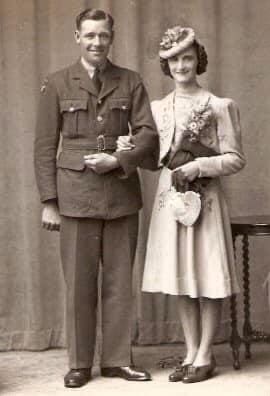

“MY LASSIE FROM STIRLINGSHIRE”
By John Thomas White
The Blue Bells of Scotland
They smile at the rising sun
Refreshed by the dew of a Scottish night
And loved by a farmer’s son.
Blue Bells that awake at the dawn of day
To sweeten a Scottish morn
Your sweet perfume can be smelt
As the harvest of new mature corn.
Blue Bells forever you’ll hold a place
In my heart as the years go pass
Go where I may, I will always think
On you and my Scottish lass.
It was where you grow, you Blue Bell Rose
That my heart became a fire
As I sat on the grass with my Scottish lass
A Lassie from Stirlingshire.
A flower she was that has grown among
The many on Scottish soil
When she looked at me I was entranced
By the beauty of her smile.
Blue Bells of Scotland, I love you much
And I have but one desire
To stroll with her as I did before
With my Lassie of Stirlingshire.
Oh her figure so neat
And her smile so sweet
In my heart it made a fire
As a Queen above, I will always love
That Lassie from Stirlingshire.
LISTEN
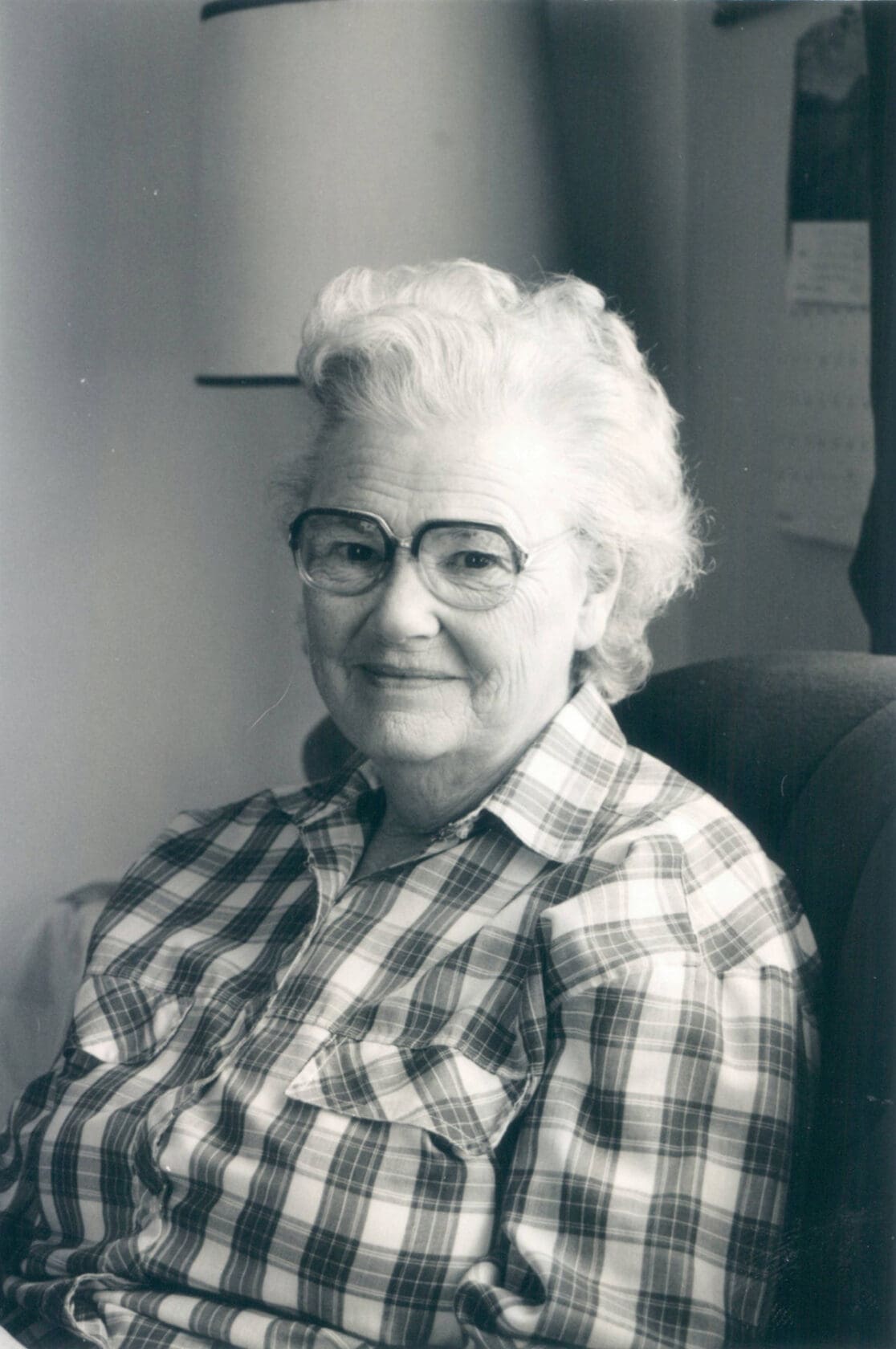
Portrait of a War Bride
Christina (Chrissie) MacLennon, a young nurse from Kinlochewe, Scotland, married Gregory Cole (NOFU #744) from Fogo in 1946. They began their married life together on Fogo Island, where no medical professionals or facilities existed at the time. Nurse Cole devoted her life to providing medical care to Fogo Islanders—many times without any additional medical support and often at great personal risk due to the hazards of travel from one end of Fogo Island to the other, especially during winter. Chrissie Cole retired in 1983, having delivered more than 800 babies over 35 years of nursing. “Nurse Chrissie,” as she was known, was revered by Fogo Islanders for her selfless commitment to their care. In 1991, in recognition of her service, she was invested as a Member of the Order of Canada.
