

First
World
War
HARD WORK
AND DANGER

GETTING DOWN TO WORK IN SCOTLAND
The Newfoundland Forestry Companies (NFC) was sent first to the estate of the Duke of Atholl at Craigvinean Hill. The site overlooked the River Tay, near the town of Dunkeld, Perthshire. The unit was housed in canvas tents until the men built their own camps. By early 1918, they had harvested trees from 1,200 acres (486 hectares).
The terrain was steep. Moving the logs off the land was challenging. The Canadian Forestry Corps had earlier deemed harvesting at Craigvinean impossible, but the NFC was undaunted. With the supervision of Captain (later Major) William Baird (NFC #0-192), the NFC built a chute to slide logs down from the hill. More than 3,100 feet (945 metres) long, it was said to be the world’s longest. It was soon valued as a local marvel—an innovative and inexpensive solution to the problem of moving timber on the great Craigvinean, known locally as “hill of goats.”
In mid-1918, the NFC moved to the estate of the Marquess of Breadalbane at Drummond Hill, near the towns of Kenmore and Aberfeldy. There, transporting timber was more complex and sometimes delayed shipments of lumber.
The unit finished its work in early 1919, several months after the Armistice ended the war. In total, the NFC had cut seven million board feet of lumber for wartime purposes.

Look & Listen
DANGER AND DEATH
The foresters’ work was often dangerous. Three men were killed during the NFC’s time in Scotland. Two of these deaths were work-related.
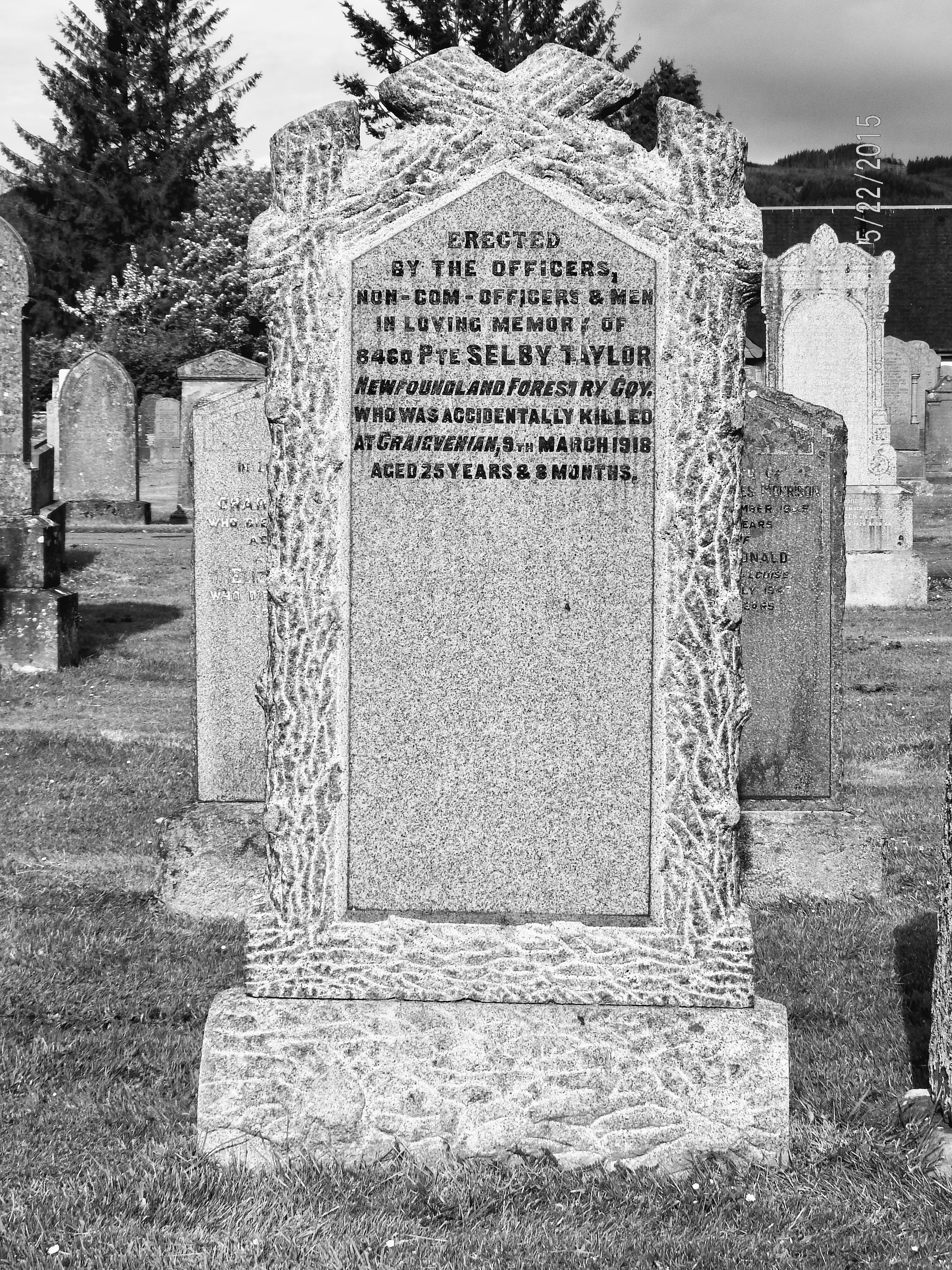
Private Arthur Wyatt (NFC #8130) drowned in the River Tay at Kenmore. Earlier, Private Selby Taylor (NFC #8460) of St. John’s, a member of B Company, had been killed at Craigvinean Hill when a log flew off the chute and struck him. And Private Gerald Hogan (NFC #8111) of Northern Bay had died when struck by a rolling tree trunk on Drummond Hill.
In a letter home, Private James Power (NFC #8124) of Harbour Grace described the circumstances of Private Hogan’s death and the funeral that followed. It was printed with the headline “Comrade Killed” in The Harbor Grace Standard issue of August 18, 1918.
This video features a sequence of historic photographs and documents that illustrate the points in the narrative. The images are of Loch Tay (Scotland), a newspaper clipping, NFC men at work in Scotland, a road with logging trucks and buildings, NFC men in front of a wooden camp building, a member of the NFC fixing a building with a hammer, a row of bunkhouses, a funeral procession, an outdoor funeral, the gravestone for Private Hogan and Private Wyatt.
Title: A Comrade Dies in Service
Narrator:
A fatal accident happened in A Company’s section of the woods on Friday, August 16, 1918, when Gerald Hogan, a chap from Northern Bay, Bay de Verde, was killed by a tree, or rather the stump of a tree. Himself and his brother Jack were cutting up a windfall, that is a tree blown down by the wind, and as they cut through the tree, the stump which was held by one root rolled suddenly over, snapped off the root and turned a double somersault. Hogan tried to get out of the way but the stump was too quick for him and coming down on top of him pinned him to the ground. He was killed instantly and his brother only just escaped as one of the moors of the stump struck him in the back. It took thirty-five men to move the stump off poor Hogan.
They brought him to the Camp and placed him in the Hospital Hut, which I happened to be putting the finishing touches on at the time, and myself and the Medical Orderly (after the doctor had examined him) washed him and dressed him in a new uniform and laid him out. We had the Rosary for him each night, and a crowd stopped up each night. The Officers gave orders to have tea for them at twelve o’clock each night. We had the Rosary for him this morning, and the Priest came from Grandtully this evening and we had a military funeral. The three Companies, A B and C, paraded and the casket, which was a splendid one, was draped with the flags and placed on a four-wheel lorry and drawn to the cemetery about a mile away accompanied by a firing party and the full battalion and preceded by two pipers.
Though Kenmore is only a small place the people were in from miles round till the graveyard was filled to overflowing.
Besides the brother who is here, Hogan has another brother, a prisoner of war, and a brother at home in Northern Bay.
This is the second death in the Foresters since coming overseas.
[Trumpet plays “The Last Post”]
Credits:
Produced by Ursula A. Kelly & Meghan C. Forsyth
“Comrade Killed in Service” by Private James A. Power (NFC #8124), published in the Harbour Grace Standard, September 20, 1918
Narrated by Darrel Brenton
Photos courtesy of Michael Pretty (Trail of the Caribou), Pat Angel, The Rooms Provincial Archives, and Archives and Special Collections (Memorial University Libraries).
“The Last Post” is a copy of an official Work published by the Department of National Defense/Canadian Armed Forces. It is used in compliance with the requirements for non-commercial reproduction. The reproduction has not been produced in affiliation with, or with the endorsement of, the Department of National Defense/Canadian Armed Forces.
2024
Logos: Grand Falls-Windsor Heritage Society, Memorial University and Digital Museums Canada
CUTTING ON THE ATHOLL ESTATE
A century ago, John, Duke of Atholl, resolved to plant the waste mountain sides with spruce and larch trees by the millions . . . . He planted 15,573 acres, mainly barren mountainside, with 27,431,600 trees. Many other northern landowners followed his lead . . . . [T]oday his foresight is proving true. The great forests of Scotland, utilized mainly during the last two generations as shooting preserves, have suddenly become an enormously valuable imperial asset. Timber must be had in vast quantities for a hundred war purposes. Scotland is supplying more than its share. Men from the ends of the Empire are in the North today, clearing the hills, felling and dispatching their giant trees . . . .
There is a Newfoundland Camp on the Atholl estate. A few days ago, the Duchess of Atholl, after entertaining a party of woodsmen guests, confessed that while she was glad to see them, and hoped to see more of them, her heart was heavy at the disappearance of her beloved woods. One can understand her grief. Here up on the Craigvinean, the Craig of Goats, as it is rightly called, 800 ft. above the sea level, one gazes around upon what was one of the most beautiful wooded scenes in Scotland. In the immediate neighbourhood are grouped a succession of fallen giants—great, noble timber.
Some distance below a lumber camp can be seen. Along the steep middle ridge of the hillside runs a temporary mountain railway built with lightning speed to transport the logs to the point where the great chute, 1,400 ft. long, falls vertically, down which the thousands of great felled trunks—often more than half a ton in weight—go thundering to the mill below. This mill has been completed in incredibly short time and the whole place has an air of hustling resolution.
The rough wooden huts of the men, and the simple effective machinery, do not seem to belong to an old civilization like ours. Planted down here, one might imagine that you were in Newfoundland. In truth Newfoundland has transferred its ways to the heart of Perthshire.
“These men work as though they are fighting against time,” said an old Scottish factor, somewhat resentfully, when he saw the Newfoundlanders set to work. “We are,” came the ready reply. “That is what we are here for in war time.”
At first the Scotsmen were inclined to feel sore at the unconventional methods of the newcomers, and various big challenges were exchanged. The cutting down of trees is a solemn affair and ought to be done with a certain stateliness. It ought above all to be done sparingly, and with a certain nicety according to estate traditions. That is the old British idea. But here are men doing it wholesale, leaving nothing behind.
It was necessary to find a means of carrying the great trees down from two high levels, 1,800 ft. in all. Experienced local men advised a mountain railway equipped with winding drum and steel cables, etc., which would have taken considerable time to construct, and would have cost something probably running into four figures. The Newfoundlanders laid a simple chute, consisting of a triple line of trunks of trees forming a kind of running trough. The total cost of this, apart from the timber, which they cut on the spot, was a few score of pounds. Down this simple line, built in a few days by men themselves, with a sloping curve at the bottom to bring the monster logs easily to their place, the great trees now descend. They come to rest in the “Log Pond,” which has been built by damming the little stream which adjoins the sawmill in the meadow at the foot of the hill, and from thence are hoisted by the jack ladders into the mill . . . .
The men now at work number about 300, to be increased very shortly, it is hoped, with fresh drafts . . . . One veteran of over 60, a general utility man, boasts of 40 years’ experience in mills. Another has been nearly 50 years lumbering. There are boys in their mid-teens here, too young to go to France to fight, but determined to do something to help to win the war.
On Sunday afternoons one sees the men of the Forestry Companies making friends with the country folk in every village around, looking in every way smart, good soldiers. And when their battalion marches into Dunkeld, it is difficult to believe that these same well-set ranks are made up of backwoodsmen who have volunteered their service from the freest life in the world—this life of the woods. They have received a warm Scots welcome from all—from Duke to cottager . . . .
Even while the Newfoundlanders are cutting down great stretches of the most beautiful countryside, large numbers of Scots women are at work planting new districts afresh, for Scottish landowners realize that under the conditions likely to prevail in the world for some time to come, their forests will be a great source of national wealth.
(Reprinted from The London Times)
LISTEN


Telegram from Sir Joseph Outerbridge, received 20 October, 1917.
To Governor, St. John’s:
Have visited Foresters; am charmed with work already accomplished under excellent arrangements by Major Sullivan and other officers. Men appear very comfortable and satisfied. Lovely country and climate very similar to Newfoundland. More skilled mill hands and lumbermen urgently required.
Outerbridge.
A LETTER HOME
Edward Humby (NFC #8084) of St. Leonard’s (now called St. Lunaire-Griquet) enlisted in the NFC on April 30, 1917. He wrote this letter to his cousin later that fall from Dunkeld, describing his experiences with the NFC.

FROM A FORESTER
November 25, 1917
Dunkeld, Perthshire, Scotland
Dear Cousin,
I am writing this in the YMCA, at the B Company grounds, right in the same fields that our mill is in, where we saw something like thirty thousand feet a day, but it is all heavy lumber such as 5 [by] 2 and larger than that. We do good work; very soon we will have two mills running.
We work quite near our huts, not a quarter of a mile from the farthest, right on the side of a hill, and as the hill is a poor place for pulling timber out with horses, we have a shoot [chute] built that takes it right from the railway to the mill; a shoot very near a half-mile long but it’s the real thing.
We have fine weather, so very little time is lost, and I am quite well. But, of course, to have a good time you must leave Dunkeld. It is easy to get a pass, especially on Saturdays. Some of our fellows think this is a very poor place, but I have often been in worse.
You may like to send me something for Christmas, so send me some good Newfoundland tobacco, and send all the news, if you are staying home the winter or not, and how everything goes at home. I am going somewhere on Christmas, but can’t tell you where just yet.
Without anything else of interest to you, I close. [Remember] me to all my friends.
From your cousin,
Private E. Humby
LISTEN
GOVERNOR DAVIDSON VISITS THE NFC
Newfoundland’s Governor, Sir Walter E. Davidson, visited the NFC at Craigvinean in late 1917. His account of his impression of the unit was reprinted in The Evening Herald.
SIR W.E. DAVIDSON INSPECTS REGIMENT AND FORESTERS
January 15, 1918
The Evening Herald (abridged)
I had the opportunity of inspecting the Forestry Companies on Friday the 14th December 1917 in company with the Right Honourable Sir Edward Morris [Prime Minister of Newfoundland], Mr. Ball, the controller of Timber in the United Kingdom; Mr. Sinclair, who presented the Scottish interests under the Controller; and Mr. Mayson Beeton, who directs the operations of our Foresters; and Major Timewell . . . .
We were met at Dunkeld by Major Sullivan, the Commanding Officer, and we had the pleasure of meeting the other officers and the full Companies at work on Craigvinean . . . . The Companies are established in two positions—the higher camp being occupied by the felling contingent and the lower by those employed in the sawing operations. I went through all their quarters and found them clean, comfortable, and adequate. The cooking arrangements were good and the rations are good and sufficient for the needs of hardworking men.
You can understand that the foresters have done their work thoroughly well; but it is also good to know that they are comfortable and happy in their surroundings and that the whole countryside, in every degree, welcomes the Newfoundlanders and treats them with old fashioned Scottish hospitality. All the famous mansions and castles on Tayside are open to the officers, and a hospital for any who may disabled by illness is provided at Dalguise Castle through the kindness and generosity of Mrs. Tempest, the owner of that historic house. We all had the pleasure of being the guests of Mrs. Tempest at luncheon on the occasion of our visit.
The Newfoundlanders have introduced in the course of these logging operations a number of improvements previously unknown in Scotland and looked upon as welcome novelties, and the output (so Mr. Sinclair assured me) was many times as great as the output would have been under normal conditions, if the work had been placed in the hands of local woodsmen (the difference between feet 1,000 and 6,000).

The special features which are outstanding are the long timber chute, 3,600 feet in length, by which the logs are shot down from the upper level into the pond which has been dammed to receive them alongside the saw mills; the railway feeder along the hillside carrying the logs to the chute; and the mill installation at the lower camp which is full of ingenious devices which are characteristic of loggers from Newfoundland, and especially those who have had experience of the methods of the A.N.D. Company.
Sir Edward Morris and I inspected the men and addressed them briefly. The men were in good heart and turned out with extraordinary smartness for inspection on parade. I had also the pleasure of presenting, on behalf of the Forestry Companies, a wedding present to Captain and Mrs. Ross on the occasion of their wedding, subscribed to by the officers, NCOs and men of the Forestry Companies. This in itself is a fair indication that all ranks are working well together, are proud of their output and are maintaining the good reputation of the Royal Newfoundland Regiment.
LISTEN
THE FORESTERS AND THE LUMBERJILLS
The Women’s Forestry Service (WFS) was formed in the UK in 1917 as a unit of the Women’s Land Army. It added one more group who could take on the work of timber production in rural Scotland. In addition to cutting and felling trees, the WFS and other members of the Land Army also planted seedlings for reforestation.
Affectionately known as “lumberjills,” the members of the WFS contributed significantly to the UK war effort. The Duke of Atholl sponsored a WFS group to work at his estate alongside the NFC.


A SCOTTISH ODE TO NEWFOUNDLAND
John MacDonald, the stationmaster at Dalguise (near Dunkeld) and a violin maker, was also a poet. He printed some of his works as postcards and sold them to raise funds for the Red Cross. In one, “An Ode to Newfoundland,” he took on the voice of an NFC soldier thinking of home.
“AN ODE TO NEWFOUNDLAND”
By John MacDonald
Sweet homeland of liberty over the sea,
How sacred and dear are thy precincts to me;
Thy forests of pine and thy prairies of snow,
Are clear to my vision wherever I go.
I’ve searched o’er the city, the town, and the plain
For treasures like thine, but my quest was in vain;
No scene can I find, though majestic they be,
Compared with grandeur, “Newfoundland,” to me.
Afar from the haunts of my youth though I roam
Yet still my heart’s true to the dear ones and home,
Which kindle new hopes for to work with a will
The Wrecker of Europe’s grim methods to kill.
The peavie, the bob-slide, and keen cutting axe
Keep merrily swinging and each muscle tax,
And stand by the Motherland against the dire foe
Whose rule of “grim piracy” we must o’erthrow.
I long for a cruise in my tiny canoe
And paddle o’er Exploits and Humber anew;
Red Indian Lake waters again for to ply
In search of the silvery salmon so shy.
The buzz of the saw in my ears daily chime
As I think of my loved ones and long for the time
To sling on the rifle and track o’er the snow
And furnish the larder with sweet Caribou.
When war’s blast is over we’ll sail for our homes
To Harbour Grace, Grand Bank, Burin, and St. John’s,
Where flags shall be floating, and bells ring with joy
As parents greet sons and each sweetheart her boy.

LISTEN
CIGARETTES AND SALT COD
The NFC foresters longed for the tastes of home throughout their time in Scotland. Mayo tobacco products, a preferred brand, were unavailable in the UK and the substitutes they could get were far less satisfying. So regular supplies of cut plug tobacco were sent to the Newfoundland men overseas. One late fall 1918 shipment to the NFC weighed a thousand pounds—and half of it was the beloved Mayo brand.
Salt fish was also kept in regular supply. Notes of thanks to the merchants who supplied it regularly appeared in the Dominion’s newspapers.

“Whilst down to England last week, Major Sullivan visited Liverpool, where, with other, he was banqueted by the Lord Mayor. During his stay at Liverpool he secured from Mr. Henry Bowring the promise of 25 quintals of dried codfish for our men. A further promise of 25 quintals was also made by Mr. S. Job. So, you see, we stand a good chance of keeping our larder fairly well supplied with the staple product of Newfoundland.”

FISH FOR FORESTERS
Department of Militia
St. John’s, NFLD
Editor, Evening Telegram.
Sir,
I am requested by Major Sullivan, Officer Commanding Newfoundland Forestry Companies, to acknowledge through the columns of your paper the very handsome donations of fish which he has received for the Forestry Companies in Scotland, from the following firms:
G. M. Barr – 10 quintals
J. C. Crosbie – 10 quintals
W. S. Monroe – 10 quintals
Harvey & Co. – 10 quintals
Job Bros – 10 quintals
A. H. Murray – 10 quintals
A. E. Hickman – 10 quintals
James Baird – 10 quintals
Baine, Johnson & Co. – 10 quintals
Bowring Bros., Ltd. – 10 quintals
Joseph Sellars – 2 casks
Major Sullivan points out that the difficulty of getting food on the other side, especially fish, is daily increasing, and the generous do¬ nations above quoted will help materially in relieving the position for some time to come.
I have great pleasure, therefore, in adding my grateful appreciation to that of Major Sullivan for this, another instance of the liberality of the above named firms.
I have the honor to be, Sir,
Your obedient Servant,
J. R. BENNETT,
Minister of Militia.
St. John’s, N.F., Mar. 15th, 1918
