

First
World
War
WOODS
WORKERS
FOR THE
WARS
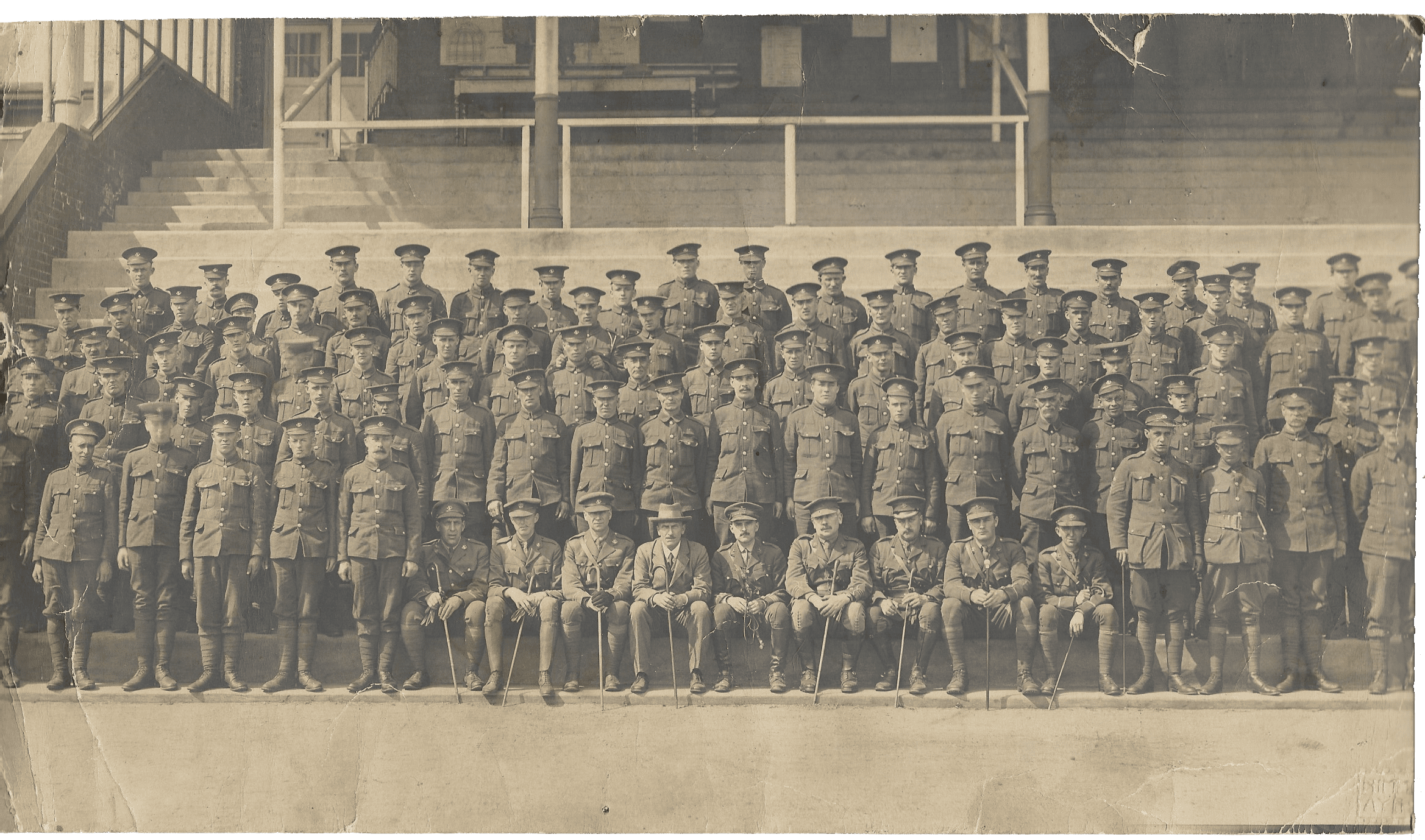


1917: NEWFOUNDLAND OFFERS A SOLUTION
When war broke out in 1914, “England’s oldest colony” established the Newfoundland Regiment and raised a battalion of soldiers to support the UK’s war effort. Many Newfoundlanders and Labradorians joined either this new Regiment or the nation’s existing Royal Naval Reserve.
As the war raged on, more needs emerged. In April 1917, recruiting for a third type of war service option began, one that would address a specific supply crisis. Part of the Regiment, the new non-combat unit was called the Newfoundland Forestry Companies (NFC).
The NFC eventually attracted close to 800 volunteers for overseas woods work. Almost 500 of them met the eligibility requirements and were enlisted.


Look & Listen
DON’T WORRY ABOUT ME, DEAR MOTHER
The video is a sequence of historic photographs and documents that illustrate the points in the narrative. They include images of Newfoundland communities in the First World War era, foresters in uniform, a troop ship, an enlistment form, and a recruitment poster.
Dear Mother,
We are going across tomorrow in the Florizel to Halifax, but I don’t know where from that. We are going to England for the summer to cut wood. There are two hundred of us from the Regiment and one hundred from the Forestry Battalion.
I tried twice for the Army and I had to go the second time to the Forestry doctor before I could pass. I shall have to be vaccinated.
I am sending 60 cents a day home to you and I hope to get more pay shortly as I hope to be promoted to Corporal and do time-keeping.
Don’t worry about me, dear mother; I am trying to do my bit for King and Country. I could not be satisfied to stay home when I think of the other fellows who are gone out to fight for me.
Good bye, dear mother,
From your son, Melville
Credits:
Produced by Ursula A. Kelly & Meghan C. Forsyth
Video by Diego Pani
Narrated by Nicholas Leblanc
Photos courtesy of Reverend Brian Colbourne, The Rooms Provincial Archives Division, Toronto Public Library Special Collections, Maritime History Archives, Library and Archives Canada, Grand Falls-Windsor Heritage Society
Newspaper clipping courtesy of the Twillingate Sun
2023
Logos: Grand Falls-Windsor Heritage Society, Memorial University and Digital Museums Canada

Portrait of a Forester
Melville Colbourne was one of the Newfoundland men determined to serve the war effort in any capacity he could. Nineteen years old in 1917, he had five younger siblings. His job with the Reid Newfoundland Railway helped support them all at home in Purcell’s Harbour, Twillingate Island. Like many men who enlisted, Colbourne’s decision to join up reduced both the earnings and the number of able hands helping his family survive.
Colbourne (NFC #8150) left St. John’s on May 19, 1917, with the first draft of NFC soldiers. He wrote to his mother on the eve of his departure for Halifax. His letter was published in the Twillingate Sun newspaper three days before the men disembarked the RMS Olympic at Liverpool, England.
Melville Colbourne served overseas until the end of the war. He was demobilized at St. John’s on April 11, 1919, at the rank of Corporal. He died in 1988.

This recruitment poster asked potential volunteers to consider the horrors if the war was raging on Newfoundland soil—and what they would do in response. It assumed that readers well knew that Germany had invaded Belgium in August 1914, which had caused the UK to declare war.
During the conflict, the front lines ran through northern Belgium and key battles took place there. German troops would occupy Belgium throughout the war, killing thousands of civilians and destroying towns, roads, buildings and the countryside.

WHO WERE THE NFC RECRUITS?
Some of the NFC volunteers were injured veterans of the Newfoundland Regiment. Others were men too young or too old for combat service, or who did not meet the Regiment’s physical requirements.
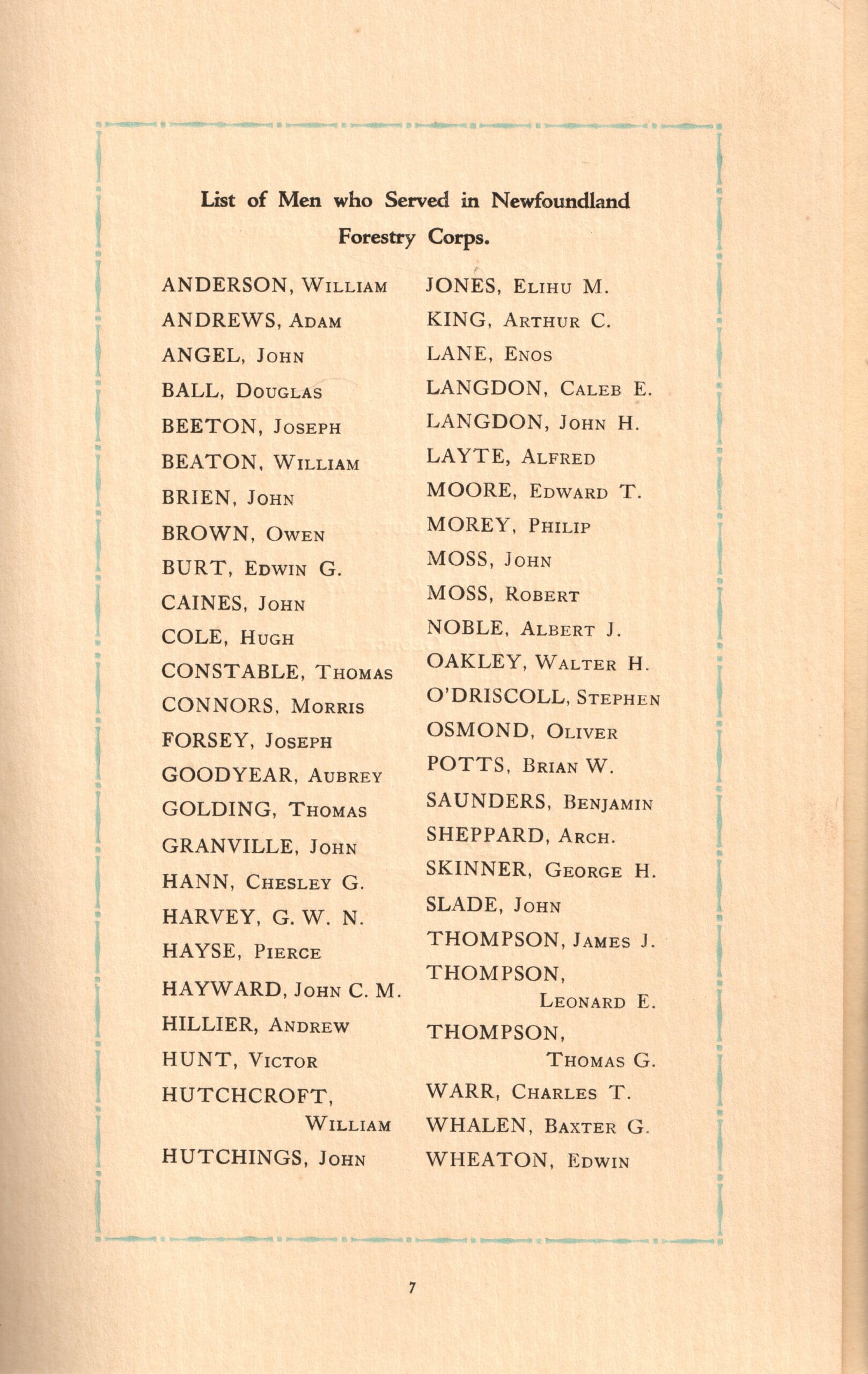
Many were employees of the two major woods operations in central Newfoundland. Fifty volunteers worked with the Anglo-Newfoundland Development Company at Grand Falls. Others worked at the Albert E. Reed and Company mill at Bishop’s Falls or smaller sawmill operations throughout the Dominion. Many men who enlisted were skilled woods workers, but others had no woods experience at all. These recruits were trained in woodcutting techniques before going overseas.
Wearing the khaki uniforms of the Newfoundland Regiment and packing pike poles, peavies, axes and saws for their work, the men sailed for the UK in drafts of various sizes beginning in spring of 1917.

A CALL TO ACTION
David J. Thistle (NFC #0-181) of St. John’s was 52 years old when he enlisted with the NFC on May 12, 1917. Married with eight children, he worked for the Department of Agriculture and Mines. Three of his sons were also soldiers, two with the Canadian Expeditionary Force and one with the Newfoundland Regiment.
Thistle was scheduled to go overseas with the second draft of foresters on August 4, 1917, but he stayed back to help with recruitment. He wrote this essay below as part of that work. It outlines the conditions for enlistment in the Newfoundland Forestry Companies and describes the larger struggle the foresters would be joining.
NEWFOUNDLAND FORESTRY COMPANIES
By Lieutenant David Thistle
TO THE MEN OF NEWFOUNDLAND
-
-
- The King’s Government call for lumber men and all skilled workmen not eligible for the Regiment or the Royal Naval Reserve for service in the forests of the United Kingdom.
- These men shall not be employed in the fighting line. They are needed for skilled work at home.
- They will be under their own officers and need no training in military duties beyond elementary drill. They will work with their friends and comrades as in Newfoundland.
- The medical examination required for these Newfoundland Forestry Companies shall be modified so that all able-bodied men can be enrolled without limit of age or height. No one shall be rejected for eyesight, flat feet, loss of fingers, deafness, etc.
- No unmarried men of military age and fitness may be accepted; their place is in the fighting forces.
- The pay, allowances and pensions of the Newfoundland Forestry Companies shall be the same as the pay, allowances and pensions of the Newfoundland Regiment.
- Skilled workmen and mechanics, such as millwrights, mill sawyers, saw-filers, cooks, etc., may be eligible for extra pay.
- The period of enlistment shall be for the duration of the war, but arrangements may be made under which skilled workmen specially required for Newfoundland industries may be released after six months.
-
On April 4th past, His Excellency the Governor caused to be published this circular letter of appeal from the Home Government, asking for men to work in the forests of the United Kingdom.
This appeal was made almost direct from the Crown to the people, and every word contained therein breathed sincerity and hope from the Motherland that her eldest daughter would send and help her in this hour of great trial.
Up to a quite recent date England has depended very largely upon other countries for her supply of wood, brought principally from ports in the Baltic and from Canada. Owing to the shortage of shipping for the transportation of lumber cargoes the British Government has decided to fell her beautiful woodland parks and convert the trees into sawn lumber for war purposes, and so the Mother Country has asked her Colonies to supply lumbermen to perform this work, because of their knowledge of the business and general fitness. Australia and New Zealand, also the United States of America, have sent armies of men to France to do similar work there. Canada and Newfoundland have been asked to supply sufficient men for the work in England, Ireland, Scotland and Wales . . .
The members of the Forestry Companies will be well fed, well clothed and well treated and their dependents will be taken care of during their absence. They will be given the chance of their lives to see a bit of the world, but above all they will be doing their bit in this great struggle; each member of the Forestry Companies will feel himself to be a man among men, doing his duty and helping his brother in arms. Every man enlisting for the Forestry Companies relieves a man for the firing line.
This war can only be won by man power. Should that man be a soldier, a sailor, a gunmaker, a lumberman or any other of the numerous branches of this great Empire’s work, you are contributing your quota towards a speedy and victorious ending of the war and a world-wide and permanent peace. The generations unborn will without doubt honor and bless the names and memory of the members of the Nfld. Forestry Companies, as well as those of the Navy and Army, because they will understand better than we do the urgency of the cause, and the horrors that the free nations and peoples of the earth were delivered from.
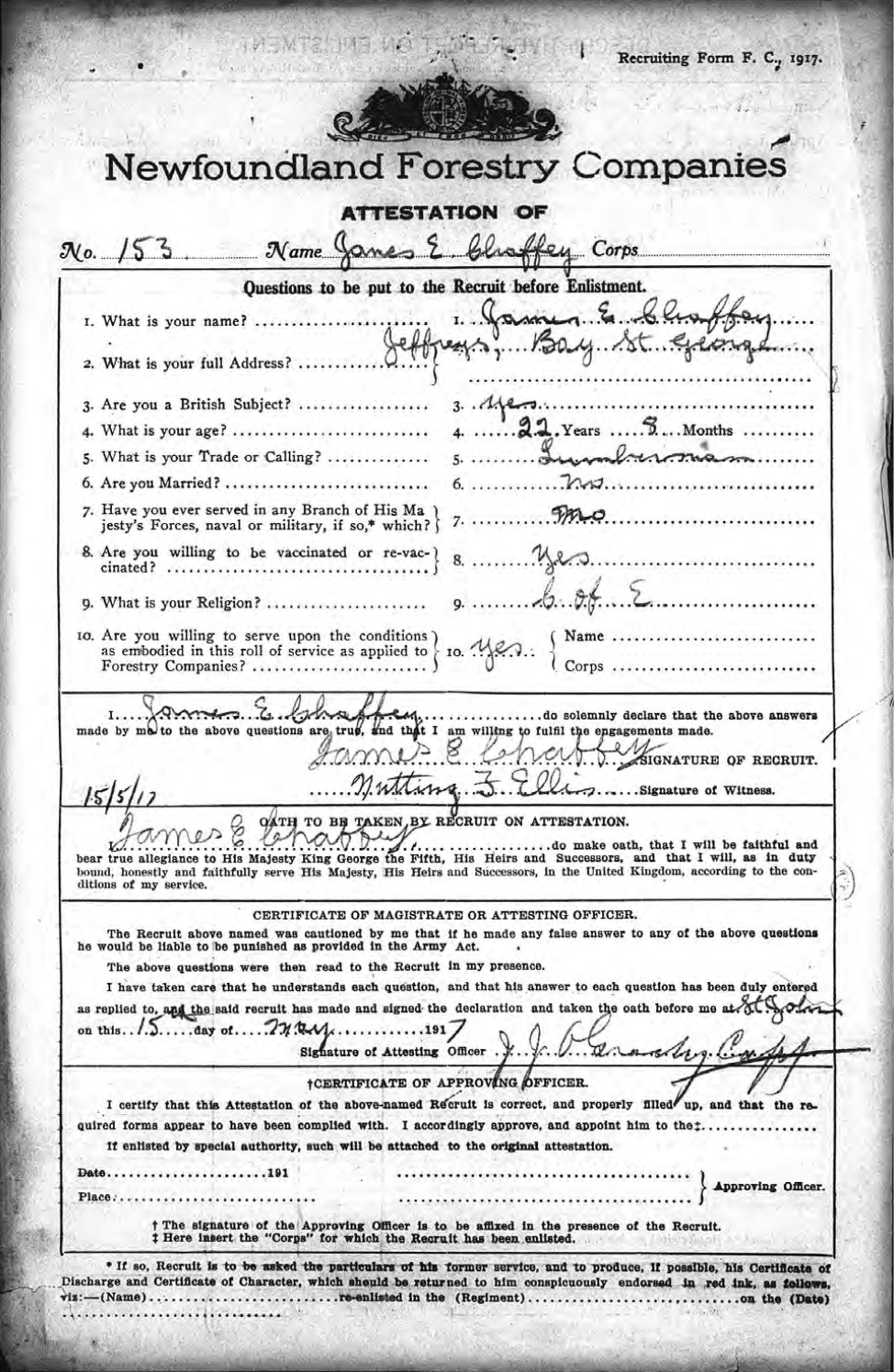
Portrait of a Forester
Private James E. Chaffey (NFC #8153) enlisted on May 15, 1917, at St. John’s and was demobilized there almost two years later, on May 19, 1919. While serving in Scotland, Chaffey married Helen Ferguson of Aberfeldy. The couple moved to Jeffreys, Newfoundland, where Chaffey farmed and fished. Chaffey died in 1923 at age 27. A year later, Helen Ferguson Chaffey and their daughter joined Helen’s sister in Idaho, USA, where she remained until her death in 1978. She never remarried.
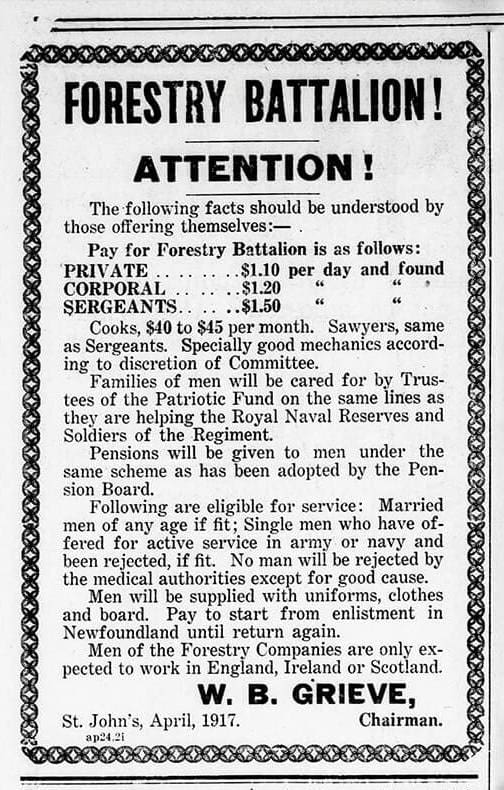
FORESTRY BATTALION! ATTENTION!
W.B. Grieve, the Chair of the Patriotic Association of Newfoundland’s Forestry Committee, offered this information to potential recruits in The Evening Telegram.
The Evening Telegram, St. John’s, April 25, 1917
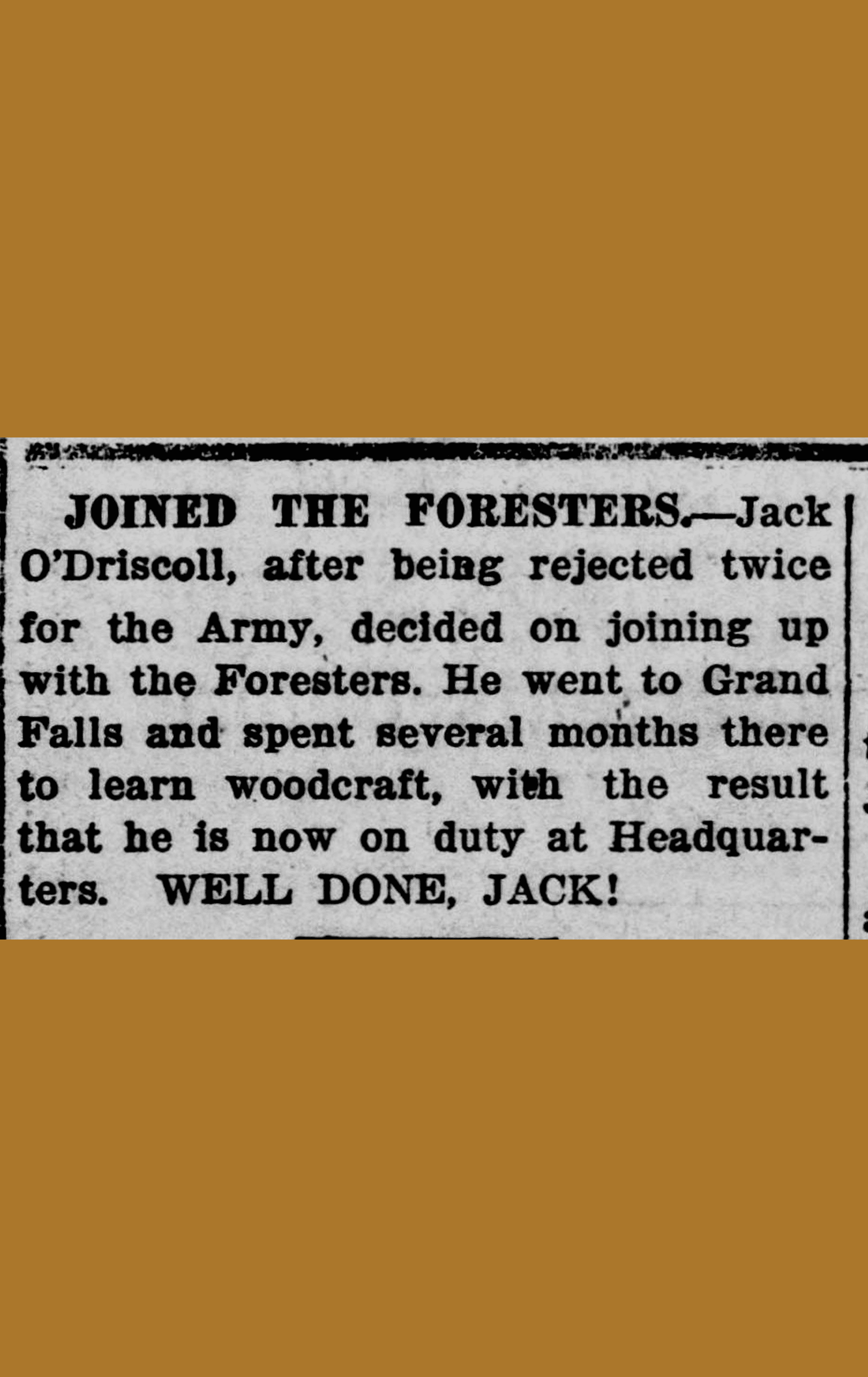
JOINED THE FORESTERS
John D. O’Driscoll (NFC #8494) of St. John’s was almost 24 years old when he joined the NFC on April 4, 1918. He served until December 31, 1918, when he was discharged on compassionate grounds.
The Evening Telegram,
St. John’s, April 13, 1918

70-YEAR-OLD VOLUNTEER
Lance Corporal Thomas F. J. Sullivan returned to St. John’s from the UK aboard the SS Cassandra on July 1, 1919. He was assigned to special duty at Depot until the war ended.
The Evening Telegram, St. John’s, August 6, 1917
#1 – Forestry Battalion!
Forestry Battalion!
Attention!
The following facts should be understood by those offering themselves:
Pay for Forestry Battalion is as follows:
PRIVATE…$1.10 per day and found
CORPORAL…$1.20 “ “
SERGEANT…$1.50 “ “
Cooks, $40 to $45 per month. Sawyers, same as Sergeants. Specially good mechanics according to discretion of Committee.
Families of men will be cared for by Trustees of the Patriotic Fund on the same lines as they are helping the Royal Navy Reserves and Soldiers of the Regiment.
Pensions will be given to men under the same scheme as has been adopted by the Pension Board.
Following are eligible for service: Married men of any age if fit; Single men who have offered for active service in army or navy and been rejected, if fit. No man will be rejected by the medical authorities except for good cause.
Men will be supplied with uniforms, clothes and board. Pay to start from enlistment in Newfoundland until return again.
Men of the Forestry Companies are only expected to work in England, Ireland or Scotland.
W. B. Grieve, Chairman.
St. John’s, April, 1917.
#2 – Joined the Foresters
JOINED THE FORESTERS – Jack O’Driscoll, after being rejected twice for the Army, decided on joining up with the Foresters. He went to Grand Falls and spent several months there to learn woodcraft, with the result that he is now on duty at Headquarters. WELL DONE, JACK!
#3 – 70 Year Old Volunteer
70 YEAR OLD VOLUNTEER – The oldest man in khaki with the Newfoundland forces is Mr. Thos. Sullivan, who is with the Forestry Battalion. He is physically a strong man and although having reached the allotted span of years is as active as many men fifty years his junior.
“THE FORESTER”
Lyrics by James Murphy
Music by Battison Haynes
James Murphy of St. John’s was a composer, song collector and journalist. He published several song collections in the first quarter of the twentieth century, beginning with The Songs and Ballads of Terra Nova (considered the first collection of local songs published in Newfoundland). Murphy’s own compositions were about key events and local happenings. “The Forester” (set to the tune of “Off to Philadelphia”) was a rare tribute to the NFC. Listen to Jim Payne perform the song.
LISTEN
Sure, Sir Edward sent a message
All the way from England’s isle
He says the Mother Country needs
Five hundred men to toil.
With axes in the English woods
A-choppin’ down the trees
So, begor, I’m going to England
Far across the rolling seas.
Chorus:
With my axe upon my shoulder
Now, there’s no one will be bolder
When goin’ from the land
I was born in;
Sure, my name is Paddy Carey
With a heart light as a fairy
I’ll be leaving for old England
In the mornin’.
There’s a girl that I am mashed on
And she lives at Logy Bay
Sure, I’m going to have her picture took
Before I go away.
And Paddy got another lass
She lives in Riverhead
Last night when biddin’ her goodbye
Now this is what he said
[Repeat chorus]
– as published in The Evening Herald, St. John’s, April 12, 1917

Portrait of a Forester
Joseph (Job) Michelin Jr. from Travespine, Labrador, was a 19-year-old student at Bishop Feild College in St. John’s when he enlisted in the Newfoundland Regiment. Wounded in fighting at both Gallipoli and the Somme, he returned to Newfoundland after his medical discharge in 1917. He then worked as a recruiter for the Regiment.
When the NFC was formed, Michelin (RNR #637) re-enlisted. By war’s end, he had reached the rank of Sergeant in the NFC. After the war, he immigrated to Canada and later to the United States. He died in Indiana in 1978.
“Although I am living in my fifty-eighth year, I have a good healthy body and a real patriotic spirit, and I don’t want to be denied the privilege [to serve]. This is no sham battle we are after; we have a foe to face, and a hard one at that!”
LEADING THE FORESTERS
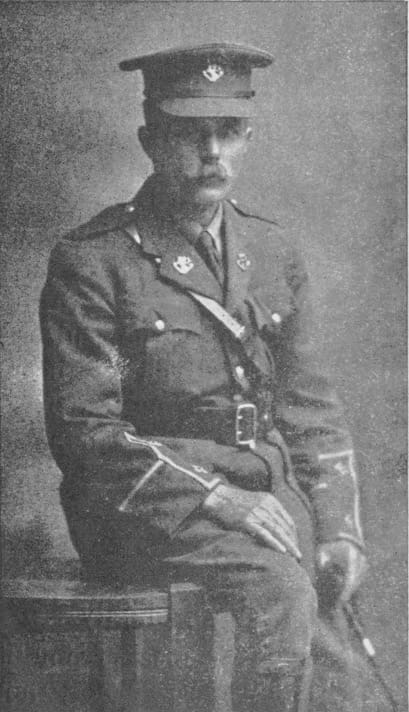
Major Michael Sullivan (NFC #0-191) led the forestry unit from 1917 through 1919. His resume included postings as an engineer with the Reid Newfoundland Company and assistant manager with the Anglo-Newfoundland Development Company and he had also worked as an independent pulpwood agent in St. John’s. He was elected a Member of the House of Assembly for the district of Placentia and St. Mary’s, serving from 1904 to 1909. In February 1918, Sullivan was in Newfoundland on a recruiting trip. He boarded the SS Florizel for Halifax on his way back to Scotland and survived the ordeal of shipwreck south of St. John’s that took many lives.
The NFC’s second-in-command was Captain Hector H. A. Ross (RNR #768), a former officer of the Newfoundland Regiment who had been wounded in the Gallipoli campaign.
The NFC’s first commissioned officers included Major William H. Baird (NFC #0-192), Captain Hugh W. Cole (NFC #0-170) and Captain Henry S. Crowe (NFC #0-25). Michael J. Gillis (NFC #0-193) and William T. O’Rourke (NFC #0-195) were commissioned as Second Lieutenants in 1917. Additional commissions occurred over the course of the war.
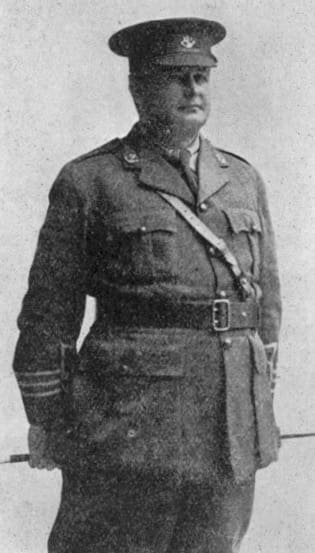
A Winter’s Tale: The Wreck of the SS Florizel by Cassie Brown (1976) describes the events surrounding the sinking of this iconic ship as well as the stories of many of those on board, including Michael Sullivan. Among the victims and survivors of the 1918 disaster were relatives and friends of NFC members. Of the 138 people aboard, only 44 survived.
A FINE OPPORTUNITY
We have now had earmarked for our operations two main locations: (1) On the Duke of Atholl’s estate near Dunkeld, where there are three separate blocks of forest a mile or two apart aggregating about 1,200 acres. (2) On the Marquis of Breadalbane’s estate at the west end of Loch Tay. This latter is a block of about 800 acres situated on a fairly steep hillside sloping down to the Loch. There is some magnificent timber on this, and it will give our men fine scope for proving their skills.
[I]f only we can get an adequate number of recruits, these two locations should give us a fine opportunity for showing what the Newfoundlanders can do as woodsmen, in comparison with other nationalities which are engaged in this work throughout the United Kingdom. These include, besides the many thousands now embodied in the Canadian Forestry Corps, men from Norway, Sweden, Portugal and the United States.
– excerpts from a letter from Mayson Beeton, Director of Timber Supply, London, to Governor Walter Davison, St. John’s (reprinted in The Evening Herald, July 31, 1917)