Second
World
War
POSTWAR TRANSITIONS
AND STRUGGLES

STRUGGLING FOR RECOGNITION
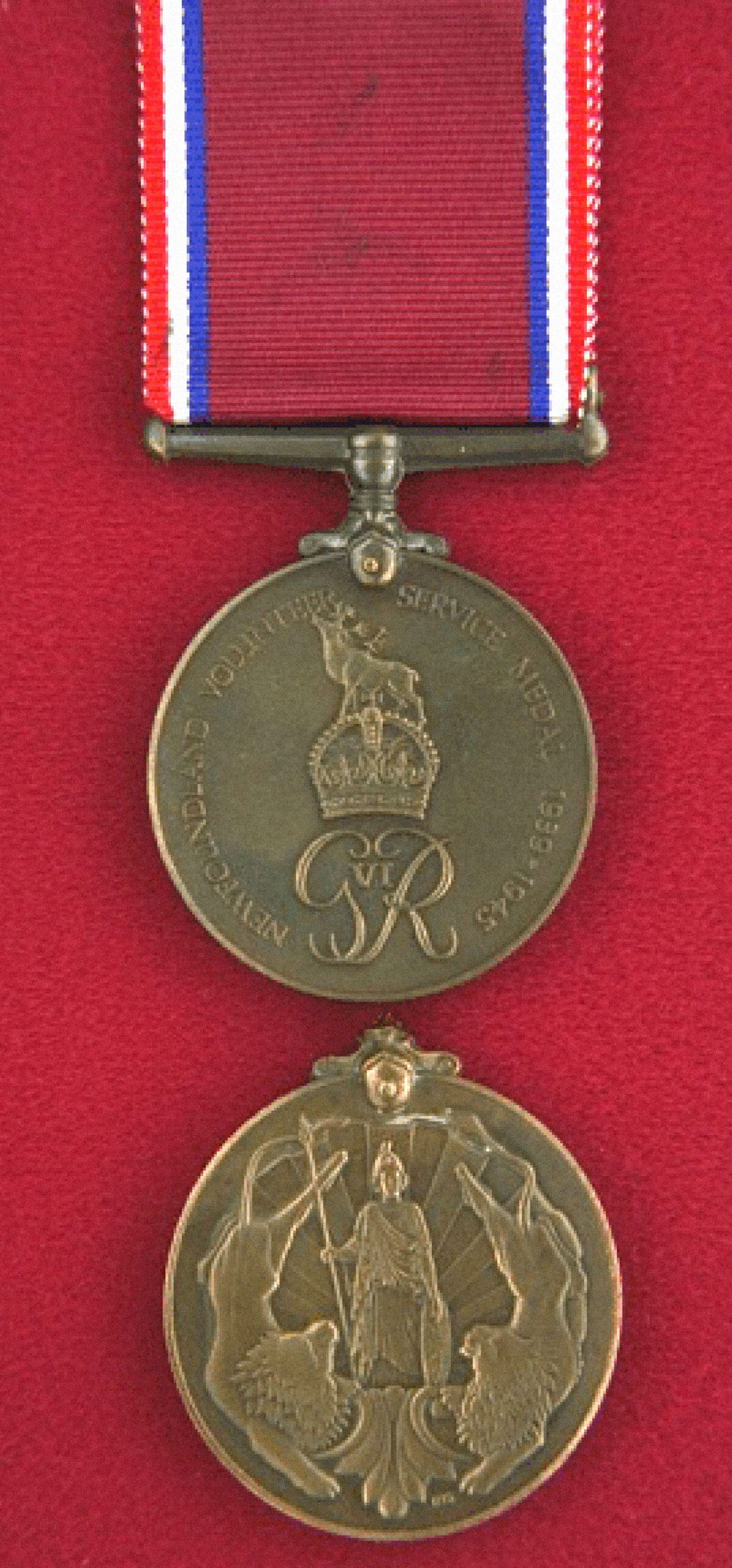
The NOFU had been hastily assembled at the beginning of the Second World War. Despite the Newfoundland Commission of Government’s preference to develop a military unit (like the NFC of the First World War), the UK government felt there was no time for military training. But that decision—to create a civilian not a military unit—had severe consequences for NOFU members both during their time in the UK and when the war ended. Their pensions and postwar opportunities were not the same as those of other veterans. In fact, many people did not consider them veterans at all.
When NOFU members returned to Newfoundland, the Commission of Government did not acknowledge the value of their service. The UK government had programs available to foresters who remained overseas, but no such opportunities were offered at home. A Land Settlement program on the Humber River, created to encourage farm development, was intended for veterans, but foresters were eligible only after all other interested service members had been considered.
It was an unsettled era on other fronts, too. In 1948, a fractious referendum was held to decide whether Newfoundland would return to responsible government or join the Canadian Confederation. A thinly split vote favoured Confederation. Newfoundland became Canada’s tenth province in 1949.
Disappointingly, NOFU members were not included in any of the concessions negotiated for veterans during Confederation talks with Canada. And they had already lost economically: while overseas, foresters had worked at wages far lower than their counterparts in wartime Newfoundland. Even at that lower pay, large numbers of them had purchased Newfoundland War Savings certificates to support the war effort. But at the end of the war, many NOFU members were without significant savings or had few work opportunities in a country that was entering a postwar economic slowdown after a wartime boom.
Despite these and other obstacles, most NOFU members went on to make lasting contributions to Canada’s newest province. Some, however, chose to leave Newfoundland to seek work elsewhere.
In 1962, the foresters were recognized under the Civilian War Pensions and Allowances Act. But it was not until 2000 that the Government of Canada awarded pension benefits to foresters. By this time, many of them had died.


“In contrast to its initial great enthusiasm in the recruiting of the Unit, the Commission of Government of Newfoundland appeared to lapse into complete apathy as far as the welfare of its foresters was concerned. No communication whatsoever was made by the Newfoundland Government with the Unit, and consequently their work and activities received little publicity in the Newfoundland press and on the radio. The Newfoundland Overseas Forestry Unit gradually became the Forgotten Service.”

Look & Listen
SCOTTISH CONNECTIONS ON THE LABRADOR
This video features a sequence of historic photographs and newspaper headlines that illustrate the points in the narrative. The images are of people mentioned in the narrative and other Labrador woods workers, a large pulp and paper mill, work and forest scenes, and a fiddler entertaining woods workers in a bunkhouse.
Title: Scottish Connections on the Labrador
Narrator: How to re-enter the workforce was a concern for the foresters returning to Newfoundland and Labrador after the war. Many sought work in new trades they had learned in Scotland. Some got work with one of the two large pulp and paper employers—Bowater and the Anglo-Newfoundland Development Company. Still others sought experiences farther afield.
Captain John Grieve had served with the Nova Scotia Highlanders during the war. Along with his two brothers, he resumed their family woods business at Kaipokok Bay, Labrador. Three Rapids Estates had been started by their parents, Andrew and Barbara Rapsey Grieve of Scotland, but it had shut down before the war.
Jack Turner, back at his job as Chief Forestry Officer for Newfoundland, had concerns about the Three Rapids Estates restart because of a shortage of experienced woods workers in Labrador.
Image of a newspaper headline with the words “Wants Loggers for Labrador”
The Grieves pinned their hopes for success on hiring well-respected woodsmen from the island of Newfoundland who could train local workers.
Among those who joined Captain Grieve’s operation was Kenny Gaulton—Skipper Gaulton, as he was known. He returned to Grand Falls after six years of war service as a camp foreman with the NOFU. Familiar with Gaulton’s work in Scotland, Captain Turner likely felt that he would be a good person to train Labrador woods workers.
In summer of 1946, Gaulton signed on with the well-liked Captain John Grieve. They made a good team, for they shared more than a love of woods work: both were also talented musicians. While in Scotland, Kenny Gaulton featured regularly in bunkhouse entertainment. John Grieve was known in Labrador for playing the bagpipes. One can imagine how their music sometimes filled the deep quiet of a Labrador wilderness night.
Two men from the Makkovik area, Max Jacque and John Broomfield, often composed songs in the bunkhouse at Kaipokok Bay, including “Lay That Bucksaw Down.” Their moniker song tribute, “Captain John Grieve,” gives Kenny Gaulton an honourable mention.
Image of a newspaper headline with the words “Fire Destroys Supply Store On Labrador”
Gaulton returned to Newfoundland in the summer of 1947, after a springtime fire destroyed the depot at Kaipokok Bay. Three Rapids Estates voluntarily dissolved later that summer.
[guitar]
Title: “Captain John Grieve” (Max Jacque & John Broomfield, performed by Gerald Mitchell)
Image of CD cover with words “From the Big Land – Music of Makkovik featuring Gerald Mitchell,” a sepia photo of Gerald Mitchell playing his guitar, and a sepia photo of a group of men, women, and children. In the front row of the group, several men hold brass instruments.
[Male voice singing with guitar]
Here’s to the Happy Valley crew as you would all may see
A godlier crew has never walked that other bunch of men
Max Jacque he is our Foreman as you would all may see
Dave Mitchell is our Second Hand and a darn fine man is he
The next that comes is Captain Grieve and we can’t let him down
Ten thousand cords of wood, my boys, can’t fail to hit the ground
The drive is coming in the spring and we must do it good
To help that good old Captain Grieve to drive out all his wood
[guitar]
The man who runs the depot is Skipper Walter Grieve
He took a trip to Mic Mac Lake one day when he had leave
T’was he and Kenny Gaulton went around in their canoe
They saw a million cords of wood; they swear they’ll saw a few
The next that comes is good old Ted; Ted Bursey is his name
He operates the two-way set that connects across the main
Some people they don’t like him, boys, but I do think he’s good
To operate that two-way set; it does the people good
[guitar]
Carsten Stroud he is the man that makes up all the books
And at the end of every month he hands us our checks
[guitar outro and fades out]
Credit slide:
Produced by Ursula A. Kelly & Meghan C. Forsyth
Text by Ursula A. Kelly
Narrated by Dave Paddon
Recorded by Spencer Crewe
“Captain John Grieve” by Max Jacque and John Broomfield,
recorded by Gerald Mitchell for From the Big Land: Music of Makkovik featuring Gerald Mitchell (Research Centre for the Study of Music, Media, and Place, 2011)
Photos courtesy of the Gladney family, The Rooms Provincial Archives, Them Days, Zero Minus One Sheet Music, The Daily News, Digital Archives Initiative (Memorial University Libraries), Ballater Historic Forestry Project Association, Illustrated Magazine, The Evening Telegram, Maritime History Archive
2024
Logos: Grand Falls-Windsor Heritage Society, Memorial University, and Digital Museums Canada
STANDING UP FOR THE NOFU
The Newfoundland Overseas Foresters’ Association (NOFA) formed in Scotland to advance the interests of the members of the NOFU. After the war, it continued its work in Newfoundland with the aim of gaining recognition for the service NOFU members had provided. In a brief submitted to the Government of Canada (1949), the Association presented its case for equity with other veterans. This excerpt addresses the issue of the NOFU being given civilian status.
BRIEF SUBMITTED ON BEHALF OF THE NEWFOUNDLAND OVERSEAS FORESTRY UNIT, 1949
Since their work was the same as the work of the members of the Canadian Forestry Unit and since it was carried on in the same country, in the same area, at the same time (but for a longer period of time) and under the same conditions; and since they were even trained for offensive warfare there is therefore but one difference between them, and that is: the Canadians wore a uniform and the then Newfoundlanders did not. This is the only reason that the members of the Canadian Forestry Unit are treated as ex-servicemen while the members of the Newfoundland Overseas Forestry Unit are not.
Should the wearing of the uniform, under these circumstances, make all this difference? Why did the Newfoundland Unit not have a uniform?
It is submitted that the only reason is because the United Kingdom Government wanted loggers and wanted them badly and fast. There was no time to provide the first contingent with uniforms. It was much less expensive for the Government to send them in their own civilian clothes and in fact the men could, most likely, work with greater ease and more comfort in these clothes than in uniforms. Two thousand (2,000) Newfoundland Overseas Forestry Unit men were in Britain by February 1940 whereas the first contingent of Canadian Forestry Unit men did not arrive there until late 1941 and early 1942.
What difference, for example, is there between the Newfoundland Forestry Unit in the Second World War and the First World War? There is none except the uniform. It is the same difference now between the Canadian and Newfoundland Forestry Units. What about the Newfoundland Militia who remained in Newfoundland but are completely covered under the Veterans’ Charter because they wore uniforms?
Assume for a moment that, when these men were asked to join up in the Forestry Unit, they were told they would not get any after-war benefits unless they were in uniform. Is it not reasonable to assume that every man would [either] have joined a service where he would be wearing the King’s uniform or have returned home?
Ask any officer of the Unit or the officials concerned in the United Kingdom Government what would have happened when they were pleading with the men to remain in the Forestry if these men were told that they would get no benefits? Not one man would have remained in the unit. They [would have] wanted to transfer to other services.
LISTEN

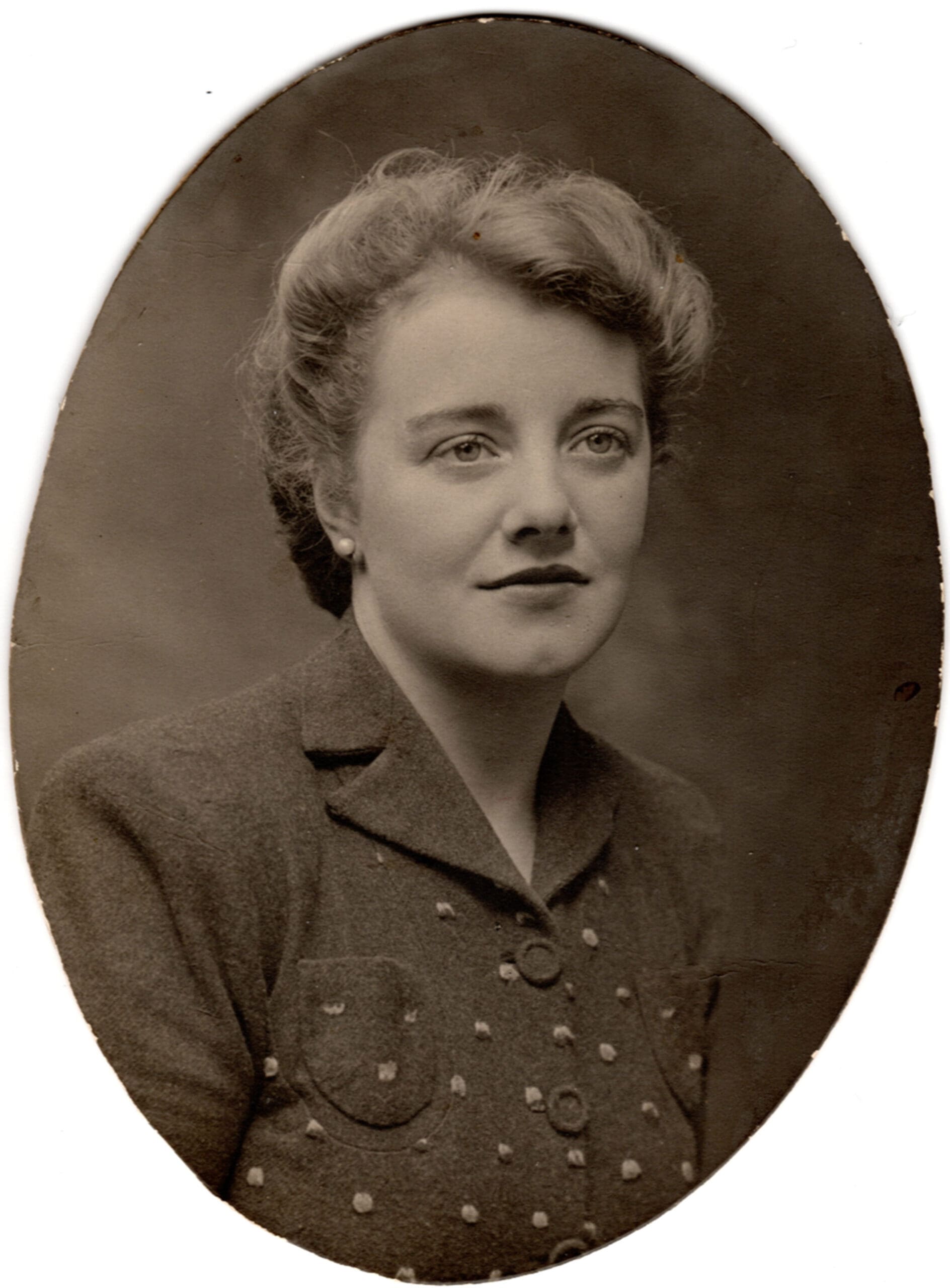
Portrait of a Forester
Thomas V. Curran (NOFU #1978) was one of more than forty men from the logging town of Gambo who enlisted in the NOFU. He served as District Superintendent and, eventually, assistant to the Commanding Officer, Captain (later Colonel) Jack Turner, as well as Company Commander of B Company of the 3rd Inverness (Newfoundland) Battalion (a Home Guard unit). Curran was a founding member of the Newfoundland Overseas Forestry Association and held various executive positions with the organization.
Following the war, Curran returned to Gambo with his new wife, Margaret MacPherson of Inverness. Once home, he continued to raise awareness about the importance of conservation of natural resources through his work with the federal Department of Fisheries. As President of the NOFA, he led efforts to secure Canadian government recognition for the wartime foresters under the Civilian War Pensions and Allowances Act. He wrote They Also Served, published in 1987, to provide an account of the NOFU’s work in the UK. In recognition of his efforts on behalf of the foresters and his decades of conservation leadership, Curran was awarded an honorary Doctor of Laws from Memorial University of Newfoundland in 1995. Thomas V. Curran died in 1997.

DOUBLY WELCOMED
This article, published in The Western Star in 1942, describes the musical contributions at a surprise homecoming party for NOFU member Alex (Sandy) MacIsaac (NOFU #0604) of Doyles.
On Friday night a surprise party was tendered Sandy MacIsaac son of Mr. Frank Maclsaac at his home, Doyles. Sandy has just returned from the Newfoundland Forestry unit after serving two years over there. He was doubly welcome in his Scotch community, as he brought back a set of bag-pipes, striped with the MacKenzie plaid. These pipes were duly tried out by our veteran pipers, Allan McArthur and Hughie Mc-Neil. Violin music, with organ accompaniment, and several Scotch songs were special features of the evening. However, the party had in its midst a talented guest, Mrs. Richard Ryan, the former celebrated singer Miss Alice Curtin, who lent her voice to the occasion and granted the many song requests of the assemblage. As the evening passed the surprise party was in for a surprise itself. The train came and another one of our boys dropped in. He was Joseph White of the Royal Navy. Sandy’s party from thereon became the party of Sandy and Joe. A tasty lunch was served and an address of welcome read the boys. A good time was enjoyed by all, and we would like to see all of our Newfoundland boys look so happy on their homecoming as the two who were feted on Friday night.
LISTEN
A digital copy is available online through the Digital Archives Initiative at Memorial University Libraries, Newfoundland and Labrador (https://collections.mun.ca/digital/collection/cns2/id/41706).
INVALUABLE SERVICE
The Secretary of State for Dominion Affairs expressed his gratitude and best wishes to the foresters in a message addressed to the Governor of Newfoundland in July 1946.
I should not like the last contingent of the Overseas Forestry Unit to leave us without letting you know how indebted we feel to Newfoundland for the invaluable service of these men through the war years in this first year of peace. I should also like all members of the Unit themselves to know of our gratitude to them for the real contribution to victory which they have made by their cheerful and unfailing assistance to us in our desperate need for timber during these years. To those who have married here I send a special message of hope that the wives and children who go with them will strengthen still further the ties of kinship between Newfoundland and this country and of confidence that they will be happy in the land of their adoption.
During its sojourn in Scotland the Unit has justly earned the friendship of the Scottish people and the commendation of the British authorities. When it finally returns to Newfoundland the Unit will leave behind a reputation for efficiency which will reflect credit upon Newfoundland as a whole.

MESSAGE FROM GOVERNOR OF NEWFOUNDLAND, SIR GORDON MACDONALD
My visit to the North of Scotland to make contact with the Foresters from Newfoundland proved to be both interesting and enjoyable. Enjoyable because of the warm and friendly welcome extended to me by all the Newfoundlanders and also by those who are to become Newfoundlanders in the near future. Interesting because of the keen interest shown in the future of Newfoundland by all those I contacted during my brief stay . . . [and] the clear conception shown by many of the problems and also of the possibilities in their homeland. . . .
The good work done by the boys from Newfoundland in helping to win the war is likely to be equalled by the service they will render and the work they will do back home in the days to come . . . [that will be of] lasting service and permanent value to the oldest of our colonies.
LISTEN
Portrait of a Forester
A long-time mariner, Peter Troake (NOFU #917) of Durrell, Twillingate Island, served in the NOFU from 1940 to 1942. After he returned home, he operated his own schooner until 1950, when he became Captain of the MV Christmas Seal. A “ship of hope,” the Christmas Seal was operated by the Newfoundland Tuberculosis Association and served as a mobile x-ray testing clinic for residents of outport communities. Peter Troake earned the title “the pied piper of Newfoundland” for the way he helped children ease their fear of TB testing.
From 1971 to 1979, Captain Troake helmed the International Grenfell Association medical ship Strathcona. In 1987, he was invested as a member of the Order of Canada, and in 1992 he received an honorary Doctor of Laws from Memorial University of Newfoundland.
Peter Troake published his memoir, No One is a Stranger, in 1989.

Look & Listen
A BYGONE FOREST
The Glenmuick camp at Dalmochie (Camp 49), near Ballater, Aberdeenshire, was built along the lower slope of Craig Coilleach Hill. Foresters from Newfoundland harvested trees from its slopes and also on nearby Pannanich Hill. They began cutting in the spring of 1940. By 1943 all work was completed and the foresters had moved to other sites. The camp was then used to house Italian prisoners of war.
In 2005, the Ballater Historic Forestry Project Association was established with the goal of restoring the NOFU camp on its original site. Interpretation panels have been installed. In 2005, the documentary A Bygone Forest was made. It tells the story of the NOFU at Ballater during the Second World War. The film features author Ian Cameron, Chair of the Ballater Historic Forestry Project Association, who was a young boy when the NOFU was posted near his hometown, and forester Cornelius Swyers (NOFU #2496) of St. George’s, Newfoundland, who served at Camp 49. Swyers stayed in Scotland after the war, residing at Tomintoul.
Watch an excerpt of A Bygone Forest, written and produced by Tim Fitzpatrick. (Used with permission)
The narrated sections of this video feature sequences of archival, black-and-white video clips and black-and-white photographs. Sections with Ian Cameron and Cornelius Swyers talking are in coloured film shot in 2005.
Close up video of a Second World War-era Ferranti radio. The video pans down and zooms in.
[Radio broadcast with static]
Voice of Prime Minister of the United Kingdom: …by 11 o’clock that they were prepared at once to withdraw their troops from Poland, a state of war would exist between us. I have to tell you now that no such undertaking has been received and that, consequently, this country is at war with Germany.
Narrator: September the 3rd, 1939.
Video of buildings destroyed and on fire, soldiers putting out a building fire, and soldiers digging through building rubble in the smoke.
[air raid siren, fire burning]
Britain is at war. The coming months and years would be those of a country thrown once again into the horror of modern warfare. Warfare that is now brought directly to civilian populations.
[building crumbling]
This was a country fighting for its future and the future of a free Europe.
[car engine]
Video of a ship setting sail while hundreds of passengers wave to onlookers from the upper and lower decks; photograph of women welding in a factory.
And alongside the men and women of the Armed Forces, [ship horn] people from all walks of life were being mobilized for the nation’s war effort.
Photograph of 8 women walking through a field with armfuls of hay.
[Birds chirping]
Video of a city street in the UK during the Second World War with cars driving and men walking in long black coats and black Homburg hats.
There were areas of national importance, however, [car horn] where Britain needed to look for help beyond its borders.
Video of men working in a logging mill; close-up video of a log being moved through a machine.]=
[industrial sound]
And one of these was the production of timber. At the outset of the war, Britain was suffering a chronic shortage of timber.
Video shot from above of a peaceful, foggy forest scene; photograph of soldiers in uniform lined up in rows in front of a small building.
Supplies from the Baltic had already been cut off and supplies of British timber were being limited [solo trumpet music begins] by the fact that so many of the forestry and estate workers were signing up with fighting units.
[Solo trumpet music]
Sequence of black-and-white photographs of ships at sea, with smoke rising from some of them, and a yellowed press release from the Daily Express (21st November, 1939) titled “2,000 Lumbermen to Serve Britain”; video of Newfoundland flag waving in the wind; and image of NOFU badge over on a snowy background with a green fir tree sticking out of the snow.
Late in 1939 the British government sent out a plea to its allies and Newfoundland, then a country in its own right and independent of Canada, responded by establishing the Newfoundland Overseas Forestry Unit.
Video of a steam train going down the tracks; video clips of men standing in rows on a ship deck; close up video of 4 men standing in front of a ship, one looks directly at the camera; video of a large ship in the water; photograph of Cornelius Swyers; video of foresters walking in a group into a logging camp building.
[Train sound]
From all across Newfoundland, men responded to the call. [slow solo cello music]
One of those men was Cornelius Swyers from St. George’s who, in June 1941, sailed from Newfoundland to Liverpool and travelled on first to Invercauld and then to the camp near Ballater. After the war, Cornelius, better known as Con, settled in Tomintoul and in the Autumn of 2005 he visited the site of his old logging camp once again.
Coloured video footage of Con Swyers and Ian Cameron driving in a Willys Jeep toward the camera on a forest road, and then parking.
[Vehicle engine]Making the visit with him that day with the added authenticity of a Willys Jeep was Ian Cameron. Local man Ian grew up in Ballater and, although just 5 years old when the operations ended, he still has his own vivid memories of the camp in Pannanich woods.
[Video pans through the forest, showing remnants of building foundations covered in moss; close up of yellow leaves; sepia photo of 5 log buildings in a row and two foresters walking near them.]
On this hillside were the logger’s huts, the working hub of thousands of acres of logging. Today these are the last faint traces of what was known as Glenmuick Camp.
[Calm string music]
Video of Ian and Con walking, talking, and pointing to where the log buildings once stood.
[Birds chirping]
Ian: Now if you’re standing from here, Con, can you describe just how you remember the camp laid out.
Con: It started with the the office.
Ian: It was highest up the hill.
Con: Yeah it was up on a bit of a rise up.
Ian: mhm
Con: And uh then up back of that a bit was the cooks quarters where they stayed.
Ian: Right.
Con: And down in the flat first the cook house.
Ian: mhm.
Con: And four four camps or five I’m not right sure and it was held with 15 or 20 men each. (Ian) So this was them running along exactly from…
Con: They ran all all the one line.
Ian: mhm.
Con: yeah…
Ian: And so you had lived just probably in the first of them down there.
Con: The first one I was into, yeah.
Sepia photo of a winter scene of log buildings with smoke rising from the chimneys, foresters walking or standing outside. One forester is pulled on a sled by a Garron pony.
Ian: This is incredible. ‘Tis.
Black-and-white video of a large ship in the water, followed by video of a logging camp scene.
[ship horn]
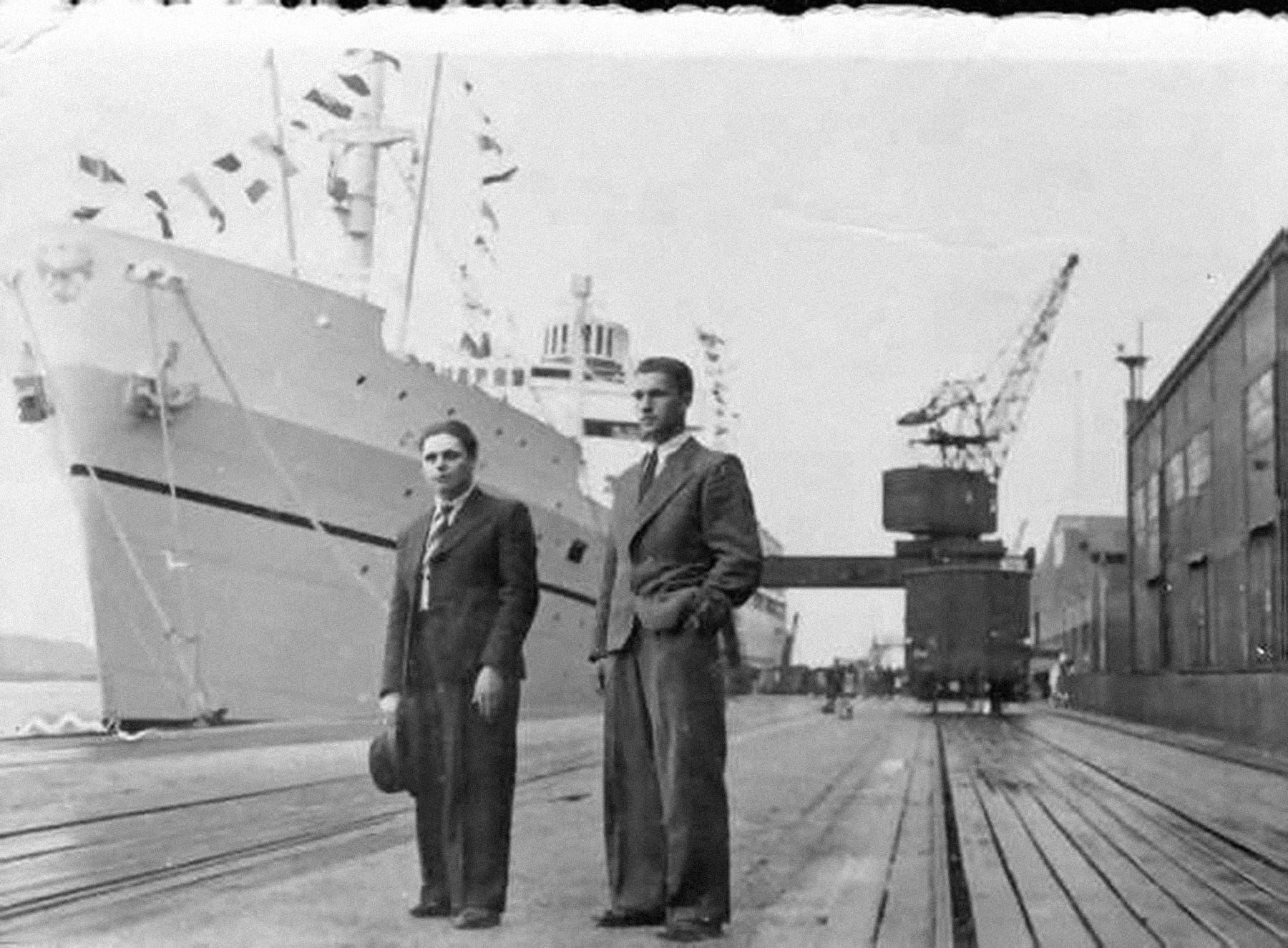
Narrator: The volunteer lumberjacks of Newfoundland began arriving in 1940 and, over the course of the war, a total of 3,400 would make the journey to the dozens of camps that were set up throughout Scotland.
Video footage of Ian and Con talking in the forest.
Ian: Inside the cabins themselves you just had your individual bed space, I presume…
Con: that, oh yes…
Ian: …a locker or something.
[birds chirping]
Black-and-white photo of the inside of a log bunkhouse. Three men relax on their beds with items hanging from ceiling above them.
Video of Ian and Con talking in the forest.
Con: Probably a couple of feet between each bed that’s what all there was and a locker for clothes and uh there was a big stove big round stove in the middle of the hut for heat especially in the winter – when it’s summer you didn’t need it much.
Ian: nanana.
Con: …but in the winter when it was cold and then some nights we’d have a a bit of a session of music, [men singing fades in] boys with a fiddle and accordions and we’d have sometimes a great night and maybe some lads come in with… half shot from from the village. (laughs)
Sequence of black-and-white photos: a group of men in a bunkhouse (one man plays the fiddle and boots hang from the ceiling); a row of log buildings; a group of men holding axes, one man plays the fiddle and looks into the camera.
[men singing “Squid Jigging Ground” with accordion]
Video of tractors carrying logs, a forester guiding a Garron pony that is hauling logs and work in a sawmill.
Narrator: Along with their expertise the loggers brought a degree of mechanization previously unknown in the forests of Scotland [tractor sounds] and perhaps more than anything else it was the versatility and sheer brute strength of the Caterpillar tractor that best encapsulated that new approach. But extracting the felled timber couldn’t be done with Caterpillar tractors alone. [chain sound] As the trees were felled, Garron ponies were used to get the timber to the lower levels of the forest where the Caterpillars could then take over the hauling to the sawmills or to waiting trucks. [Industrial sounds]
Coloured video footage of Ian and Con talking in the forest, interspersed with archival footage of foresters chopping down trees and trucks carrying logs.
Ian: It was your own job here.
Con: I was in the woods working cutting down trees that was my job and uh [axe chopping tree] and sometimes a lorry would…lorry driver and taking loads out to the sawmill…
Ian: oh, ah, alright.
Con: …and or the station where they were shipped away.
Black-and-white photo of a sawmill and video of logs moving down a chute.
Narrator: Over the course of the war, thousands of square miles of timber were cut and transported away. The timber from the camps of the Newfoundlanders was suitable for a number of uses but the key use was for pit props in the mines, vitally ensuring the nation’s coal supply.
Video of 3 men working in a sawmill; sepia photo of the outside of a sawmill, surrounded by piles of logs.
Ian: It was a big big thing…
Con: Oh yes…
Ian: Still coal mines everywhere.
Con: Yeah that’s right…
Video of Con and Ian talking in the forest.
Ian: ...we’ve forgotten about coal mines but that was
Con: …and uh cut a lot of poles for put on the beaches in case it was an invasion.
Ian: Ah
Con: …and put the poles down in the sand so if land…would try to land would planes
[both men talking, fades out]
Sepia photo of piles of felled trees in the forest stretching into the distance.
Narrator: One by one, the hillsides were cleared and the saw mills processed the constant supply of timber. In felling the trees, it was common for the loggers to work in groups of four or sometimes just in pairs.
Sepia photo of two loggers working in the forest. One holds an axe, the other holds a bucksaw.
Coloured video of Con and Ian talking in the forest, interspersed with a black-and-white photo and video of men working in the forest.
Con: And we worked six days a week, 8-hour days and uh sometimes we go back in the evening. We start on piece-work after a while, make a bit of extra money and uh go in it for a couple hours after tea and then come out in a hurry and get washed and cleaned up and that and out to Ballater to a dance. And go to the pub first, of course.
[slow cello music]
Black-and-white photo of a large group of foresters walking in the forest.
Narrator: And, at the day’s end, the men would make their way back to the camp on the hillside, a small slice of Newfoundland in the Scottish Highlands.
[music continues]
Sepia photo of a row of log buildings in the forest.
Video of Ian and Con sitting on a pile of felled trees, looking at a black-and-white photo. There is a close-up of the photo showing a group of men in a bunkhouse. One man plays the fiddle and boots hang from the ceiling.
Ian: We were speaking about the actual cabins I’ve got this photograph here.
Con: yeah
Ian: And this is you here, I think.
Con: That’s me…there and that’s a chap by the name of Bill O’Quinn he played the fiddle.
Ian: He he’s he was a fiddler? Did he go back Newfoundland?
Con: Yeah, he did.
Ian: He didn’t stay on…
Con: No
Narrator: By the end of 1943, the work was done at Dalmochie, the surrounding hills all cleared of usable timber.
Videos of a man guiding a log that is attached with chains onto a pile and men in Armed Forces uniforms. Sepia photos of an outport Newfoundland scene, a log house with one woman standing in the foreground and a woman and a baby standing in the doorway, and a town scene with trucks delivering goods.
Some of the men would move on to logging operations elsewhere. [Slow trumpet] Others joined up with fighting units. At the war’s end, most of the men made the long journey back to the towns and villages of their homeland.
Coloured photos of 2 older men in suits, smiling at the camera; a group of 13 older men pose in 3 rows. They wear suits with ribbons pinned to the left breasts. A black-and-white photo of 4 men sitting casually on a log pile, smiling.
Each year in Newfoundland, families and friends of the loggers, along with the dwindling numbers of the men themselves, gather together to remember a small but special chapter in the history of their country. And forever bound up in that chapter they remember with affection and pride their friends and their kinsmen who were the men of the Newfoundland Overseas Forestry Unit.
Black-and-white photo of two young foresters facing each other and smiling. One carries an axe over his shoulder.
[trumpet fades out]