

First
World
War
IT WASN’T
ALL WORK
KEEPING SPIRITS HIGH
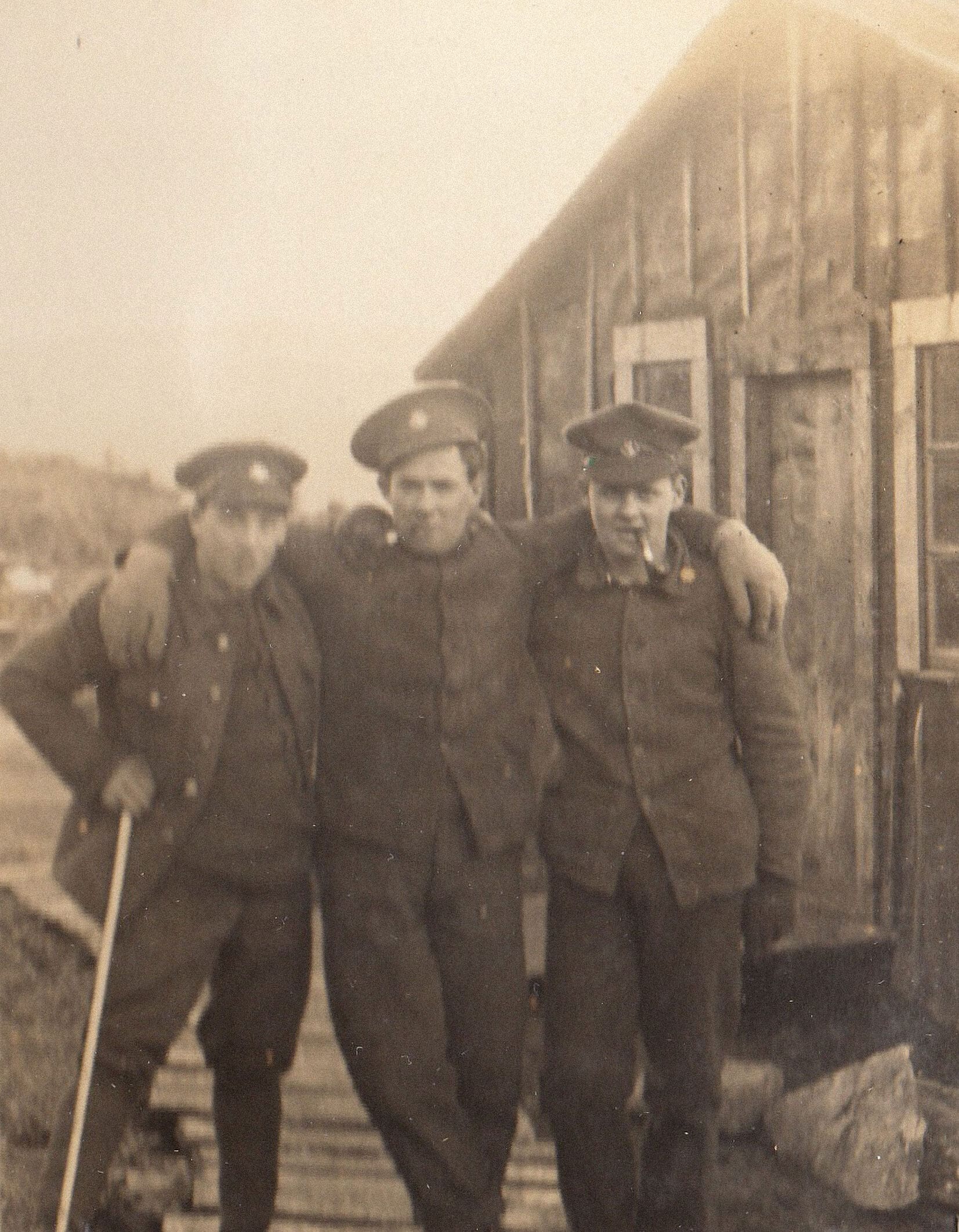
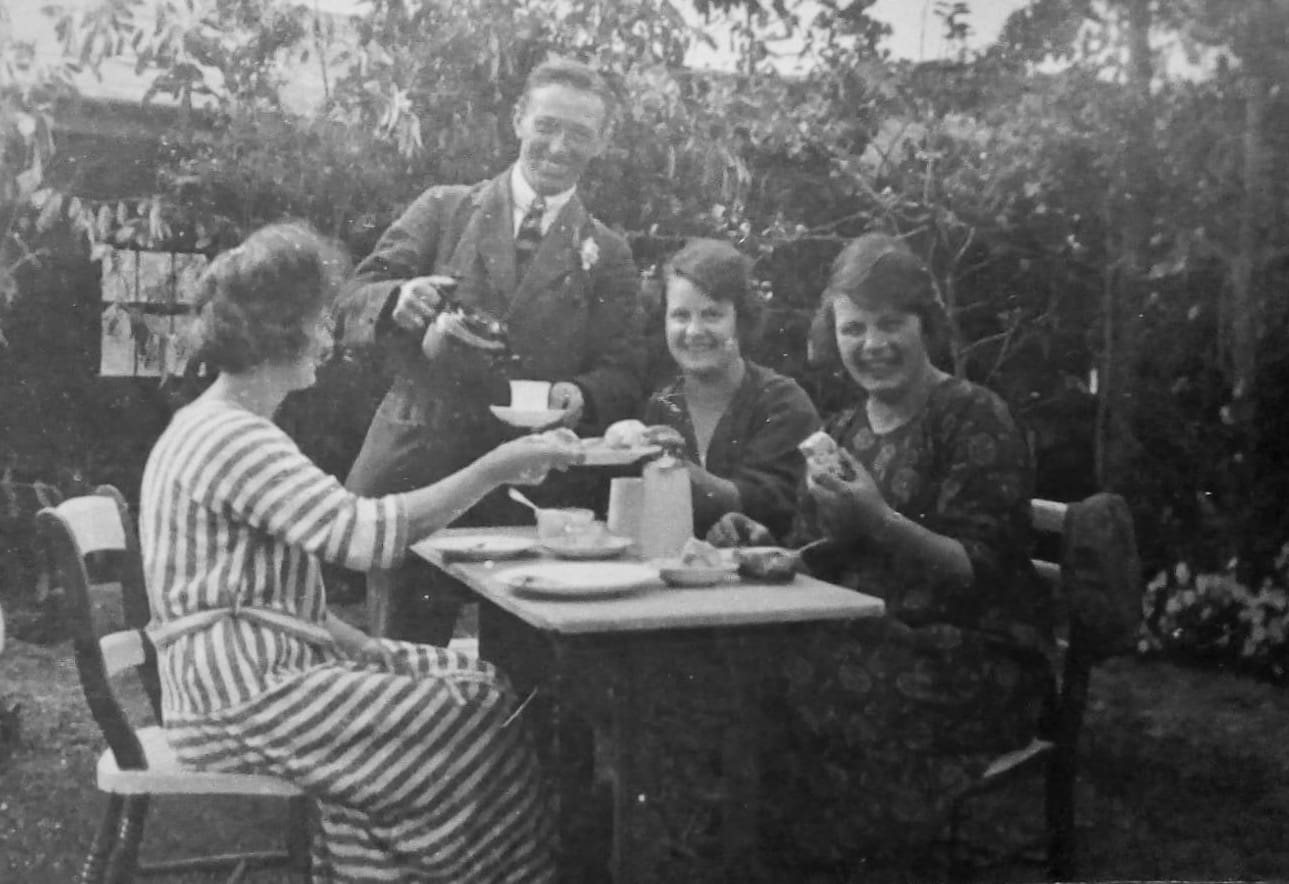
Recreational and leisure activities helped boost the morale of the foresters serving overseas. Each camp had a recreational “hut” where the men could read, make or listen to music, and play games. Friendly but more physical competitions—track and field events, tug-of-war challenges and woodcutting contests—were also held with soldiers from the Canadian Forestry Corp. NFC members took great pride in their Newfoundland identity and bridled at being mistaken for Canadians. This pride fuelled the competitiveness of sport competitions.
Community concerts were common in both Newfoundland and Scotland. In Newfoundland, they were held as fundraisers to support the war and to boost the morale of families missing loved ones overseas. “Moving pictures” were sometimes a feature of these concerts, as were guest speakers from the NFC. (In the UK, with its larger towns, movies were screened to enthusiastic audiences.)
Concerts in the UK were both patriotic fundraisers and a way to entertain the foresters and build cordial relations between them and nearby communities. The people of Scotland mounted concerts to show their regard and appreciation for the visiting soldiers. They featured singing, poetry reading, piano recitals and skits. Residents and NFC members both attended and performed.
In addition, foresters could visit local tea gardens and public houses and spend longer leave time in Edinburgh and Aberdeen. All these experiences gave them quite the taste of Scottish culture.

FROM MUG-UP TO HIGH TEA
Many of the social and cultural experiences the foresters had in the UK were new to them. The traditional Newfoundland “mug-up,” for example, was an informal snack of tea and biscuit or bread at home. It was far different from a “high tea” served at Loch Lomond, as described by William Woodford (NFC #8211) and quoted in The Fighting Newfoundlander (by Gerald W.L. Nicolson).
“[There were] two waitresses to serve four of us, a butler standing majestically in the background, ever ready to anticipate your slightest wish, as well as a footman standing rigidly at attention near the door. The food was delicious, and plentiful, the service impeccable.”
Look & Listen
A CONCERT AT DUNKELD
Daniel Hill Bruce and Jane Lamont Bruce owned the Tea Garden at Dunkeld and ran it with their daughters Jean, Hope and Jesse. The daughters often performed at concerts held for the NFC and at one they recited a poem their father had written as a tribute to Newfoundland and its “gallant sons.”
In a December 1917 letter home, Regimental Quartermaster Sergeant John A. Barrett (NFC #8028) described this concert. Listen to a reading of his letter and a recitation of Daniel Hill Bruce’s poem “The Glories of Newfoundland.”
This video features a sequence of historic photographs and documents that illustrate the points in the narrative. In the opening narrative, the images are of the town of Dunkeld, NFC mustered by a mill in Dunkeld, the Blue Puttees marching, the gates of Dunkeld Academy, NFC members and women at the tea room, Captain Ross, men and women in the woods, and groups of NFC members in relaxed poses. In the poem reading, the images are of nature scenes of Newfoundland, including a house on a cliff, the cliffs at White Bay, and the Long Range Mountains; men with dogs and sleds; men with haystacks; a women with two boys; troops departing Newfoundland by ship; a cemetery of white crosses; and a group of women and girls.
Title: A Concert in Dunkeld
Male narrator:
Yesterday afternoon was the occasion of a free concert and tea, tendered us by a number of prominent ladies of Dunkeld.
The men of our Companies were at first paraded on the ground of the mill, and after going through various manoeuvres, were photographed in groups. Then we all marched into town, presenting quite a military appearance with Captain Baird and Captain Ross, on chargers, heading the parade.
The concert consisted of songs, dances, piano duets, violin selections, sketches, etc. Mr. Crombie, headmaster of Dunkeld Academy, was the chairman, and in his opening remarks extended to us a hearty welcome, and a Scottish welcome at that. He hoped that the Newfoundland boys while in this country would find that there were warm hearts in Scotland for them.
For over two hours we were entertained by the vocal and instrumental members, whose renditions were so creditably given that they were frequently encored.
At the close of the performance, Captain Ross, on behalf of the men of the Forestry Companies and the men at St. Mary’s Convalescent Home, thanked the ladies for the very interesting and enjoyable entertainment. He spoke of the true Scottish hospitality extended to Newfoundlanders in different parts of Scotland, claiming that our boys were being as well received and entertained as they would be at home.
Three cheers were called for the ladies who helped towards the afternoon’s entertainment, and they were given with such a gusto that they still ring in my ears.
While the concert was in progress a number of ladies were busy behind the scenes, making preparations for the supplying of the wants of the inner man, and soon we were served with tea, sandwiches, scones, tarts, cakes, etc.
This treat brought forth more rounds of cheers for the ladies for their untiring efforts on our behalf.
Title: The Glories of Newfoundland
Female narrator:
I’ll sing you a song of a far-away land
On the wide Atlantic shore,
Where the rocks rise sheer from the pebbly strand,
And resound to the ocean’s roar
A land of bays, and the wide lagoon,
Where the scaly codfish feeds,
And the summertime flies but all too soon,
Before the storm king’s chariot steeds.
I’ll sing you a song of a sturdy race.
Among the mist, the snows, and fogs,
At their lumber toll on the rocky face,
Or at sport with the sleigh and dogs;
On the playful crest of the bountiful waves,
As the boats out to the sea;
On the fields, gathering in the gifts God gave,
Where so I smiles benignly.
I’ll sing you a song of their hopes and joys,
When the heart beats a rapturous tune,
And love runs riot amongst the girls and boys,
Midst the woodlands in leafy June.
I’ll sing you a song of their doubts and fears,
Of a mind now and then depressed,
And I’ll tell you of a smile hid behind the tears,
Begot of a soul rest.
I’ll sing you a song of its gallant sons,
Who have sped from the peace of home,
To the hard-fought fields where the bomb and gun
Go crash, and the hell-fiends roam
Where the timber cross dots the fields of France,
By the act of a kindly hand,
Is inscribed there for he who scans,
“A Hero from Newfoundland.”
Then here’s to the mountain, and here’s to the moor,
Whereon caribou and ptarmigans found,
And here’s to the rifle, and here’s to the spoor,
And the salmon and cod in the sound.
Here’s to the matron, and here’s to the maid,
The soldier and grandsire bland,
Let the theme of my song swell from hill and glade,
“The glories of Newfoundland.”
Credits:
Produced by Ursula A. Kelly & Meghan C. Forsyth
“A Concert at Dunkeld” was excerpted from “Hunting Game” by John A. Barrett, printed in The Western Star, December 12, 1917.
Narrated and recorded by Jim Payne
“The Glories of Newfoundland” by D. H. Bruce
Read by Fiona Miller
Audio recorded by Keith Miller
Photos courtesy of Dunkeld Community Archive and The Rooms Provincial Archives
Opening photo “Across the Tay to Dunkeld” by Gordon Hatton (CC SA-BY 2.0)
2024
Logos : Grand Falls-Windsor Heritage Society, Memorial University and Digital Museums Canada
CAMP SONG
“CHANSON DE BÛCHERONS” (loggers’ song)
Composer unknown
Performed by Josie LaCosta
This French song recounts the dangers and tragedies associated with logging, particularly during the spring log drive. It was a popular song in the early 20th century woods camps in Quebec and New Brunswick, as well as in Francophone communities on the west coast of Newfoundland. It, and “Lumberjack Breakdown” below, are examples of music that many foresters might know and play, in camps and in community concerts in Scotland.
Josie LaCosta (1904–1982) of La Grand’Terre (Mainland) and later Cap St. Georges learned the song from Willy Robin, who had picked it up in a woods camp in New Brunswick. Both LaCosta and Robin were well-known singers and storytellers on the Port au Port Peninsula in Newfoundland.
This recording was made by folklorist Gerald Thomas, who recorded many songs from LaCosta between 1973 and 1981. It is included on Mentioned in Song: Song Traditions of the Loggers of Newfoundland and Labrador (2014) and is used here with permission of the Research Centre for the Study of Music, Media, and Place.
LISTEN
This transcription has been translated from French:
Three young boys left on a long trip
To overwinter at a camp
Good traveler, I tell you again
You will die without seeing your home again.
It was on a Sunday afternoon
That I set out atop a jam
Good traveler, I tell you again
You will die without seeing your home again.
But in the spring we went on a drive
On a dangerous river
That cascaded over rapids
There was nothing but a branch to save myself.
As I went down the river at Maplante
It was there that I lost the rest of my blood
With an arrow, the savage wilderness
The rest of my blood spilled.
What sad news to send to his mother
That her child is dead, he died on a drive
Please tell her not to grieve
Sometimes in the forest you will be overcome by death
Please tell her not to grieve
Sometimes in the forest you must succumb to death.
CAMP TUNE
“LUMBERJACK BREAKDOWN”
Composer unknown
Performed by Larry Barker (accordion), Gerald Quinton (harmonica) and Moses Harris (unidentified instrument)
This lively “single” (the term used for a fast polka in Newfoundland and Labrador) was recorded by folksong collector Genevieve Lehr in 1978. It features the playing of three well-known musicians from Bonavista Bay North, on the northeast coast of the island of Newfoundland.
Larry Barker (1917–2011), a fisherman and logger from Open Hall, was a member of the NOFU (#1794) who played accordion and fiddle. He performed frequently with Gerald Quinton (1922–2009), who was well known for his harmonica playing and step dancing, and with Moses Harris, who played a variety of handmade instruments. The trio was featured in a 1976 episode of CBC’s Land and Sea, “A Time in Red Cliffe.”
This recording is included on Mentioned in Song: Song Traditions of the Loggers of Newfoundland and Labrador (2014) and is used here with permission of the Research Centre for the Study of Music, Media, and Place.
LISTEN
WAITING FOR PARCELS THAT NEVER ARRIVED
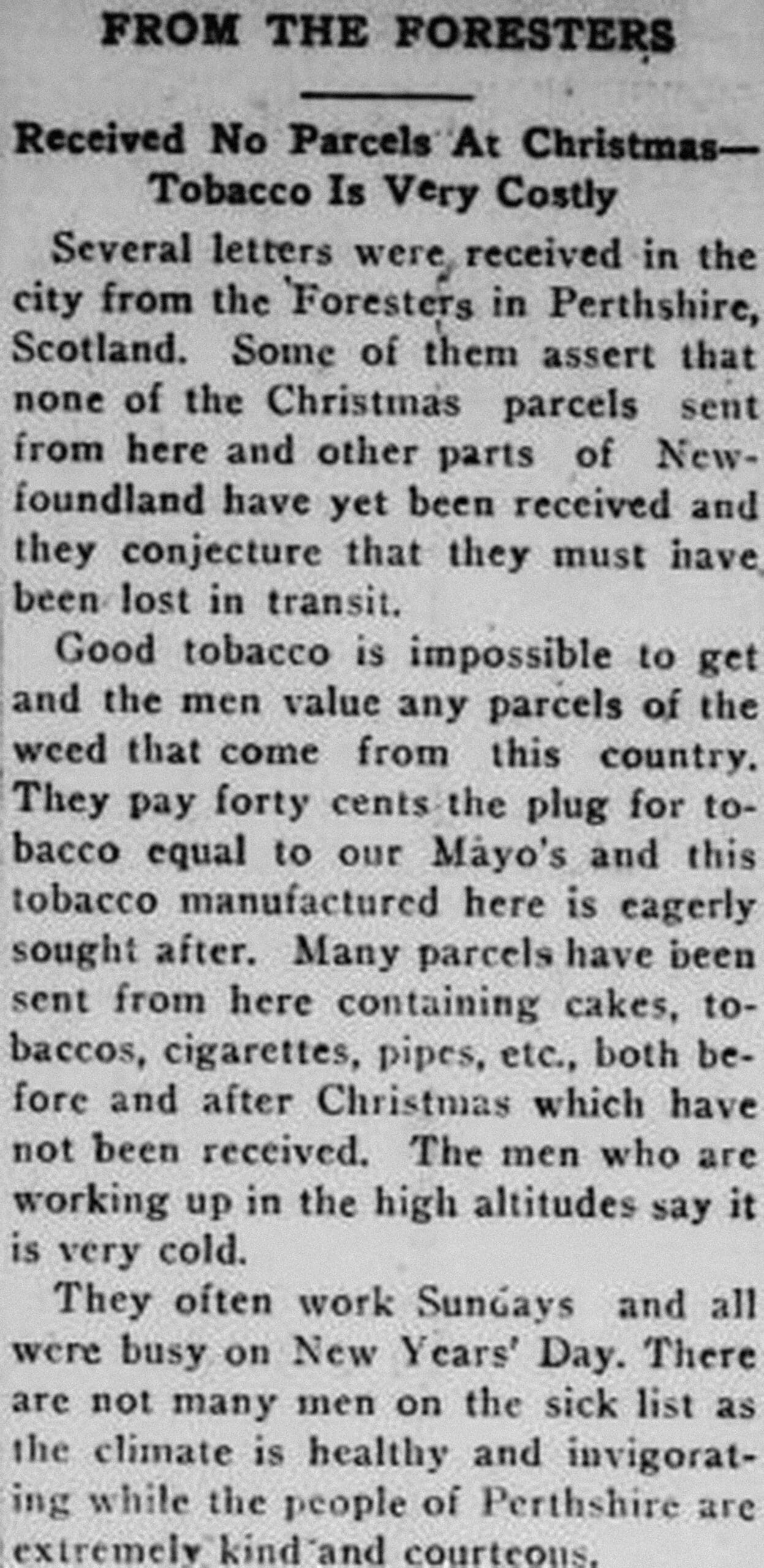
A St. John’s Daily Star article from February 13, 1918, reported that hoped-for Christmas packages for the overseas foresters had “been lost in transit.”
From the Foresters
Received No Parcels at Christmas—Tobacco Is Very Costly
Several letters were received in the city from the Foresters in Perthshire, Scotland. Some of them assert that none of the Christmas parcels sent from here and other parts of Newfoundland have yet been received and they conjecture that they must have been lost in transit.
Good tobacco is impossible to get and the men value any parcels of the weed that come from this country. They pay forty cents the plug for tobacco equal to our Mayo’s and this tobacco manufactured here is eagerly sought after. Many parcels have been sent from here containing cakes, tobaccos, cigarettes, pipes, etc., both before and after Christmas which have not been received. The men who are working up in the high altitudes say it is very cold.
They often work Sundays and all were busy on New Years’ Day. There are not many men on the sick list as the climate is healthy and invigorating while the people of Perthshire are extremely kind and courteous.
NO LETTERS FROM HOME
Like parcels, personal letters were often slow to arrive in wartime. This inquiry about the situation from Bertha Hull, wife of Private Ephraim Hull (NFC #8191), was sent to William Coaker, editor of The Evening Advocate. A member of Newfoundland’s House of Assembly, Coaker also headed the Fishermen’s Protective Union (FPU), which oversaw the rights of woods workers at the time.
Dear Sir,
Would you please find out for me the reason the men in the Forestry Companies in Scotland receive no letters from home. My husband has been over there since July and he has not got a word from me since he left. I wrote to him every week. I get all letters which he sends but he don’t get mine. I would like you to find out for me why it is. There are four other men with him and they don’t get any news from home either. Please let me know as soon as possible.
And oblige, yours truly
Mrs. Ephraim Hull
Birchville, Springdale, Hall’s Bay
– The Evening Advocate, November 23, 1917

FRIENDLY BUT FIERCE COMPETITION
One of the sports competitions between the NFC and the CFC was covered in the October 24, 1917, Perthshire Advertiser.

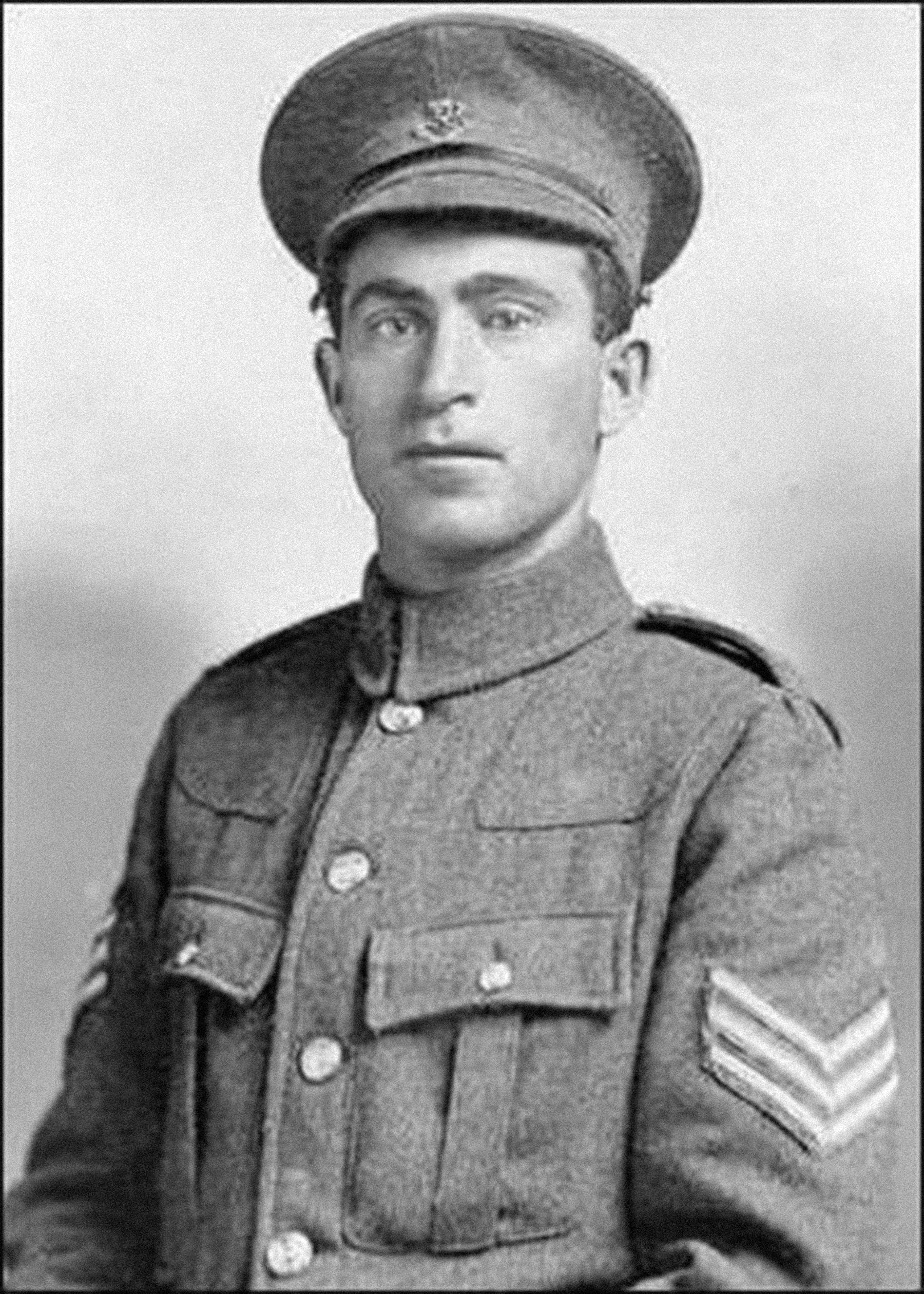
Much interest was taken in a unique demonstration at Stanley on Saturday, promoted by the District War Relief Committee. The sports were organized and carried out by members of the Canadian [Forestry Corps] and Newfoundland Forestry [Companies] who are at present engaged in useful war work in the Perthshire woods.
Remarkable exhibitions were provided showing the ability and science for which the “backwoodsman” is noted, while sports peculiar to these British dominions overseas proved extraordinarily attractive. The lumbermen entered with enthusiasm into the endeavor to swell still further the £800 raised at Stanley on 1st September last in aid of Red Cross Funds. And they succeeded admirably for something like 2,000 people paid at the gate . . . .
The activities of the afternoon were centred in a field close by the village main road. The field had been recently smiling under the golden grain, but, now, the stooks had been safely harvested and on the stubble was laid a number of felled trees ready to be operated on by saw and axe.
There was also ample “elbow-room” for the game of baseball, a recreation as popular on the Western Continent as football is in these islands . . . . The exciting struggle at baseball with which the sports programme opened was greatly interesting, and, of course, quite a new game to the majority present.
A well-contested tug-of-war between teams of Canadians and Newfoundlanders resulted in victory for the latter who gained two consecutive pulls.
The winning team, later, tried conclusions with a local side and, amid much excitement, the tug proved so prolonged that a draw was declared.
There were also hotly contested competitions in log chopping, and log squaring, the implements being wielded with rare skill and energy . . . .
A move was afterwards made to the curling pond nearby, where probably the most interesting item in the sports program was decided. This was log hurling in the water in approved lumbermen fashion. Skirted by rows of fir trees, the pond might have appealed to the imagination as a creek in the St. Lawrence. At any rate, the burling exhibition in the water showed the marvellous footwork and agility in taking logs “down stream” by experienced lumbermen. Some of the “stunts” called for the greatest daring and balancing, and one of the competitors showed altogether extraordinary cleverness. The banks of the pond were lined with rows of onlookers who unstintingly applauded the skilled performers . . . .
Music was provided by the Black Watch Band, conducted by Bandmaster Austing, the musical entertainment being greatly appreciated. A refreshing cup of tea was served, the Hobart House girls acting as attendants under the supervision of Mr. A.H. Smith. A collection for Red Cross funds made by the girls brought in a sum of over £12.
LISTEN

I AM LONESOME
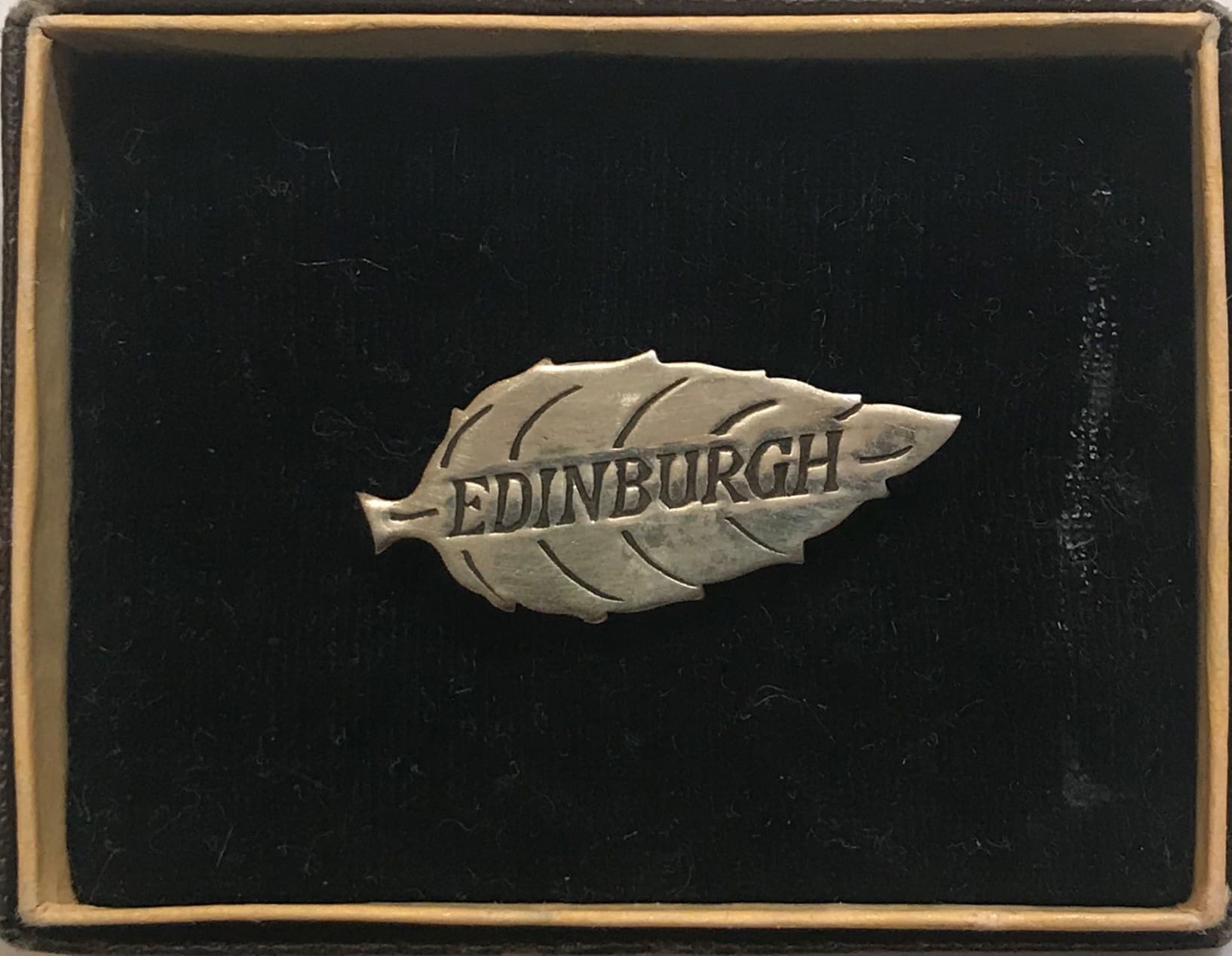
John Angel (NFC #8383) scribbled those words on the back of a photo he mailed from Scotland to his wife Anastasia, at home in St. John’s. The silver brooch—engraved “Edinburgh,” the city where it was bought—arrived safely and is still a valued heirloom in the Angel family.
“I sent you a brooch. I hope you get it. I am lonesome.”
HOME AWAY FROM HOME
A main highlight of the working days in camp was the evening meal. The NFC men were pleased to be given permission to supplement their standard army diet with wild game, which was plentiful on the Atholl Estate where they worked. This excerpt from The Times History and Encyclopedia of the War was written in 1917 and describes the type of game they encountered.

The mountain deer became less alarmed after a time at the invasion of their solitudes [by the foresters], and crept warily along at uttermost heights to look down on the newcomers. Coveys of partridges would rise up from the ground and run straight ahead as the men cleared fresh districts, and the woodland rabbits darted across their paths. To the Newfoundlanders all this seemed like their native caribou and other game spoken of in their own language as deer, grouse, hares, partridges and rabbits. Most pronounced of all among the privileges of hospitality granted to them was the privilege of using rifle and gun occasionally around their camps for their camp pot. In Newfoundland no private rights of ownership exist, and this generous concession of the [Duke of Atholl] went straight to the hearts of the Newfoundland sportsmen who were his temporary guests.