

Second
World
War
HARD WORK
AND DANGER


CHALLENGES, RISK AND ACCOMPLISHMENTS
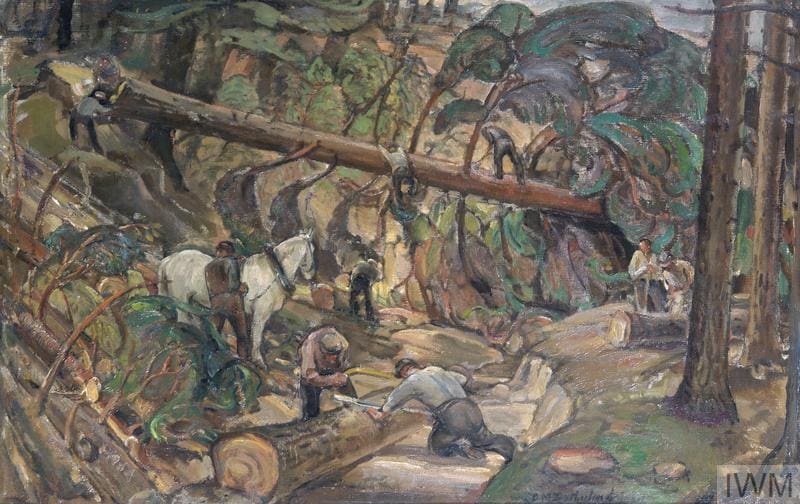
During the war years, the Newfoundland Overseas Forestry Unit (NOFU) operated 71 camps at various locations in Scotland and England. The foresters adapted the methods they used to cut, fell, and transport timber at home to the conditions and demands of their wartime workplaces.
As they had been during the First World War, the people of the UK were impressed by the skill and speed with which the men felled trees and built log cabins. They also admired their agility in operating tractors on rough hillsides and their innovations for cutting and moving timber. The horse-drawn “go-devil” sled, built to improve movement over difficult terrain, was particularly well-regarded.
During the war, about 30,000 acres of forest in total were harvested in the UK. The NOFU did its part in this work, alongside the Canadian Forestry Corps, the British Honduran Forestry Unit, and the Women’s Timber Corps (UK), an organization similar to the Women’s Timber Service of the First World War. By the end of 1944, the NOFU had harvested more than 31 million cubic feet of round timber (31,501,421 ft3 or 630,000 cords).


Thirty-four foresters died during the NOFU’s years of service in the UK, as a result of work accidents, disease, or misfortune. Hundreds more were sent home because of injury or illness. Many more died after they transferred from the NOFU to other wartime units: the Royal Navy, Royal Air Force, and Merchant Marine, for example. The resting places of NOFU members buried in Scotland are tended by the Imperial War Graves Commission.
Glovertown Youth Meets Tragic Death
Shot By Sentry Attempting To Halt A Passing Car
Maxwell Hawkins of Glovertown, B.B., who has been working in Scotland with a Newfoundland forestry contingent, met a tragic death recently when he was shot by a sentry who was attempting to halt a passing car.
Look & Listen
IN A NEARBY FOREST
The NOFU caught the attention of the print press several times during their time in the UK. When they disembarked from their ship at Liverpool on December 18, 1939, they were the first contingent of foresters to arrive in the UK from the Dominions. From there, they went by train to camps run by the Ministry of Labour at Kielder and Kershopefoot, England, near the Scottish border. A News Chronicle correspondent visited them a few days after their arrival.

“By request, one of the fishermen sang ‘Squid Jiggin’ Ground’: ‘All sorts of figures with squid-lines and jiggers / they congregate here on the squid-jiggin’ ground.’”
This video includes a sequence of historic photographs that illustrate the points in the narrative. The images are of Kielder Forest in England, the NOFU camp at Kildrummy, groups of NOFU members, two NOFU boxing, a step dancer with fiddler, fishermen, NOFU members dancing, and a hillside covered in pine trees.
Title: In a Nearby Forest
Narrator:
When dusk falls, and the axes no longer ring across the hills, the men get back by lorry to their camp—19 miles from nowhere, in the wide open spaces of Northumberland. A wash, a feed (and how they eat) and then for the night’s fun. They do not play darts or sing jazz, and cards—poker and ‘Spoilt Fives’—is a bit tame, so they make their own entertainment.
This is the show they gave me when they knew I was a stranger “chumming in” for the night: Pianoforte solos. Boxing tournament. Mouth organ selections. Tap dancing and breakdowns. Round dances. Native ballads. Fishermen’s songs.
First the glove work warmed up the party and set the mouth organs going in the long, wooden hut. When the boxing boys had packed up, the solo dancers got to work until the perspiration streamed down their bronze faces.
For a change we gathered round the piano and sang their colonial songs (‘The Trinity Cake,’ ‘Star of Logy Bay’). They made their roof ring with favourites of the far-off forest shacks in their own home country. “We’ll rant and we’ll roar like true Newfoundlanders,” they yelled.
By request, one of the fishermen-loggers sang “The Squid Jigging Ground”—squid fish being used for bait along the bays: “All sorts of figures with squid lines and jiggers / They congregate here on the squid-jigging grounds.”
Perhaps the jolliest part of this happy colonial evening in the backwoods of Britain was the round dances. A score of hefty fellows weighing anything up to 14 stone went through the old-fashioned English dances. These young giants partner each other in the Lancers and Quadrilles, whizzed one another round, while a hundred admirers stamped and clapped, and the mouth-organ maestros blew themselves into a frenzy. Jackboots banged on the floor, sweaters were discarded—the noise was deafening.
Suddenly a word from Captain Turner, and silence. “Lads, lights out soon. Are you ready?’ The crowd surged to the piano, and they sang their own anthem, which Cavendish Boyle wrote: “When sun rays crown thy pine clad hills, /And summer spreads her hand / When silvern voices tune thy rills / We love thee smiling land” after which they sang another anthem with equal fervour—”God Save the King.”
Credits:
Produced by Ursula A. Kelly & Meghan C. Forsyth
“In a Nearby Forest” written by George Pollard, published in News Chronicle, December 23, 1939
Narrated by Emma Claire Brightly
Photos courtesy of Irene Hunter, Eric Beckett, the Gladney family, the Boyd family, Archives and Special Collections (Memorial University Libraries), and The Rooms Provincial Archives
Photo ‘Kielder Forest from Deadwater Fell’ by James T.M. Towill
2024
Logos: Grand Falls-Windsor Heritage Society, Memorial University and Digital Museums Canada
A DUKE’S WELCOME
The Duke of Devonshire, the UK’s Under-Secretary of State for the Dominions, welcomed some of the Newfoundland foresters in March 1940, a short time after their arrival (an excerpt follows). His words of greeting show how highly the NOFU’s contributions were already valued. Later the same spring, he also made a three-day tour of NOFU operations in Scotland.
“VITAL NATIONAL IMPORTANCE”
Newfoundland loggers are famous the world over for their skill and hardihood. They have learnt their work in forests which supply the great pulp and paper mills at Grand Falls and Corner Brook. When you read the daily papers in this country you should remember that much of the paper on which they are printed comes from Newfoundland and may indeed be the product of your own labour.
About 1,000 of you are already in this country and the majority of them are already at work. Your party, numbering 1,000 more almost completes the unit.
I have learned from Captain Turner of the splendid spirit of keenness among the earlier arrivals under his command and I am sure that you are coming in the same spirit. I hope there will be no delay in getting you all to your important work but you will realise that a big scheme of this kind needs very careful organisation and you will not lose your keenness even if delays occur.
You have come over for a work of vital National importance. We in England cannot pay for our necessary imports without exports and of these, coal is the most important. We cannot export coal Without pit props, and those from Newfoundland and elsewhere will not be coming until next summer.
In the meanwhile, the gap must be bridged from home-grown timber, and it is up to you to see that the supply does not run short. You will be working under new and strange conditions, but you will be among friends who will appreciate greatly the way you have come to help in the hour of need . . . .
The Western Star, March 20, 1940
LISTEN

Portrait of a Forester
SUPERINTENDENT EDGAR BAIRD
Edgar Baird of Campbellton, who had served as the Chief Woods Ranger of Newfoundland from 1935 to 1937, was appointed superintendent of the NOFU at the start of the war. In 1941, he joined the Royal Air Force, rose to the rank of Flight Lieutenant and served until the war ended. Back home in Newfoundland, he pursued business ventures in aviation, lumbering and tourism, and was a key lobbyist advocating for the creation of the town of Gander. After that success, he served as the chair of the new town’s Local Improvement District and helped shape the community’s development. In the summer of 1961, Baird closed his business to fight the massive Bonavista North forest fire as a volunteer fire boss. He was also the founder of the Junior Forest Rangers in Newfoundland.
Edgar Baird died in 2005, one year after his investiture into the Order of Newfoundland and Labrador.

THE NEWFOUNDLAND OVERSEAS FORESTRY UNIT
By Captain Jack Turner
The Western Star, January 29, 1943
(Excerpt)
Just over two years after the first draft of the NOFU left Newfoundland for the UK, Officer-in-Charge Captain Jack Turner wrote the following update (in six excerpts) on the unit.
THE FIRST WINTER
We landed during one of the worst winters in the history of the British Isles. On landing we were placed in large camps which had been built by the Ministry of Labour for use as training centres for unemployed youths. These were modern camps, electrically lighted and equipped with up-to-date kitchens but were, to us, almost unbearably cold, due very largely to the fact that the climate was much damper than our own, and the local idea of a comfortable temperature indoors is about what we would consider rather chilly outdoors.
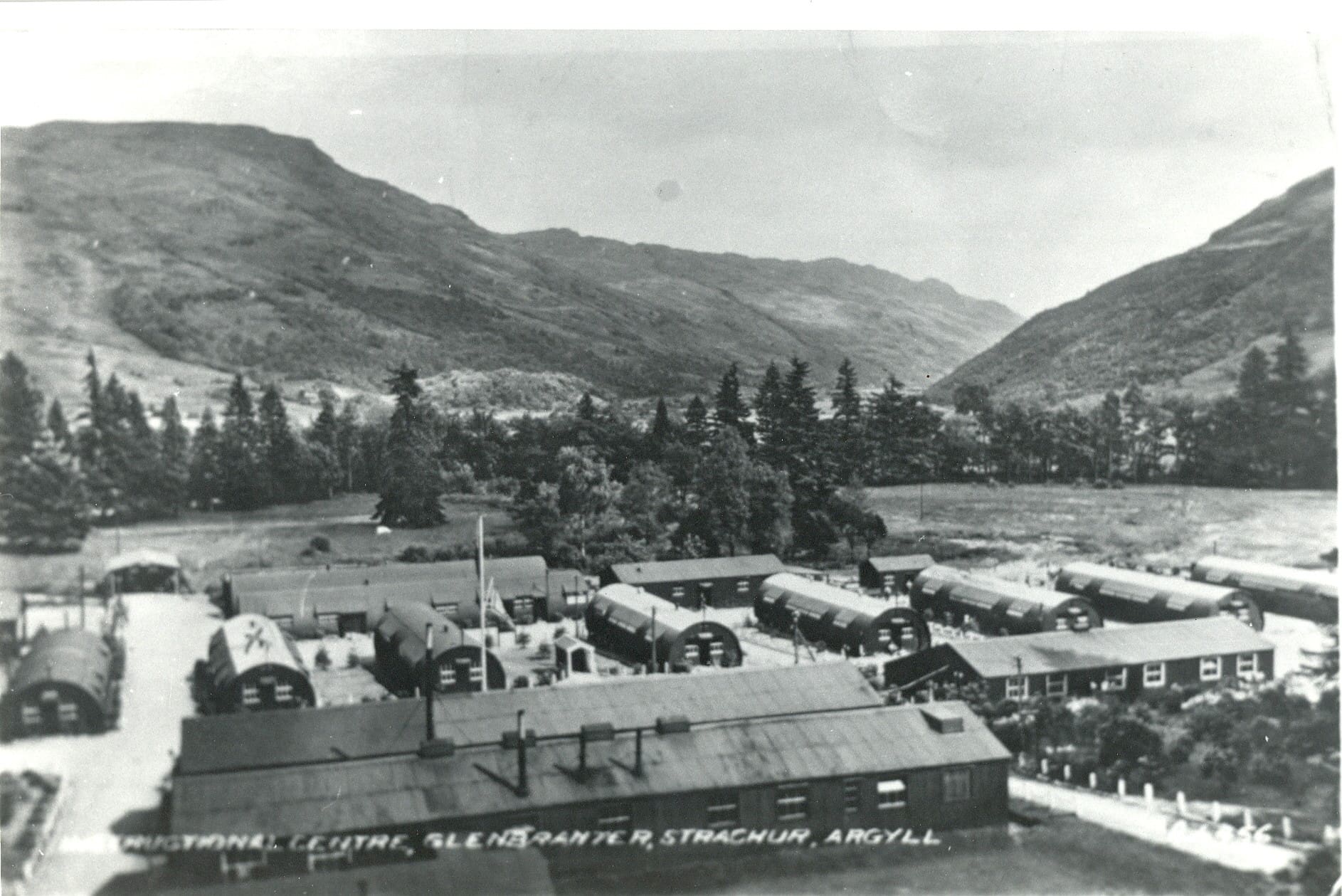

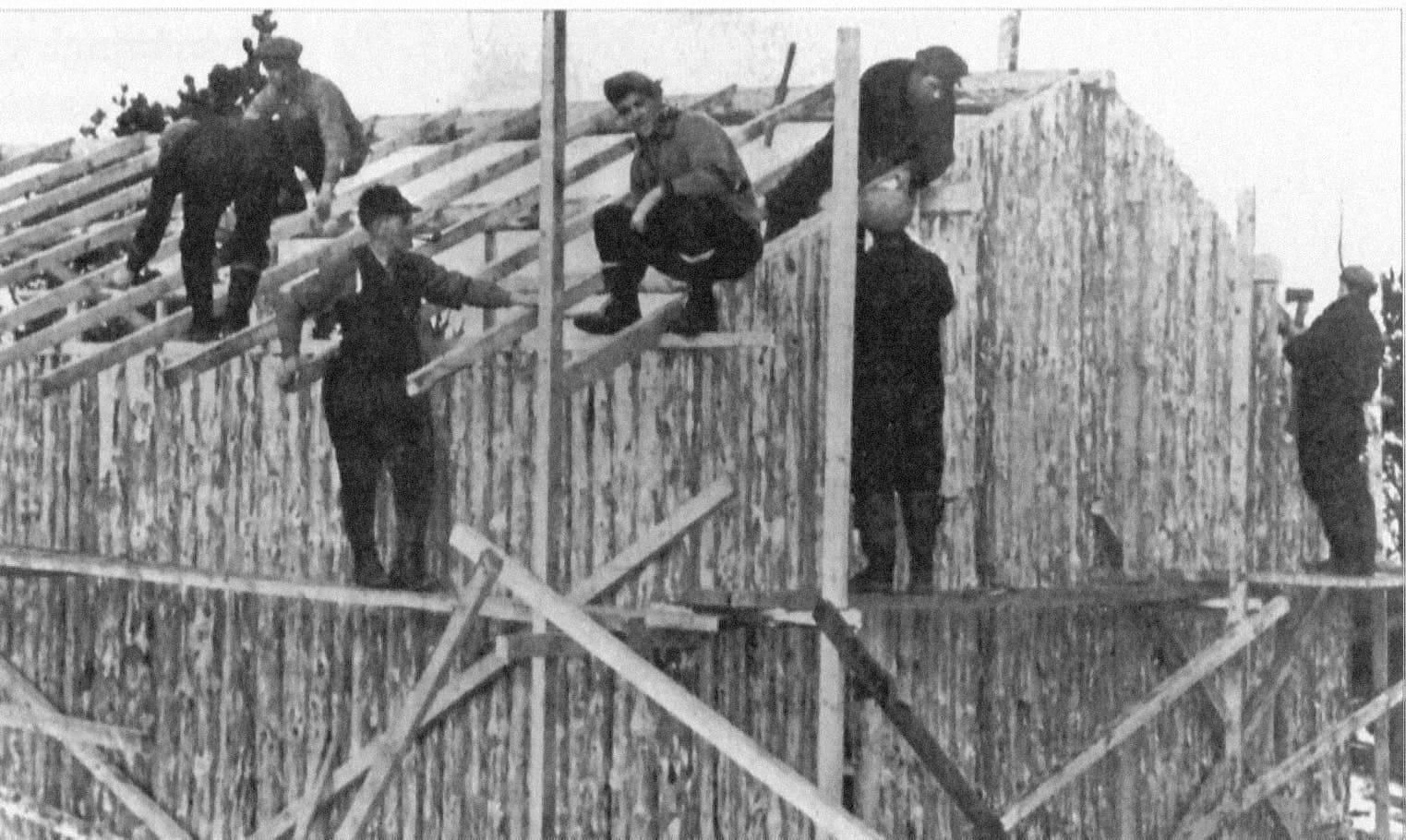
Getting settled down in the woods was quite a proposition, as we had to start from scratch. Many of the woods we had to tackle were rather isolated, and, before we could start camp building, we had to find somewhere to live while doing it. We took over village halls, drill sheds, empty cottages and barns. As soon as we got one building up, a few men would move in and build the next. This “snowball” process went on step by step and by the late spring of 1940 we had moved everyone out of the base camps into the woods.
During this time we had a good deal of illness, due largely to the fact that we were not used to the damp and were very much inclined to treat colds too lightly. “Flu” was rampant, and occasionally developed into pneumonia, and we had a few cases of meningitis, which seemed to be cropping up in scattered places all over the country. As Spring advanced, things improved, and though almost all new arrivals seem to have had to go through an acclimatising stage—the general health of the Unit has been quite good for some time. I do not know if the Newfoundland Forestry Corps built log camps during the last War, but I am pretty sure that we built the first ones seen in many parts of the country. In the early days they were looked on as quite a curiosity, and people used to come from a good many miles away to admire them.
During this time the weather had been almost unbelievably bad. In one place, roads were blocked for days on end, and we had to turn out whole gangs to dig through the drifts. In other places it rained almost every day. In spite of the worst the weather could do, we gradually got straightened out and by the end of Spring had camps in operation from the South of England to almost the North of Scotland.
LISTEN

LEARN NEW TRICKS
One of the first things we discovered when we got down to work was that we had quite a lot to learn. It is one thing to turn a whole stand of trees into four-foot pulpwood, but it is quite another thing to turn every tree into pit props of a dozen sorts and sizes, each of which must be cut exactly to size, and each size piled and shipped separately. However, slowly and painfully with a lot of grief and a certain amount of rather rude language, we learned.
We also found it hard to get used to hauling everything on bare ground. We missed the snow and ice—and most emphatically did not like the mud.

Then we had to get used to Scots sawmill machinery, and trying to combine Scots gear and Newfoundland ideas into a mill that would turn out reasonable quantities of lumber. On the whole, we had to throw overboard many of the methods we had been used to, and adopt or invent new ones . . . .
We have learned a lot of new tricks, and have adjusted ourselves and our methods to local conditions. As a result, we are a much more smoothly working organization than we were even a year ago. I do not think that any member of the Unit will admit that there is a better outfit than ours in the forests of the United Kingdom.
LISTEN

ORGANIZATION
We are now pretty well self-contained. We build our own camps and roads; make our own sleds, etc.; handle our own catering; operate our own recreation huts and canteens; design, build and operate our own sawmills; repair and maintain a great deal of our own machinery and equipment; and are now organizing our own Home Guard-Battalion.
In order to save time and labour, we have standardized as much as possible, and are trying to develop a system of logging suited to local conditions and available equipment.
Naturally, complete standardization is impossible, but we are going a long way in that direction.
Take camp building, for example. A special small gang looks after this part of the work, and does all the construction, including plumbing and water supply. As the number of men in our newer camps varies from 80 to 120, there must be some variation in the size of the camps. In order to get as near a standard camp as possible, we use a standard bunkhouse, holding twelve men, and merely vary the number of bunkhouses. The cookhouse, which consists of dining room, kitchen, pantry, and cooks’ living quarters, is built in the shape of a capital “T,” with the kitchen forming the stem. The width of both parts of the building is the same in all cases, so for a bigger camp we only have to lengthen the two parts. We use a standard ablution hut in each camp. As these are all alike, it is not much of a job to move the plumbing from a cut out camp to a new one. Recreation huts are on the same lines as cookhouses, with the canteen and manager’s living quarters forming an annex. Forepeak, stores, etc., are the same in all the newer camps.
LISTEN


CONSTRUCTION
The construction gang is a busy organization. Besides building camps they have to keep them in repair and that, in itself, is quite a job. The same gang—with two or three mill-wrights—builds and maintains our sawmills.
Another small gang does most of our road building. Until recently, all this was done by hand but, lately, we have acquired some mechanical equipment. Some idea of the amount of road building required may be gained from the fact that between now and New Year we have over ten miles of gravelled road, fit to carry heavy motor trucks, to build and it is now mid-November.
MECHANICS KEPT BUSY
The mechanical and repair gang is another important branch. Their job is to keep our machinery and equipment running with as little lost time as possible. We have established a repair depot near the geographical centre of our operations, and here all badly damaged machinery is brought while minor repairs are made in the Districts.
At this depot you may see Newfoundland mechanics at work on everything from a broken-down stove to a badly wrecked tractor.
Of course, we cannot handle all repairs, as we have not the necessary plant, but our little repair shop has given our hauling equipment a good many thousand days’ working time which they could not otherwise have had. Here, too, we have a Carpenter Shop where all sleds used in the operation are made and repaired, and other woodwork done. This depot started in the corner of a local blacksmith’s shop and grew steadily as its importance was realized until it now consists of a group of shops and stores, manned by about thirty skilled workers, who have their own living quarters close by.
LISTEN
INGENIOUS COOKS!
A Forestry Unit marches on its stomach so catering is a major operation. In each District a Catering Officer handles the buying and distribution of all food and camp supplies. In these days of rationing his job is no bed of roses, as men who work hard and long need good food, and lots of it. In spite of rationing and difficulties of distribution, there is no shortage of good, well-cooked food in our camps. Many of our cooks have performed miracles in making Newfoundland dishes from British materials.
When a cook can produce first-class baked beans without either molasses or fat pork, and turn ships’ biscuit and Iceland fish into really good fish and brewis, he is GOOD. Most of our cooks do this regularly, and I think this is as good a place as any to give them a well-earned pat on the back.
The Unit has earned the distinction of being the most efficient now operating in the United Kingdom and its output per man employed is higher than that of any similar unit. Of this record the members of the Unit are justly proud.
LISTEN

NOTICE
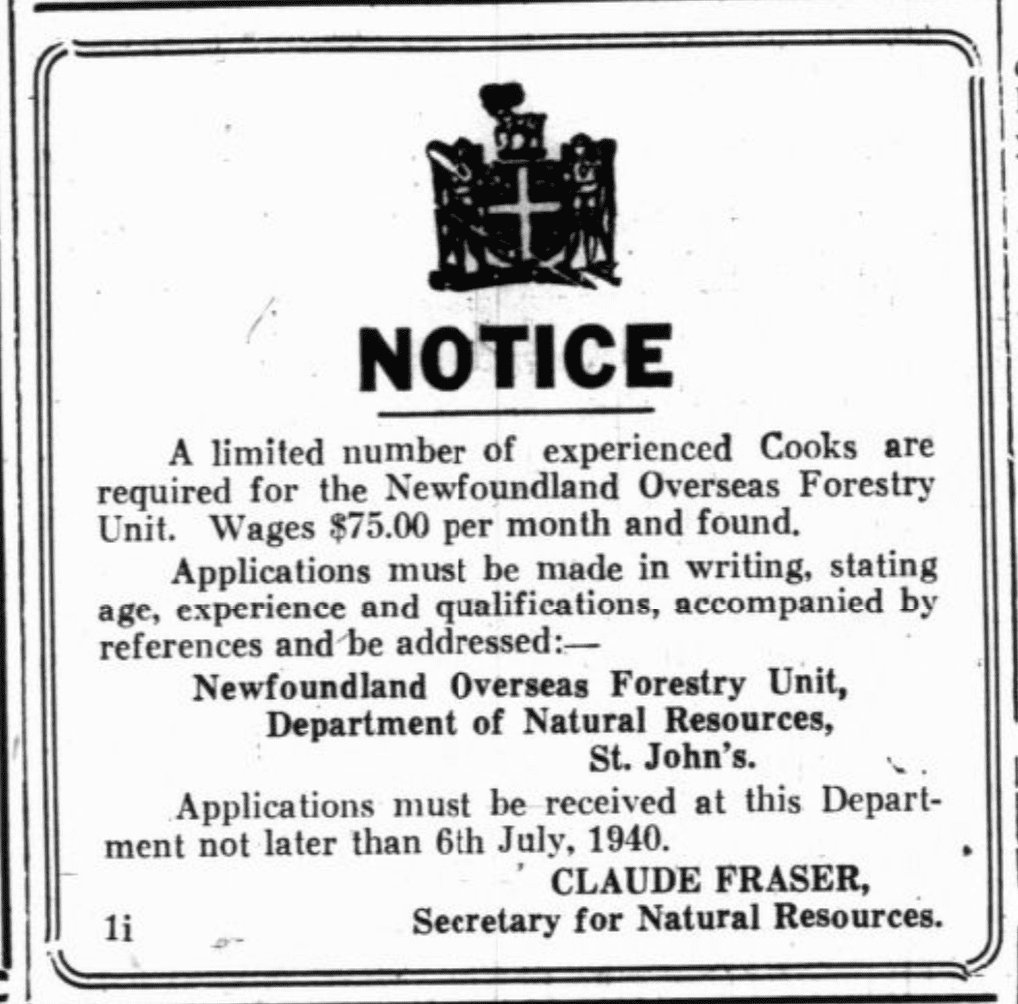
A limited number of experienced Cooks are required for the Newfoundland Overseas Forestry Unit. Wages $75.00 per month and found.
Applications must be made in writing, stating age, experience and qualifications, accompanied by references and be addressed:
Newfoundland Overseas Forestry Unit
Department of Natural Resources
St. John’s.
Applications must be received at this Department not later than 6th July, 1940.
Claude Fraser, Secretary for Natural Resources.
THE LOGGERS OF THE NORTH: NEWFOUNDLAND WAYS
January 1, 1941
The Western Star
(abridged)
Away up in the wilds of North Northumberland, where the wind blows chill about the hill-tops, and a glutinous mist boils up from the valleys, hardy Newfoundland loggers are felling giant trees at the scene of ancient Border conflicts.
They sing as they swing their axes, and rock-like oarsmen as the cross-cut saw bites deep into the vitals of old Scottish fir or Norway spruce.
These men from the land of fogs and fjords . . . are making a vital contribution to the Empire’s war effort. They are providing timber to box the shells and the food of the fighting forces, pit props for the mines, and sleepers for the railways.
They live in a wood and corrugated-iron encampment along the North Tyne. The river here is narrow, but fast flowing enough for logs to be floated seven miles to the sawmills. Driving the lumber down-river however, is child’s play compared with the 75-miles’ run down the Exploits in their own country. Over there they ride the lashed logs. On the Tyne they just heave the trunks into the water, and leave them to float to the boom near the sawmills.
When I visited the camp yesterday, a section of the 58 Newfoundlanders there were lopping down pine and spruce on a luxuriantly clothed hillside. Chips of wood flew like sparks from the bases of trees as the axes descended, and from a nearby clump of trees came the rhythmic “zzz-zzz” of the cross-cut.
The men wore clothing which they had brought with them from Newfoundland—Caps, fur-lined; leather boots which they call loggins; windbreakers, or, to the uninitiated, Jerkins; knee breeches; and thick woollen jumpers.
I talked to Winston Churchill McLean, a ruddy-faced man of 28 from St. George’s, on the west coast of the island. He was “mighty proud” of his Christian names, and the quiet of the North Northumberland moors did not upset him, he said.
He came to England in January, liked the Old Country so much that he signed on for another six months when his contract had expired, talked about staying here for the “duration.” His parents are Scottish. There are relatives in Inverness he’d like to meet.
“Things’re all right out here,” he said with a drawl. Only grumble is the cost of tobacco. Fortunately, we can get Newfoundland tobacco, duty free. Four ounces cost a shilling. How’s that for value?”
Bespectacled Arthur Hamlin came over here in December as sub-foreman, was made foreman-in-charge in March. His father came from South Wales. He has been in the tree felling business for 18 years, is able to tell, after a few seconds’ examination, the approximate age of the tree.
Up at the sawmills, a squad of his men were reducing the pines and spruce to timber as the carpenter knows it. Showers of wood particles leapt into the air from a circular saw, logs from the Tyne and from nearer felling points rolled into the yard on bogies, and here and there were stacks of cut timber awaiting transport.
Over the camp flew the Newfoundland flag. The neatly grouped camp buildings were originally used by the Ministry of Labour as an instructional centre.
“Very comfortable,” said Mr. Hamlin, as he pointed out tidy bedrooms, a communal dining room, shower baths and other amenities . . . .
When work is finished for the day the men listen to the wireless, play billiards, read, or wash their shirts. They like dancing. Some of them give step dancing exhibitions in the recreation hut. Once a week, dances are staged in the village halls, and girls come out from the surrounding districts to dance with the Newfoundlanders.
LISTEN
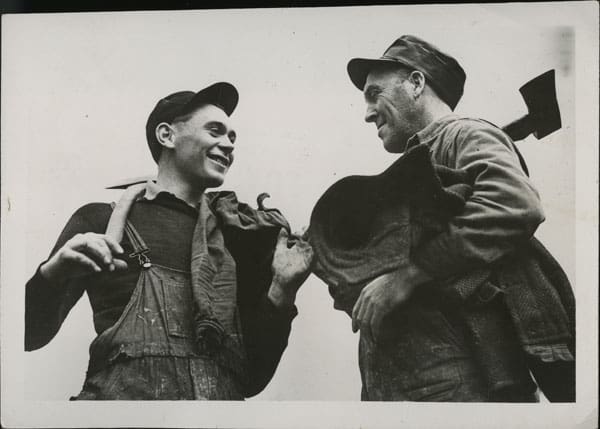
WITH THE LUMBERMEN IN ARGYLLSHIRE
The Daily News
November 30, 1940
Anxious to answer the appeal of their Mother Country, a party of Newfoundlanders came over immediately to help in the woods . . . . Arriving at Liverpool in January, they soon found themselves in the sparsely inhabited country on Lochaweside beneath the shelter of Ben Cruachan, still capped with snow.
In a few days the advance party had erected a log camp to hold the 45 men, complete with stables, etc., and even on the coldest days the huts were absolutely warm, the strongest winds being unable to penetrate the moss-filled walls.
Soon the axes were chipping away and what were recently dense plantations became tracts of laid timber, all in tidy rows, the tops and branches being burned as they worked. These trees were drawn to the saw bench by horses on a wooden sleigh-like contrivance known as a “go-devil,” then measured and cut to required lengths and stacked in graded heaps.
In early May came the “speed-up” order and a 12-hour day followed, including Sundays. The screech of the saw continued until after 8 o’clock on most evenings.
The songs and whistlings of the men as they laboured showed that they accepted the long hours and extra work in the right spirit though they were very pleased to get Sundays free again after a few weeks.
They found it very quiet and dull in their free time, far from any town or village, but fortunately May and June were so fine and hot that they enjoyed boating on the loch—all being completely at home on the water.
As their camp wireless announced the sinking of a ship, the capitulation of Belgium and the retreat from France, these strong men from overseas became anxious to take up arms. Some wanted to join the British Navy—in spite of the fact that the Government considered them more necessary in the woods—and when their six-month contract was completed on July 19th, a good many returned home, some to join up and others to rejoin their families, leaving their places to be filled by fellow countrymen.
LISTEN


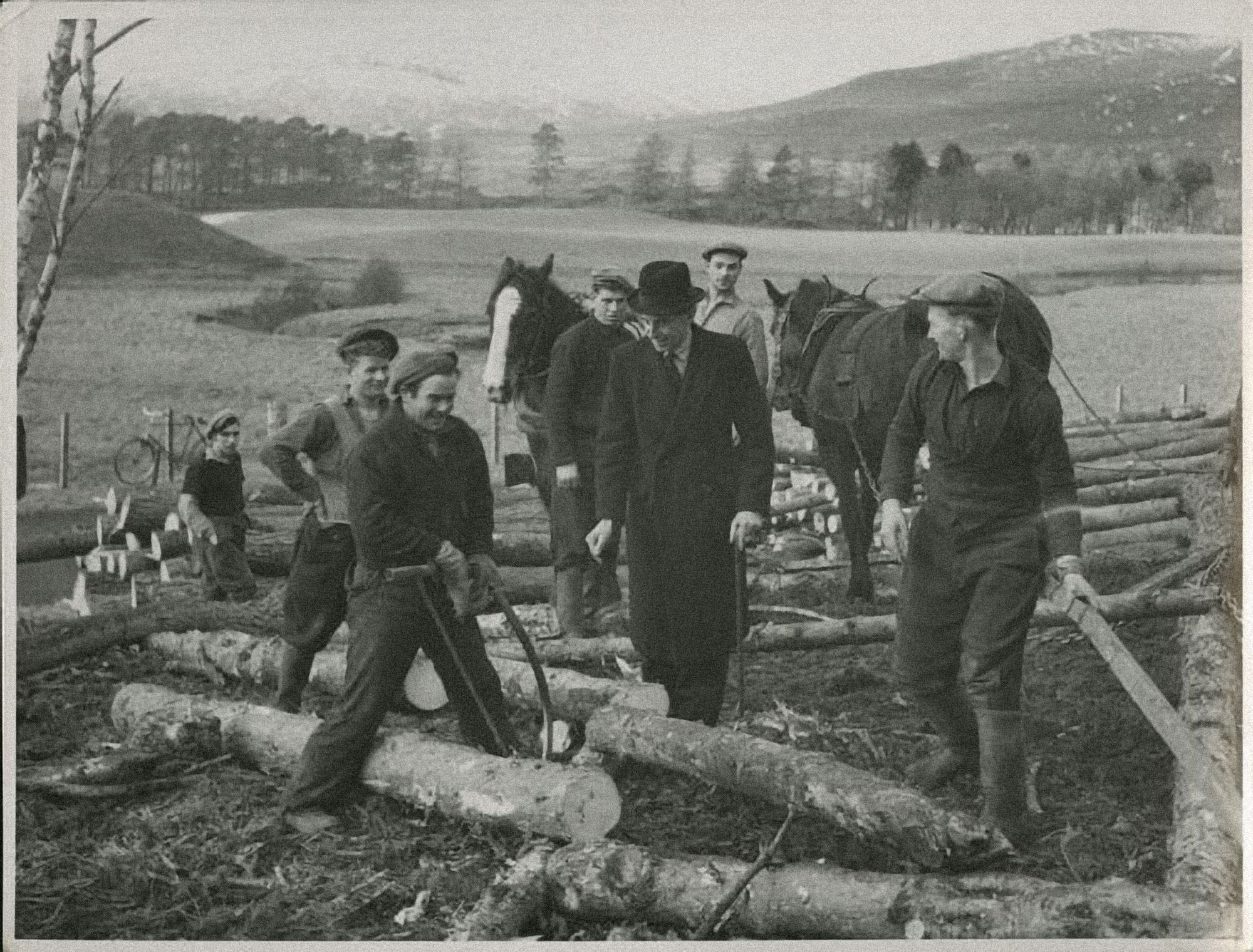
Nfld. Loggers Play Big Role In War Effort
Commissioner Penson Describes Visits To Camps In Scotland
Nfld’s Sacrifices Appreciated in Britain
Hon. J. H. Penson, Commissioner for Finance, last night delivered an address on the subject, “Britain Speaks to Newfoundland,” wherein he gave some interesting information as to the work being performed in Scotland by members of the Newfoundland Overseas Logging Unit.
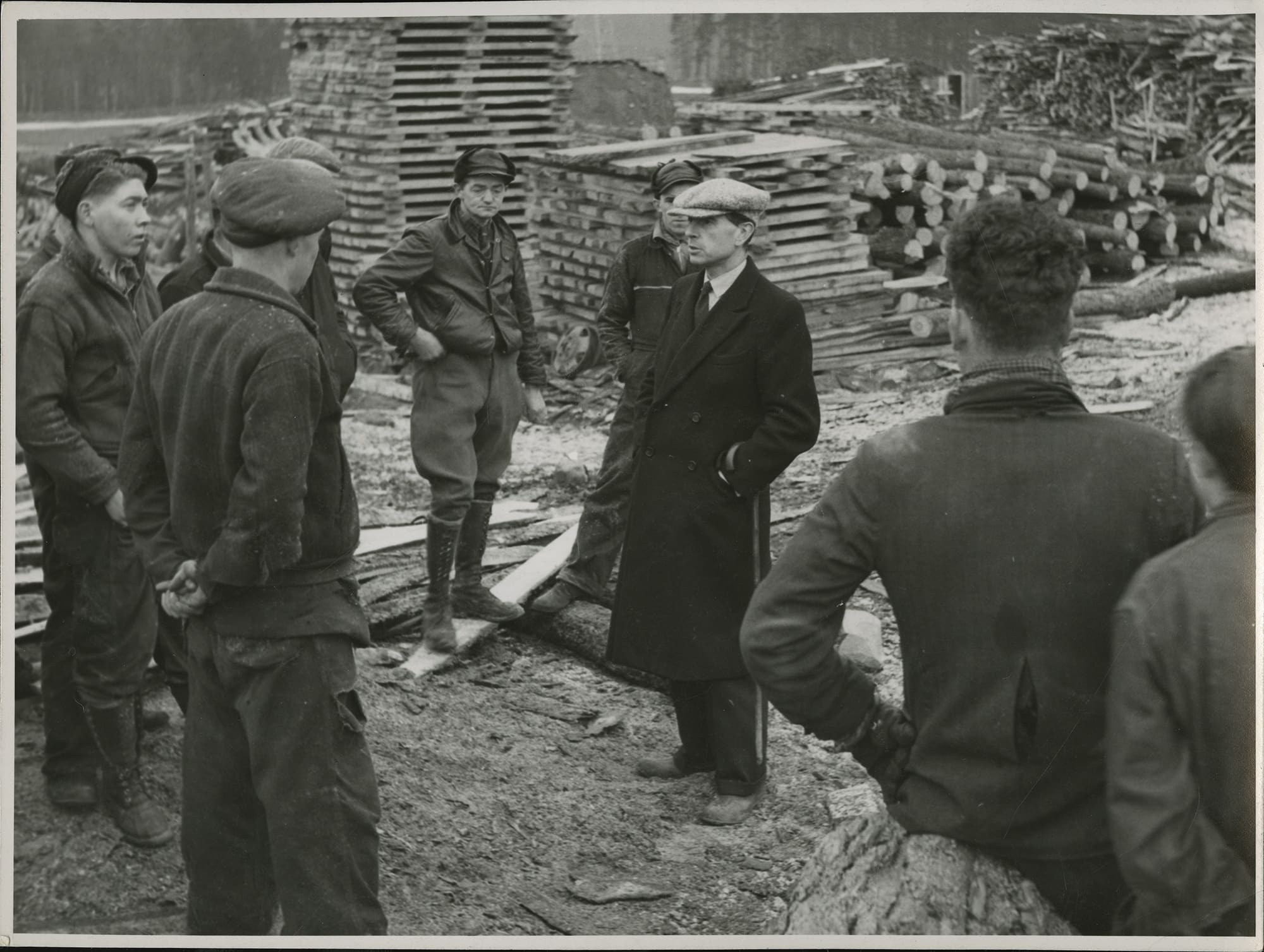

EXPRESSING EMOTIONS
As they did at home, the NOFU foresters relied on songs and rhymes to convey their feelings about their work life and to boost their morale. Several of these short rhymes were printed in British newspapers.
[These songs were] sung by the tough, expert lumberjacks from Canada, Newfoundland, Australia and New Zealand, whose camps with their log cabins and picturesque names have brought bustling activity to once-quiet woodlands.
“The trees we’ll use for coffins
For Herr Hitler and his crew,
And we’ll bury all the Nazis
So they won’t bother you.”
LISTEN
“My first twelve months overseas was in the New Forest, twelve miles from Southampton. There was plenty of action with the enemy. They would make their raids daily. In spite of the raid action, we would always go to Southampton on our weekends. We were only five miles from the English Channel. I was there when the Germans tried to invade England. It was like hell in the sky. I spent six months fighting fires that had been caused by incendiary bombs.”
as quoted in Hodge’s Cove by E. Stringer (2011)
OFFICIAL RECOGNITION
The UK’s Deputy Prime Minister, Clement Attlee, visited the foresters in 1942. He publicly praised their work and wartime contribution.
Out of a population of less than 300,000, over 10,000 [people from Newfoundland] have crossed the seas to take part in some form of war service . . . [i]n the Navy, in the Army, in the Air Force, in the Mercantile Marine, and in the Forestry Units . . . . Less than a fortnight ago I was able to visit some of the camps of the Forestry Unit that is doing a service no less vital to the war effort than those of the fighting men. Here again I saw a splendid lot of men fit and healthy and, I believe, happy. I had dinner in one of the men’s dining rooms and I can assure you that they are being well fed. I suppose that there is no part of the far flung British Empire which has a longer tradition of loyalty and service than Newfoundland.
The Daily News, September 18, 1942

A LETTER HOME
Very few letters sent home by NOFU men ever appeared in Newfoundland newspapers. This exception shows how overseas foresters tried to reassure friends and families far away. Note that the locations of NOFU camps were not disclosed for wartime security reasons.
“A nice country, but it can’t beat Newfoundland.”
April 3, 1940
“SOMEWHERE IN SCOTLAND”
Here I am in Scotland, the land of our forefathers, and I have to admit that it’s not so bad after all as to what I’ve seen of it. We are stationed at a country estate, and there is a quiet little village about three miles from our camp, where we often wander after work . . . .
All the boys are enjoying themselves, and I can tell you that the Scotch people are wonderful. Everything is done for our comfort and entertainment: canteens open, dance halls open, and every help is given to all.
I guess by this time a lot of our Newfoundland boys have joined different units and are away. “God speed and good luck” to them. Sorry that some of our boys that came with us are all split up in sections. There are only half a dozen or so here from our section of the Island “W.”
We haven’t had any experience with enemy aircraft as yet, although they were . . . quite near where we are situated . . . People in Newfoundland should count themselves lucky to be so far away from such things.
This is a nice country, but it can’t beat Newfoundland. There isn’t much more I can say only that I am fine and so are all the boys.
Best regards to all friends,
Sincerely,
HMG
LISTEN
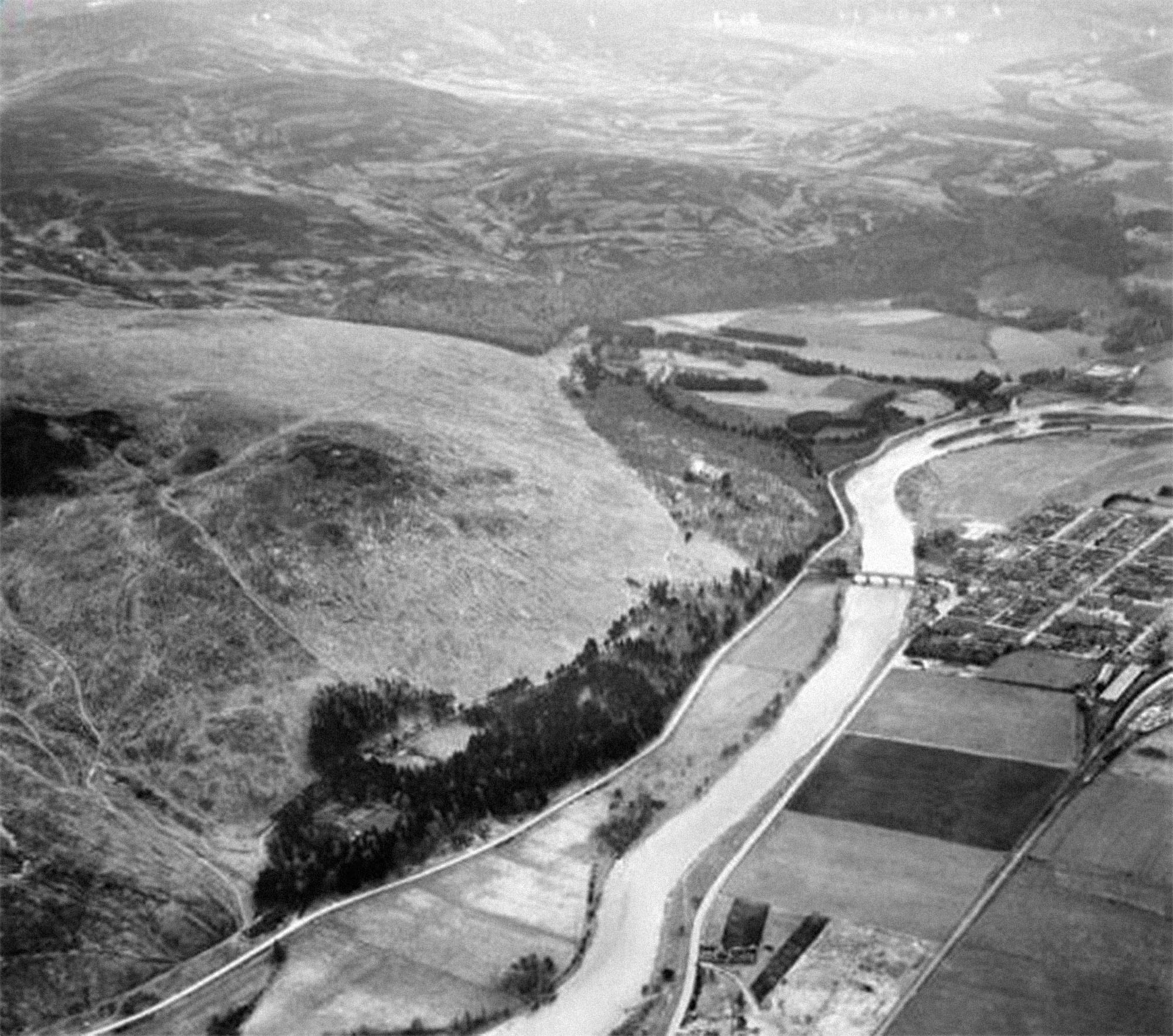
WE VISIT A SCOTTISH LUMBER CAMP
Journalist and science-fiction writer W.J. Passingham wrote one of the better-known accounts of the work the NOFU in Scotland. In this excerpt from it, he describes a camp near Ballater and the cutting taking place at Pannanich Hill. He also introduces us to Edgar Baird, one of the superintendents in the NOFU’s early years.
The Newfoundland lumberjacks have been cutting down about 3,000 trees a week, roughly 10,000 cubic feet of timber—for the British war effort during the first year of their work in the Scottish Highlands . . . . Mr. Edgar Baird, a manager of the Newfoundland Overseas Forestry Unit, was asked to establish his men in camps scattered about the Scottish Mountains where the great pines grow . . . . And today, a traveler out of Ballater, rounding the wide curve of this road, will come suddenly upon a scene he might well mistake for a typical Canadian lumber camp. There are log huts built by the Newfoundlanders, set in a forest clearing and exposed to the bitter weather on mountain sides, which for warmth and comfort surpass anything suburban builders have produced. Moss gathered from the forest is used to stuff between the rough-hewn logs and keep the huts draught-proof, and spending a few minutes inside them from the bitter weather one realizes that English and Scots alike have not yet learned how to keep themselves warm.
LISTEN
FORESTER BURIED IN SCOTLAND
July 31, 1943
The Western Star
The following is a report on the funeral of the late W.J. Mercer, received recently by the Department of Natural Resources from Forestry Unit Headquarters in Scotland:
The funeral of William James Mercer [NOFU #340], Mundy Pond Road, St. John’s, a member of the Newfoundland Forestry Unit, who met with a fatal accident at Granton Sawmill, (Grantown-on-Spey), took place at Carrbridge, Inverness-shire, on Saturday, 22nd May, 1943.
The procession started from Grantown-on-Spey at 11.30 a.m. under the direction of Mr. Leo Bruce, Regional Welfare Officer. The coffin, covered with the Newfoundland Flag and a large number of wreaths from Headquarters Staff, colleagues and friends, preceded the procession which was met at Carrbridge by Mr. A.M. Hart, Administrative Officer, Mr. Joe Curran, Technical Adviser (representing Captain Turner who was on leave at the time) and other senior officers and men of the Unit, who formed a procession behind the hearse to the church. The pall-bearers were eight colleagues from the deceased’s camp who carried the coffin into the church, preceded by the Minister, the Rev. Mr. Nelson, who conducted the service. After the service, the cortege proceeded to the cemetery where the coffin was lowered into a grave which is by the side of two other members of the Newfoundland Overseas Forestry Unit who lost their lives in the service of the Empire.
A headstone is being erected by the members of the Unit and this little plot in the Carrbridge cemetery will always remain sacred to Newfoundland.
William came to this country with the Newfoundland Overseas Forestry Unit three and a half years ago. He was well known and well-liked by all his fellow workmen. He leaves a widow and seven children in Newfoundland to whom the Officer-in-Charge, on behalf of his colleagues, extends deepest sympathy.

