

Second
World
War
WOODS
WORKERS
FOR THE
WARS

1939: A CIVILIAN RESPONSE
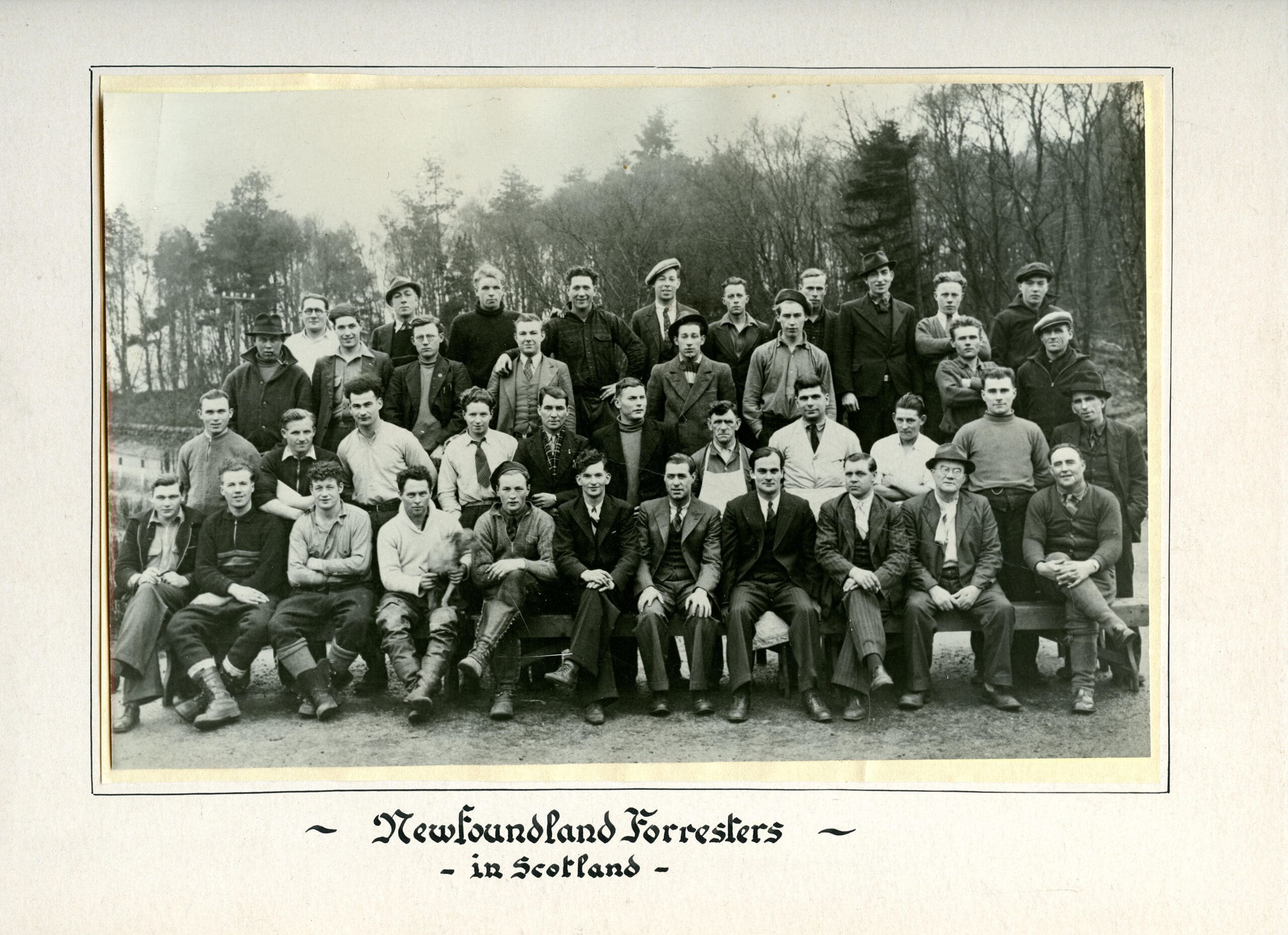
More than 13,000 people from both the island of Newfoundland and parts of Labrador enlisted in various capacities during the Second World War. The largest portion of them—about 3,600 volunteers—enrolled in the Newfoundland Forestry Unit, widely known as the Newfoundland Overseas Forestry Unit (NOFU). They served in both Scotland and England.
Separate from the armed forces, this civilian unit was created in fall of 1939. A few of its men were former members of the NFC, who stepped forward to support the UK as they had in the First World War.

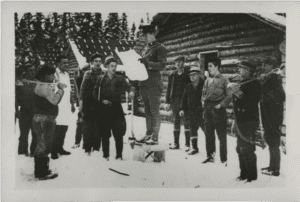
A Newfoundland Ranger (police officer) reads the Proclamation of War
to loggers at a camp in central Newfoundland in 1939.
Courtesy of The Rooms Provincial Archives Division, A7-166
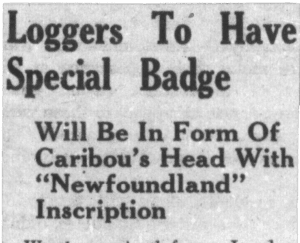
In this war, the foresters from Newfoundland were not in uniform. This badge identified them as members of the NOFU civilian volunteers. Its caribou emblem linked their service to the men of the First World War’s NFC.
The Western Star, Corner Brook, July 3, 1940
More than 2,100 woods workers answered the initial call for volunteers. Many of them had worked with one of the two major pulp and paper companies: the Anglo-Newfoundland Development Company (ANDCo) at Grand Falls and Bowater at Corner Brook.
When the unit’s first six-month contracts expired, many NOFU volunteers transferred to combat forces (especially the Royal Air Force) or returned to Newfoundland. In each of the following two summers, a repeat call for foresters went out and another 1,500-plus men enlisted.
The NOFU maintained a strength of more than a thousand members in every year of the war. Many of its men were in Scotland for the duration. These foresters were proud of their contributions and proud of the country they represented. At all of their camps they flew the Newfoundland Red Ensign, often on a flagpole topped with the symbol of the Royal Newfoundland Regiment of the First World War: a woodland caribou. They also sang the country’s anthem, “Ode to Newfoundland,” wherever and whenever they could, to boost morale and remind their hosts of who they were and from whence they came.
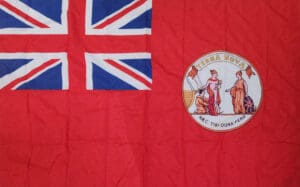
In 1904, the Newfoundland Red Ensign became the official flag for civilian ships and the “Ode to Newfoundland” became the dominion’s official anthem. The flag had no official status on land, yet it was widely adopted and flown from buildings and homes and at public events for many years. The flag pictured belongs to Michael Pretty of the Trail of the Caribou Research Group. It has been with him on visits to every grave, battlefield, and memorial site where people from Newfoundland and Labrador units have served: in seventeen countries across three continents.
Courtesy of Michael Pretty, Trail of the Caribou Research Group

Public notices like this one appeared in newspapers throughout the country. Recruiters also travelled widely to enlist volunteers.
Public Notice
Men Wanted for the Newfoundland Overseas Forestry Unit
His Majesty’s Government in Great Britain has requested that an additional four hundred men be recruited in Newfoundland forthwith for service in the United Kingdom with the Newfoundland Overseas Forestry Unit.
Full Details of the terms and conditions of service, to be incorporated in a contract which all men will be required to sign before being accepted, will be published as soon as possible. In general the terms are similar to the previous contract. The more important provisions of the contract will be:
- Men will be required to sign on for the duration of the present war and will not be allowed to transfer to any of H. M. Armed Forces or to any other unit. They may, however, be released from their contract, if their services can be spared, one year after the date of their arrival in the United Kingdom or at any time subsequently.
- Free transportation will be provided from Newfoundland to the United Kingdom; except in cases where men are dismissed for breach of contract they will be provided with free transportation back to their homes in Newfoundland at the end of their period of service.
- The basic rate of wages will be at the rate of $2.00 per day and found although piece work rates may be substituted. Men will be required to work not less than forty-eight hours per week. For time lost due to sickness half the normal rate of wages will be paid. Men will be covered by the provisions of the British Workmen’s Compensation Acts.
- Each man will be required to make payable to his dependents in Newfoundland an allotment equal to half his wages.
- No man will be accepted who has served previously in the Newfoundland Overseas Forestry Unit and who has returned to Newfoundland.
- Only men certified as physically fit for woods work will be accepted.
All applications must be made in person to recruiting officers; the names of these officers and the areas in which they will be located from time to time will be announced through the press and radio.
Department of Natural Resources
26th April, 1941.
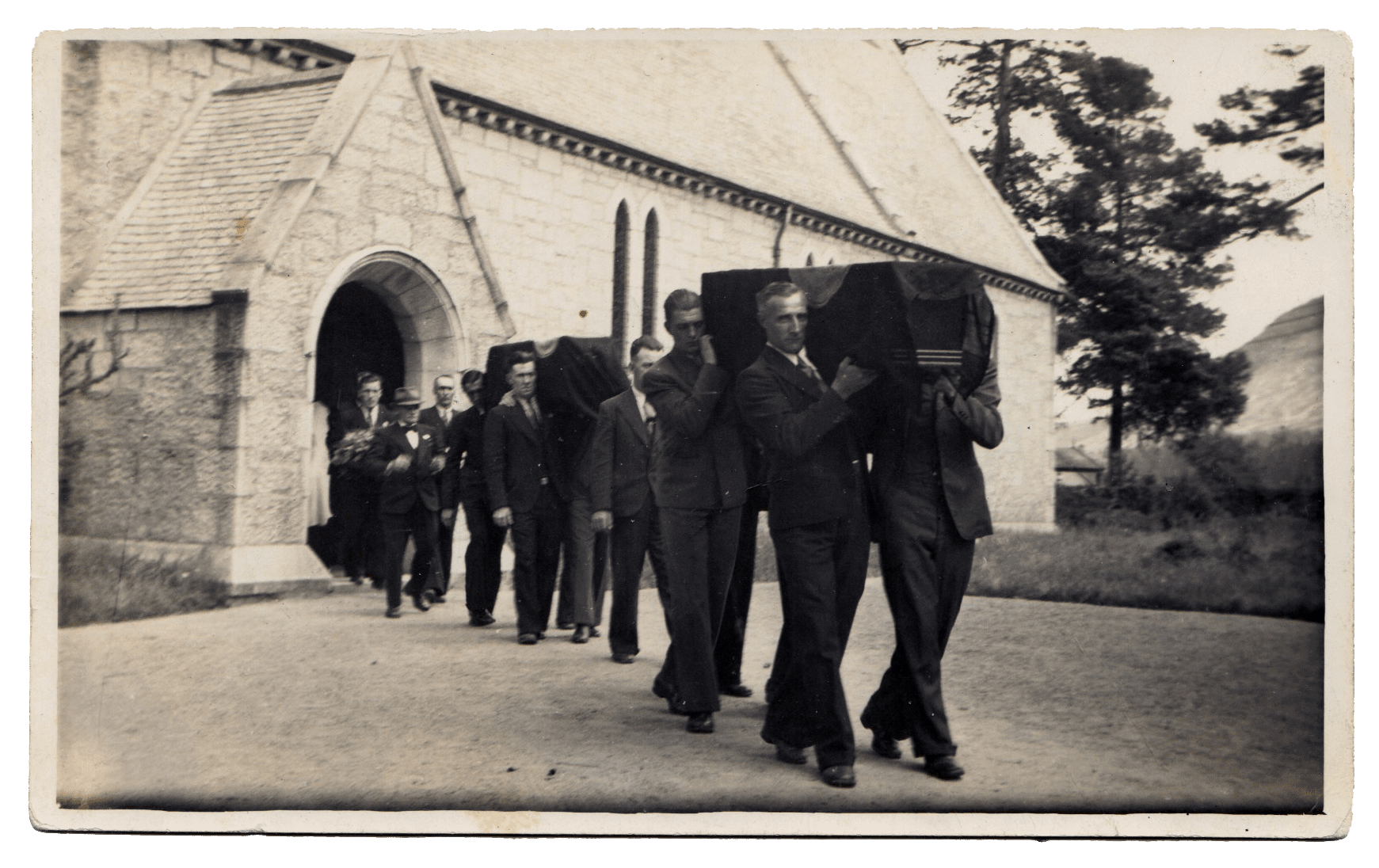
The coffins of Charles Short (NOFU #2557) and Cecil White (NOFU #2547), draped in the Newfoundland Red Ensign, are led from St. Kentigern’s Episcopal Church in Ballater, Scotland. Short and White were killed in a truck accident in 1941. They are interred at Tullich Old Churchyard, Glenmuick, Aberdeenshire.

Like most NOFU stationery, this notecard bears the unit’s Latin motto, which translates as “These gifts I bring to thee,” also used on the Red Ensign.
Look & Listen
THE FORESTERS’ SONG
On January 13, 1940, the third contingent of Newfoundland foresters departed Bay Bulls aboard the CPR liner Duchess of Richmond. Six days later they arrived safely in Liverpool. Many of the 409 NOFU men hailed from communities along the Southern Shore of Newfoundland’s Avalon Peninsula, including James Carew (NOFU #952) of Cape Broyle and Patrick Carew (NOFU #953) of nearby Admiral’s Cove. They composed “The Foresters’ Song,” a rare musical account of the experiences of the Second World War foresters.
“You’re welcome to this country from dear old Newfoundland.”
The video is a series of historic photographs and newspaper clippings illustrating the lyrics of the song. They include images of some of the Southern Shore communities, of men and the ships they travelled on, of fishing, haying and woods work, and of the camps and people encountered once the UK was reached. At the end the words of the final verse of the song (not sung) are shown. The song is performed in the video below by Pamela Morgan.
[A title slide shows the face of a round pin engraved with a caribou head in profile in the centre and the words Newfoundland Forestry Unit around the outside. Below the pin, the title of the video, The Foresters’ Song, is shown.]
[Flute and acoustic guitar]
There came a call from o’er the sea for lumbering men to go
To cross the briny ocean to test the German foe
Our wives and our sweethearts they did mourn as they stood on the pier
Lamenting for the ones they loved and they shed many a tear.
I say now, boys, you are called upon to go and do your part
As Newfoundlanders always did and we shall make a start
So cheer up boys and do your best while you are far away
And you’ll come back a credit to your countrymen someday.
It was for England in January from Bay Bulls we did sail
On a liner bound for English shore, we gave a hearty cheer
The passengers did line her deck and on us they did smile
Saying, “Here’s to the boys from Ferryland and some more from old Cape Broyle.”
We’re not forgetting Witless Bay and Bay Bulls, too, likewise
And bonny little Calvert sent forth her darling boys
We’re not forgetting Tors Cove and Mobile in our song
For all the boys who did come forth to answer duty’s call.
There’s one who comes from old Fermeuse who says he’s not afraid
Young Thomas Tobin was his name, a fisherman by trade
He bid “Adieu” unto his friends as he left home that day
Saying, “When I will return again, you will have in your hay.”
The rest that stepped on board of her all hailed from St. John’s town
Commanded by Captain Turner who never wore a frown
Saying, “I am going with the boys as I have done before
To show the spirit of the men from Terra Nova shore.”
There’s Torbay too included, who nobly did their part
They left their sweethearts on the shore all with a broken heart
We’re not forgetting the northern men, the mainstay of our land
The finest crowd of lumbermen that ever left this strand.
So now boys we are on our way to cross the ocean foam
To cut the trees in Scotland before returning home
So boys don’t be downhearted while crossing o’er the main
There’s lots of girls in Scotland to cheer you up again.
Now we’re gliding o’er the sea, the land is drawing nigh
A sharp lookout for German ships is watched by every eye
So thanks be to kind Providence, we’ve landed safe on land
And we danced the Stack of Barley and stepped out on the strand.
Now we’re seated on the trains, some heaved a heavy sigh
The girls stood at the station as we were passing by
They brought us lunch and gave us tea and took us by the hand
Saying, “You’re welcome to this country from dear old Newfoundland.”
Text shown on slide but not spoken:
Our six months now are drawing near and soon we will go home
Back to our wives and sweethearts no more from them we’ll roam
Composed by Jim and Pat Carew may the heavens on them smile,
For they are two among the few that came from old Cape Broyle.
Credits:
Produced by Ursula A. Kelly and Meghan C. Forsyth
Video Created by Diego Pani
2018
Arranged and performed by Pamela Morgan for Mentioned in Song: Song Traditions of the Loggers of Newfoundland and Labrador (Research Centre for the Study of Music, Media, and Place, Memorial University of Newfoundland, 2011)
Photos courtesy of Exporail-Canadian Pacific Railway Company Fonds, The Rooms Provincial Archives Division, UK Ministry of Information Photo Division, John Baillie and Forest Memories, Rhonda O’Keefe Arsenault and Diego Pani.
Logos: Memorial University; Research Centre for the Study of Music, Media, and Place; Social Sciences and Humanities Research Council of Canada; and Government of Canada

NEWFOUNDLAND OVERSEAS FORESTRY UNIT
This outline of the terms and conditions for volunteer enlistment with the NOFU appeared in several Newfoundland newspapers (in different versions) in the fall of 1939:
The British Government has requested Newfoundland to organize a civilian Forestry Unit of approximately two thousand experienced woodsmen to undertake the production of pit props in the United Kingdom.
The organization of the Newfoundland Forestry Unit has started today. As soon as a sufficient number of men are engaged, and sea transport is available, the first group will go over. Other groups will leave at short intervals. The whole unit must be at work in the United Kingdom at the earliest possible date.
The Forestry Unit will be self-contained. All members of the staff will be engaged in Newfoundland and the Unit will work under the direct control of the Chief Forest Officer, who will go to England with the first group. All jobs will—as far as possible—be filled from the membership of the Unit.
The terms of voluntary engagement are as follows
(1) Engagement will be for 6 months after sailing for the United Kingdom. Members will then have the option of returning home or of re-engaging for a further definite period or for the duration of the war.
(2) Free transportation to United Kingdom and free transportation home at the termination of engagement. Members incapacitated by sickness or accident to be brought home free of charge at earliest opportunity.
3) Men engaged with the Unit to be free to seek enlistment in any branch of the fighting services on giving reasonable notice.
(4) Basic rate of pay to be $2.00 per working day and found. Board, lodging and tools to be provided without charge. Subforemen and foremen to be paid at proportionately higher rates.
(5) Medical attention to be free. The provisions of the legislation governing Employers Liability and Workman’s Compensation Act to apply. That is, a member of the Unit is to be in the same position, with regard to compensation for injuries, as if he were employed by one of the local Paper Companies.
(6) All members of the Unit allot at least half their pay to next of kin, to be paid to them direct in Newfoundland. Variation may be made in special circumstances subject to approval.
(7) For working time lost on account of sickness, half the regular rate of wages to be paid. In all circumstances, allotment to dependants to be paid in full.
(8) Any man persistently misbehaving to be discharged and sent home at his own expense.
(9) Age limits to be from 18 to 50. In the case of foremen and staff, some variation may be made in special circumstances.
(10) Physical standard to be approximately that required in the woods operations of the Paper Companies. That is, a man must be bodily sound, with good heart and lungs, free from any form of skin or other contagious disease.
Engagement and Organization
(1) As far as possible, men will be engaged in groups of twenty or more from the same locality.
(2) After being accepted by a representative of the Unit . . . and passed by a doctor, men will sign an engagement contract, and will then carry on with their normal occupation.
(3) As soon as transport arrangements are complete, sub-foremen or foremen will be instructed to collect groups and will, at the same time, receive full directions for bringing them to the port in Newfoundland from which they will sail. As soon as a man is instructed by an official representative of the Chief Overseas Forestry Officer to get ready to move, he is considered as under orders.
(4) Only representatives of the Unit are authorized to engage men. In order to avoid delay, however, men wishing to engage may apply by letter or telegram to Newfoundland Overseas Forestry Unit, Department of Natural Resources, St. John’s
NOTE: It will save time if applicants can arrange to be medically examined in advance. If a man since June 1st, 1939, [has] been passed by a doctor authorized by either of the Paper Companies, his certificate will be accepted without further examination.
(5) Representatives of the Newfoundland Overseas Forestry Unit will visit as many places as possible immediately. Efforts will be made to keep the public informed of the movements of these representatives by means of the public message and by radio. Newfoundland Overseas Forestry Unit, Department of Natural Resources, St. John’s.
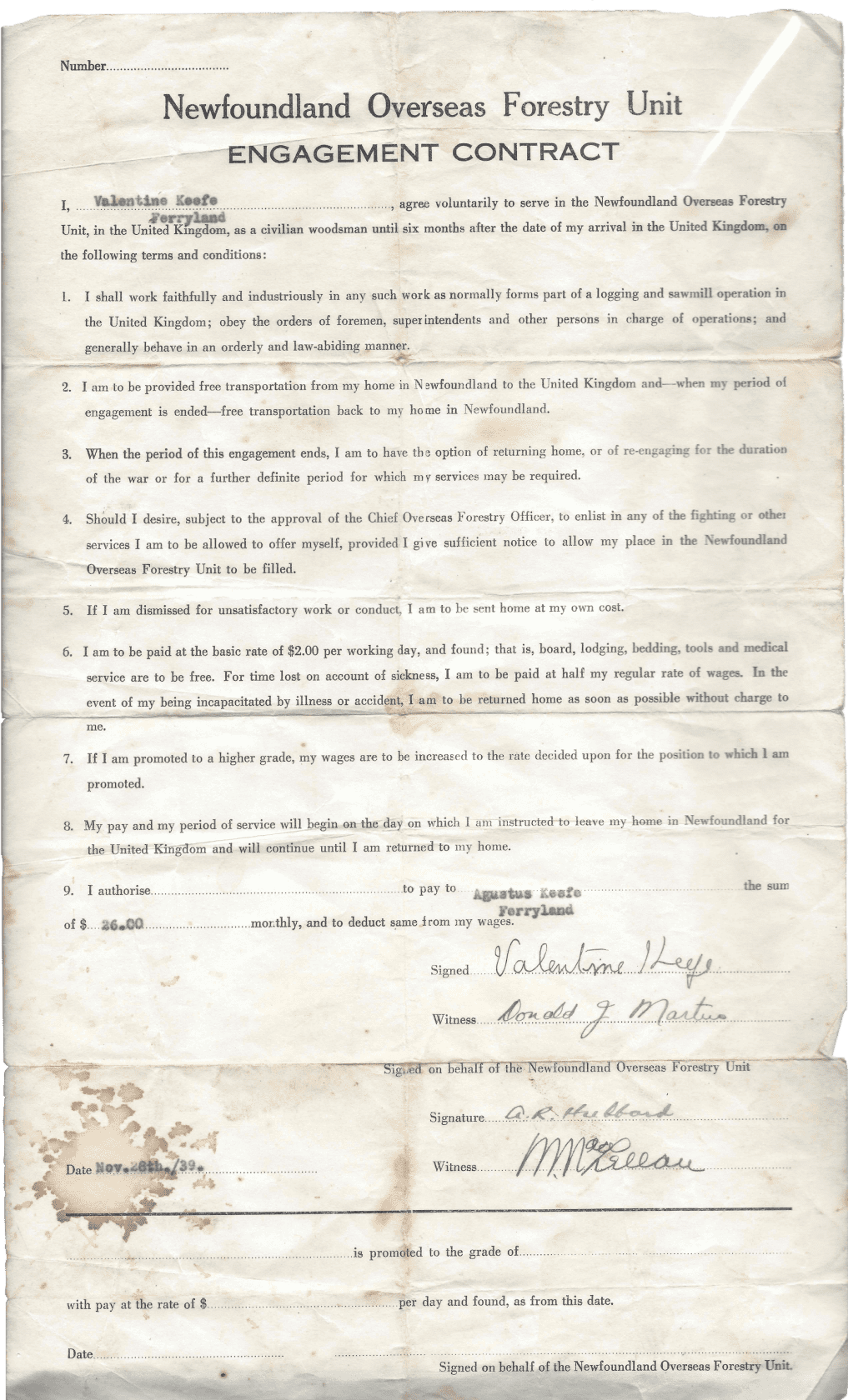
Valentine J. Keefe (NOFU #972) was among a couple of dozen men from Ferryland who volunteered for the NOFU in the fall of 1939. Keefe served with the unit until 1945. He is standing in back row, at left, with NOFU friends in Scotland, ca. 1942. Valentine Keefe died in 1990 at Ferryland.
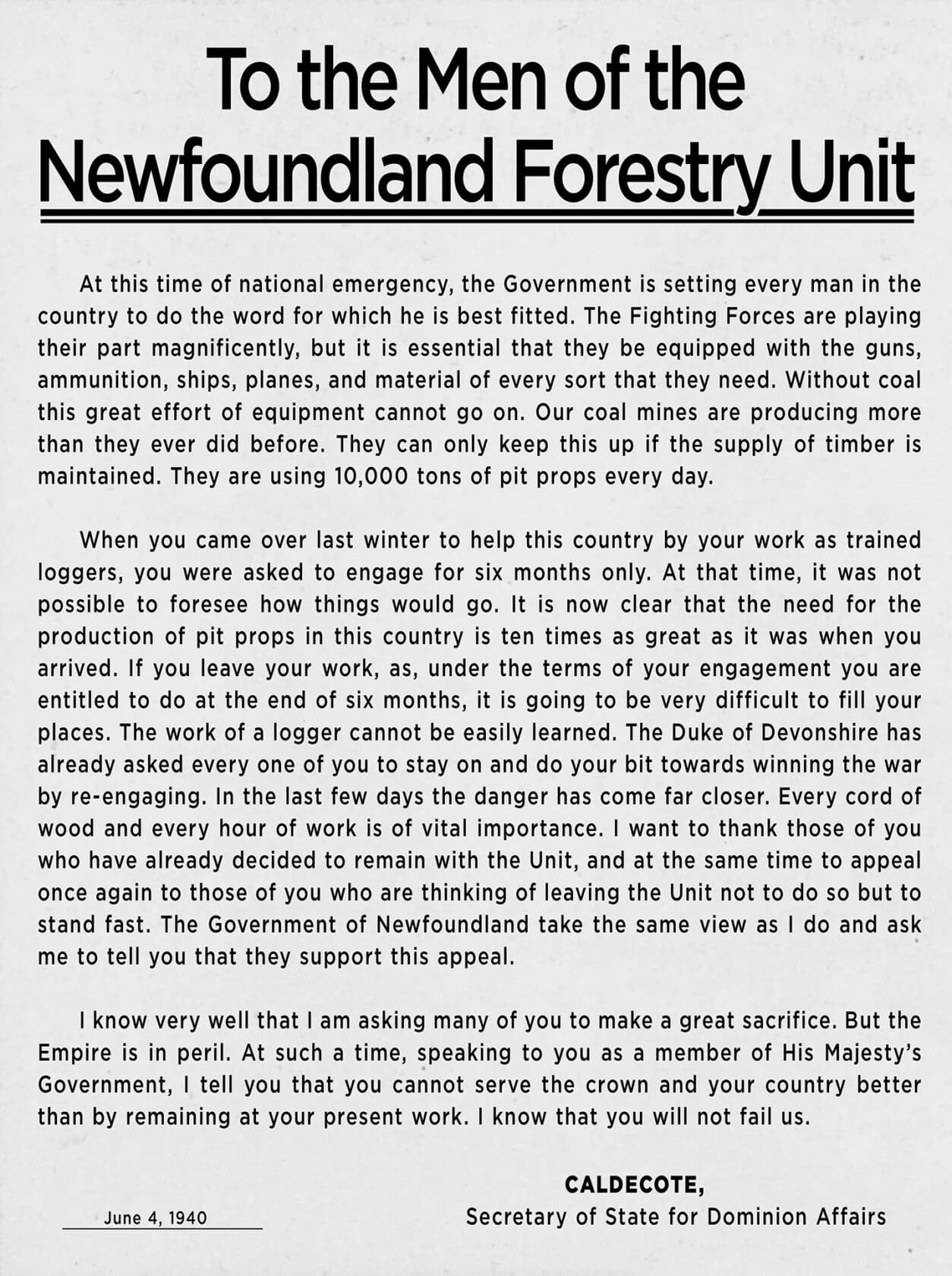
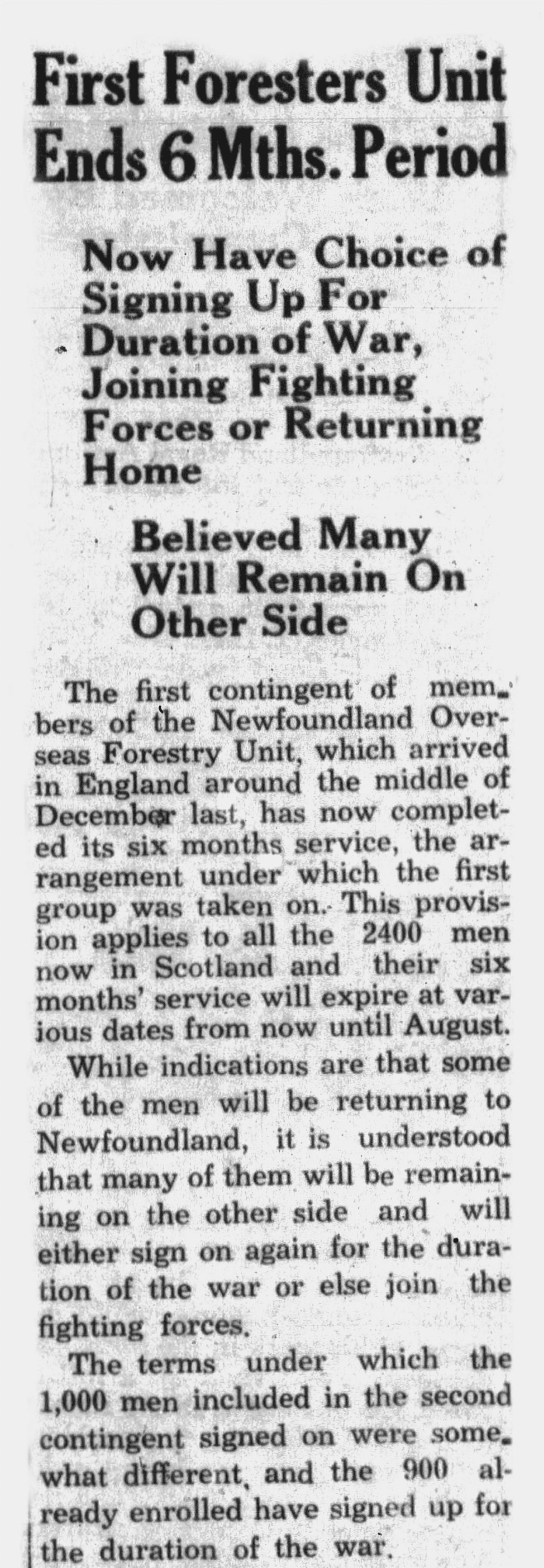
The terms of volunteering changed as the Second World War went on, as this clipping details.
To the Men of the Newfoundland Forestry Unit
At this time of national emergency, the Government is setting every man in the country to do the word for which he is best fitted. The Fighting Forces are playing their part magnificently, but it is essential that they be equipped with the guns, ammunition, ships, planes, and material of every sort that they need. Without coal this great effort of equipment cannot go on. Our coal mines are producing more than they ever did before. They can only keep this up if the supply of timber is maintained. They are using 10,000 tons of pit props every day.
When you came over last winter to help this country by your work as trained loggers, you were asked to engage for six months only. At that time, it was not possible to foresee how things would go. It is now clear that the need for the production of pit props in this country is ten times as great as it was when you arrived. If you leave your work, as, under the terms of your engagement you are entitled to do at the end of six months, it is going to be very difficult to fill your places. The work of a logger cannot be easily learned. The Duke of Devonshire has already asked every one of you to stay on and do your bit towards winning the war by re-engaging. In the last few days the danger has come far closer. Every cord of wood and every hour of work is of vital importance. I want to thank those of you who have already decided to remain with the Unit, and at the same time to appeal once again to those of you who are thinking of leaving the Unit not to do so but to stand fast. The Government of Newfoundland take the same view as I do and ask me to tell you that they support this appeal.
I know very well that I am asking many of you to make a great sacrifice. But the Empire is in peril. At such a time, speaking to you as a member of His Majesty’s Government, I tell you that you cannot serve the crown and your country better than by remaining at your present work. I know that you will not fail us.
Caldecote,
Secretary of State for Dominion Affairs
June 4, 1940
——–
First Foresters Unit Ends 6 Mths. Period (newspaper clipping)
Now have choice of signing up for duration of war, joining fighting forces or returning home
Believed many will remain on other side
The first contingent of members of the Newfoundland Overseas Forestry Unit, which arrived in England around the middle of December last, has now completed its six months service, the arrangement under which the first group was taken on. This provision applies to all the 2400 men now in Scotland and their six months’ service will expire at various dates from now until August.
While indications are that some of the men will be returning to Newfoundland, it is understood that many of them will be remaining on the other side and will either sign on again for the duration of the war or else join the fighting forces.
The terms under which the 1,000 men included in the second contingent signed on were somewhat different, and the 900 already enrolled have signed up for the duration of the war.
RECRUITMENT: AN ENTHUSIASTIC RESPONSE
Captain Jack Turner, Officer-in-Charge of the NOFU, was the main point of contact with the unit and the official source of information about it. This letter, prepared in early 1943, was the first of two published updates Turner sent home. By that time the unit had been in the UK for over two years. Turner’s second report (below) was issued at the end of 1945.
On November 10th, 1939, we were authorised to raise the Newfoundland Overseas Forestry Unit, for service in the United Kingdom. It was to be, as far as possible, a self-contained Unit, with a strength of approximately 2,000.
Recruiting started before the ink was dry on the papers which established the Unit, and so enthusiastic was the response, and so keen the desire of the lumbermen of Newfoundland to play their part that in two months the required number of members had been enrolled. The first draft of 300 was on the high seas in about a month, and the whole Unit— numbering over 2,000—had reached the British Isles in just over three months after recruitment. I am not sure that our first draft was the first Overseas Contingent to reach this side, but I am sure that it was among the earliest.
It may be worth mentioning here that, when the Unit was being raised, there was very little recruiting in Newfoundland for the Armed Forces. A few recruits were being accepted for the Navy; the Newfoundland Artillery Regiments were yet unborn; and no arrangements had been made for enlisting Newfoundlanders in the Royal Air Force. This, from the viewpoint of the Unit, was both good and bad. One result was that we got a large number of very good young men, who would have enlisted in the armed forces if this had been possible; this was all to the good. The other side of the picture was that many of these boys really used the Unit as a means of getting over to join up on this side.
I want to make it perfectly clear that they did not let the Unit down. They worked well and faithfully for the six months they had agreed to serve, but the minute that time was up they left us to take what they thought was a fuller share in the war effort. My best wishes go with all of them—I hear from some of them occasionally, and see some of them once in a while. Many, I shall never see again, but wherever the ships sail, or the planes fly, or landing parties rush the beaches, there will be found Newfoundland boys who crossed the ocean as members of the Unit.
– excerpted from The Western Star, Corner Brook, January 29, 1943
LISTEN
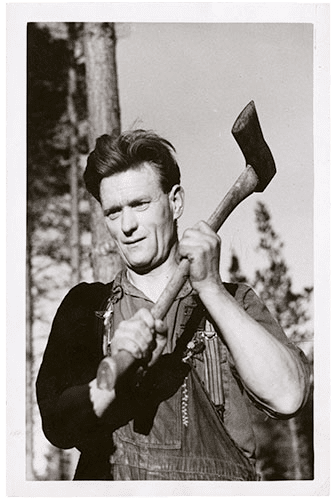
NOFU member with axe, ca. 1941.

A DUTY OF VITAL IMPORTANCE
By J. H. Gorvin, Minister of Natural Resources, Commission of Government
Let no one suppose that Newfoundland’s outstanding record written in the pages of British history, in the last war, have been forgotten by the Mother Country, or that Newfoundland’s readiness to live up to that record is ignored. Nothing would be further from the truth . . . This country is now called upon to undertake a duty of vital importance. His Majesty’s government in Great Britain has asked Newfoundland to send over, as quickly as possible, a large number of skilled woodsmen, to produce pit props from the forests of England and of Scotland. The excellent reputation established in Great Britain by Newfoundland woodsmen during the last war, and held ever since, has prompted the authorities of the Mother Country to call on Newfoundland now that timber is urgently needed for war purposes. Newfoundland is asked to raise and send to Great Britain immediately a civilian Forestry Unit of two thousand skilled lumbermen. Although this call was received only a few days ago, arrangements with the British authorities have now been worked out.
– excerpted from “Address to the Country”
LISTEN
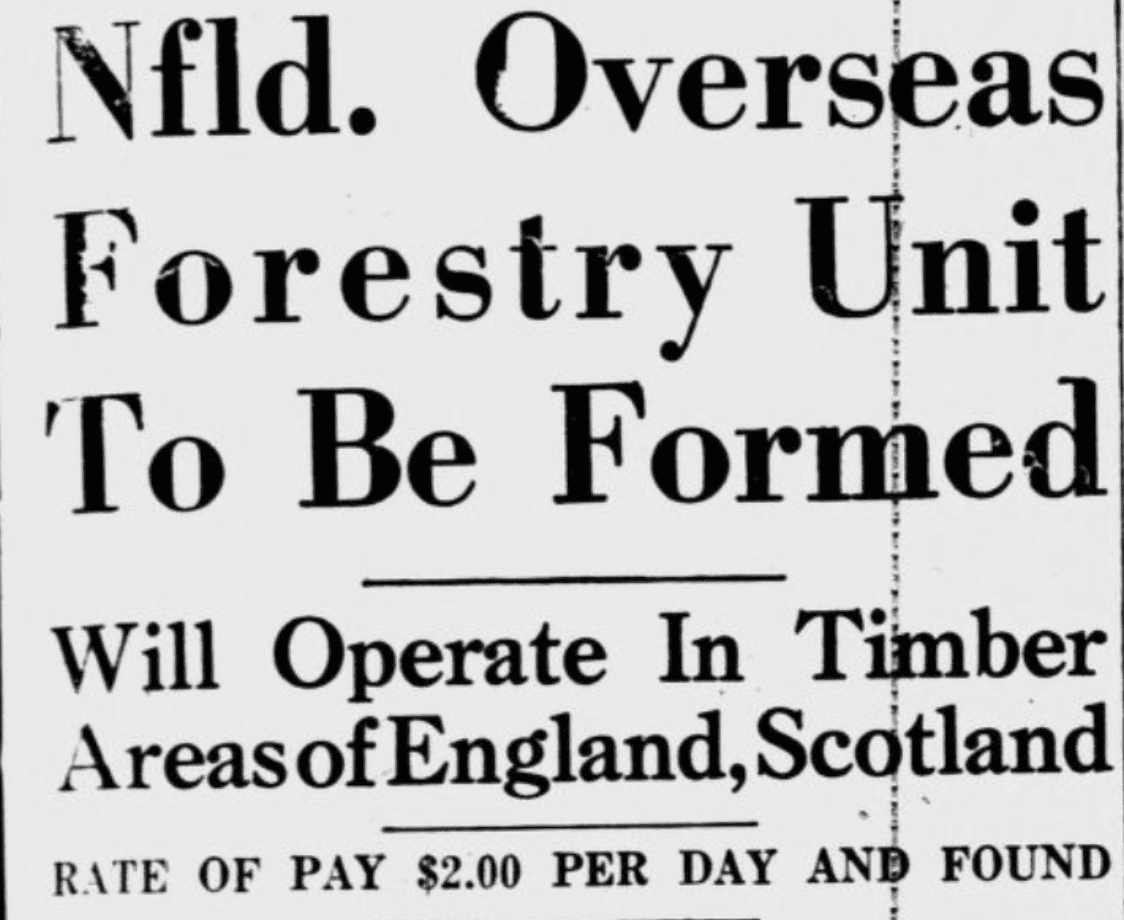
The NOFU was announced early in the war and the response was brisk. Men were eager to serve and only a small number of volunteers had signed up for the Royal Navy before the NOFU call was issued. Recruits for other service units would begin later in 1939 and into 1940.
–The Daily News, St. John’s, November 20, 1939
“THE BOYS FROM NEWFOUNDLAND”
This short ditty was recited often in the overseas woods camps and reprinted in several Scottish papers. In it, the foresters of the Second World War recall the Newfoundland Regiment of the First World War. It honours the courage of the men who fought with the Newfoundland Regiment and those who work on the seas. The SS Ranger, mentioned specifically, was owned by merchants Bowring Brothers and used in the country’s seal hunt for over seventy years. It was crushed in the ice off Change Islands in 1942.
Over there in ’14
The officers in command
Could not help but praise them up
The boys from Newfoundland.
Hitler needs a hundred-thousand men
And Chamberlain takes none.
I’d take the crew of the Ranger
And the battle would be done.
– reprinted from The Scotsman, April 4, 1941
LISTEN
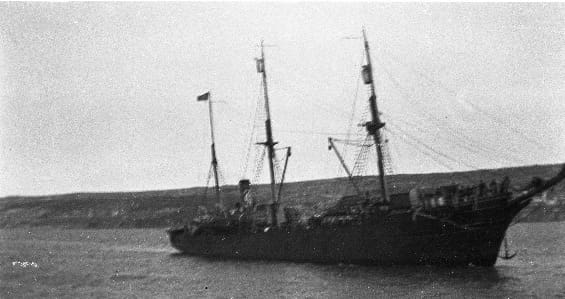
The SS Ranger steams into Harbour Grace, Newfoundland.
LEADING THE NOFU
John (Jack) Turner of St. John’s worked with both the Anglo-Newfoundland Development Company at Grand Falls and the Reid Newfoundland Railway before moving to British Columbia in 1911. During the First World War, he enlisted in the Canadian Expeditionary Force and in 1918 published a collection of his war poetry, Buddy’s Blighty and Other Verses from the Trenches. After the war he returned to Newfoundland and took up work as a forest surveyor and timber cruiser with the ANDCo.
In 1934, Turner was appointed Forestry Officer with Newfoundland’s Department of Natural Resources. In this position, he developed innovative and experimental logging, sawmilling and tree nursery operations at Back River and Deer Park. Among the men working with him were two brothers, Thomas V. and Joseph M. Curran of Gambo, Charles Cahill of St. John’s and Edgar Baird of Gander. All would be appointed to NOFU leadership positions in Scotland.
When war again ended, Jack Turner returned to his forestry position. He died suddenly in Ottawa in 1948, where he had been advancing forestry and forester concerns during negotiations about Newfoundland’s Confederation with Canada. He is remembered as an innovative, sustainability-minded forester whose efforts helped build modern forestry policies and practices in Newfoundland and Labrador.
Portrait of a Forester
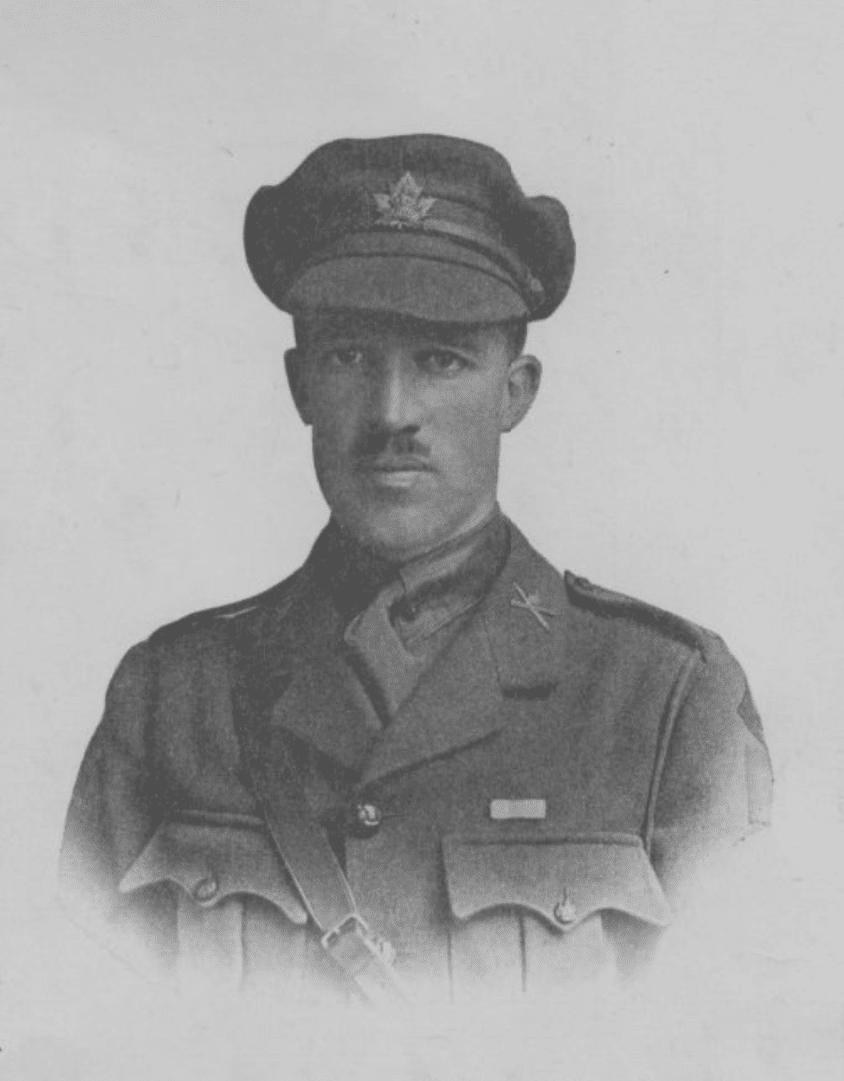
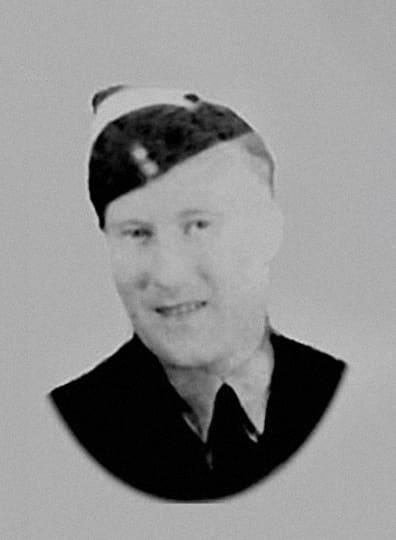
John A. Dumaresque (NOFU #3422) of Forteau, Labrador, worked for several years as a logger with the Labrador Development Company after it opened in Port Hope Simpson in 1934. He moved on to teaching on the Labrador Straits and the Great Northern Peninsula of Newfoundland. In 1941, he enlisted in the NOFU.
In Scotland, Dumaresque worked as a scaler at Camp C (#6) at Laggan, where he was friends with John Nick Jeddore (NOFU #3361). In his book, Moccasin Tracks, Jeddore described Dumaresque as a wonderful and knowledgeable man.
Like many who joined the civilian NOFU, Dumaresque was interested in military service and he enlisted in the Royal Air Force Volunteer Reserve, 622 Squadron, in 1943. An air gunner, Sergeant Dumaresque (#1827113) was killed on September 20, 1944, when the Avro Lancaster 1 he was aboard collided with another plane mid-air, near Wormingford, Essex. He was 26. He is interred at Cambridge City Cemetery, Cambridgeshire, England.
Look & Listen
NOT ALL THE WARRIORS IN THIS WAR WEAR A UNIFORM
Recreational activities in the camps were mood lifters, but there was perhaps no greater highlight in a forester’s day than a letter from home. In the early years of the war, all mail for forestry camps was sent first to the Office of the Trade Commissioner for Newfoundland in London, D. J. Davies. It was an epicentre of home contact for everyone serving overseas. This film clip shows the arrival and sorting of mail destined for the men of the NOFU plus an overview and images of men in a NOFU camp.
Watch this excerpt from “Newfoundlanders at War,” created ca. 1942 and narrated by Jack Murphy, Assistant Trade Commissioner, London.
“The Newfoundlanders came over in cities, and none of them have been more welcomed than the lumberjacks.”
This historic film opens with the words of its title and some credits. The first images are of soldiers (and women) sorting piles of mail, then carrying the bagged mail to a van. Scenes of camp life and men at work (with ponies and tractors) follow. The men are seen returning to camp, receiving their mail and posting letters of their own. The clip finishes with the men filing into the cookhouse for a meal, stealing glimpses at the camera.
[Music: choir of men singing “Ode to Newfoundland”]
Text shown on screen:
Newfoundlanders at War
Commentary spoken by Mr. Jack Murphy
Assistant Trade Commissioner
NARRATOR:
Two thousand miles away you stamped your letter and sent it off.
It came out of the bag in Newfoundland’s corner of London.
The Newfoundland boys who sort the mail in the London Office of Newfoundland’s Trade Commissioner are as keen that it should go quickly on its way as you are.
They recognize many of the names.
Readdressing a letter to a pal is the next best thing to getting a letter yourself.
News from home and parcels from home are the greatest events in the lives of the ten thousand men who were sent out of Newfoundland’s 300,000 population.
Almost as quickly on their way are the comforts that come in generous shiploads.
Trade Commissioner Davies takes a personal interest in their distribution.
It occasionally rains in London, just as it does at home.
But the mailmen would gladly carry all the paper turned out at Grand Falls and Corner Brook in the bags His Majesty’s post office distribute to the seamen, the airmen and the soldiers.
[Music plays]
Not all the warriors in this war wear a uniform.
The Newfoundlanders came over in cities and none have been more welcome than the lumberjacks.
Your letters find them in a place very much like parts of Newfoundland.
Even the names of their neighbours in Scotland are familiar.
There are the same Bairds, McPhersons, McFarlands and McIntoshes.
The same mist, the same rocks and the same machines doing the same work.
[Music plays]
It might be the making of a Newfoundland airport all over again.
Horses do their bit too, to save petrol, and axes swing with the same force behind them. [sound of axe chopping]
Cutting and felling are war jobs Newfoundlanders do well. [sound of two men sawing wood and tree falling in a forest]
The lumberjacks’ quota in Scotland is always well above schedule. The tractors they use are much the same as those back home. The methods they use are just the same and the number of logs hauled up to the mill total up to a mighty war effort.
[Music plays]
Camp isn’t such a bad place when they are through the day’s toil.
Open air work gives an appetite, both sides of the Atlantic.
Good meals are awaiting and there is always a chance of a letter.
[Music plays]
They don’t waste much time in sorting the mail and reading it when it arrives in the logging camp. News from home is news from home, even if it is printed in the local paper. After all, there is nothing like a Births, Deaths and Marriages column to keep a man informed.
[Music plays]
The camp letter box works overtime on mail night, but even the mail bag must wait for those last kisses and S.W.A.K. messages, and the postscript to mother, not to forget the cigarettes.
[Lively band music plays]
Cookee’s pies won’t wait either.
And the boys do pretty well, though they do miss home cooking.