

Second
World
War
AU REVOIR
AND A
SAFE RETURN

SHIP AFTER SHIP
Volunteers sailed overseas from various ports, sometimes in convoy. The first contingent of the Newfoundland Overseas Forestry Unit—300 men—left St. John’s in December 1939. Four more contingents followed in January and February, until the promised unit was intact.
A second recruitment drive in the spring of 1940 resulted in an additional thousand recruits. They were similarly sent over in four groups. These men boarded ships in Botwood, Montreal, Halifax, and St. John’s.
A final group of 400-plus recruits enlisted in the summer of 1941. It, too, was split in two for travel overseas, half sailing from Montreal, the rest from Halifax.

Initial draft, 1939
- 300 men on RMS Antonio arrive Liverpool, December 18
Remainder of first recruits, early 1940
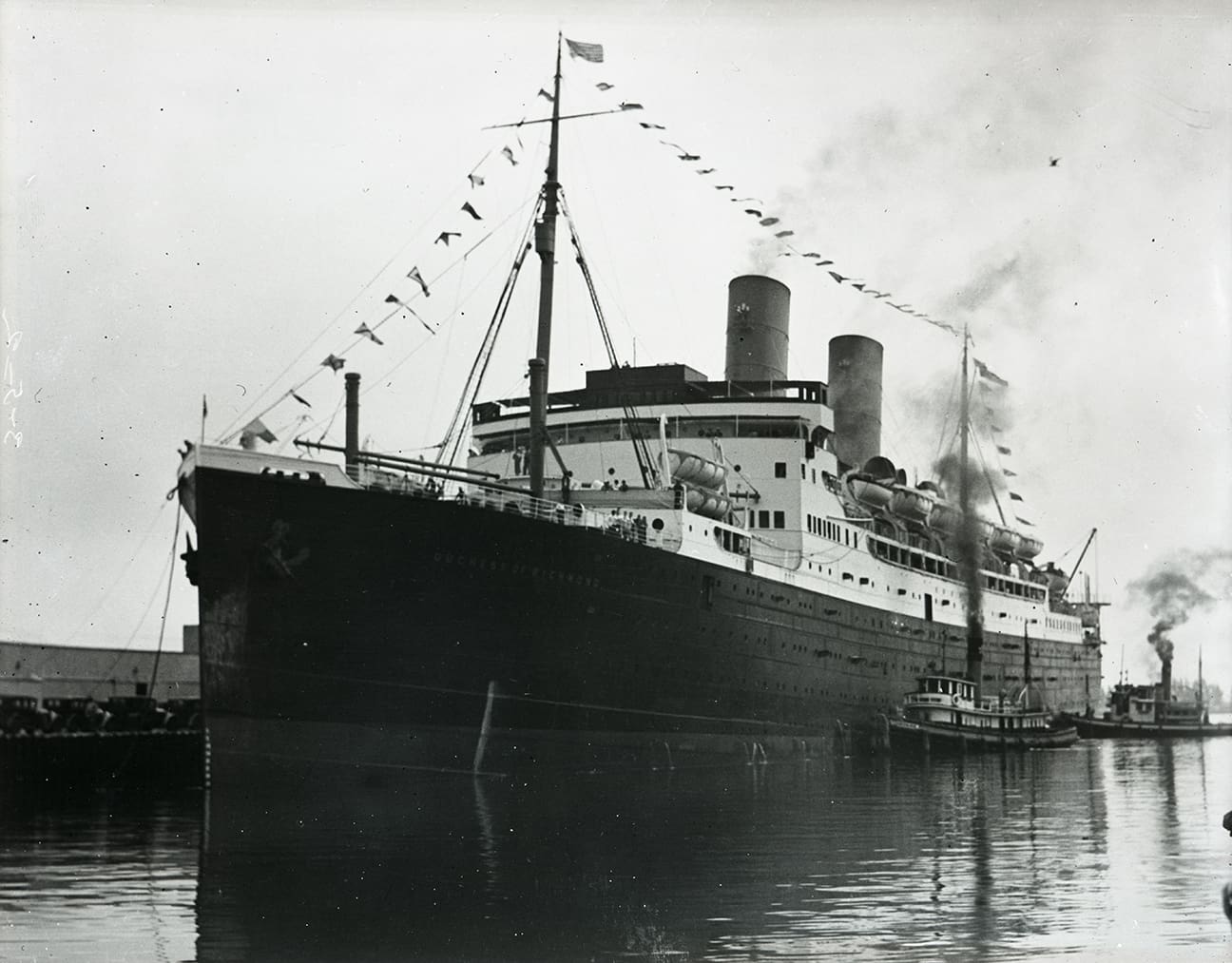
- 409 men on SS Duchess of Richmond arrive Liverpool, January 19
- 304 men on RMS Antonio arrive Liverpool, January 23
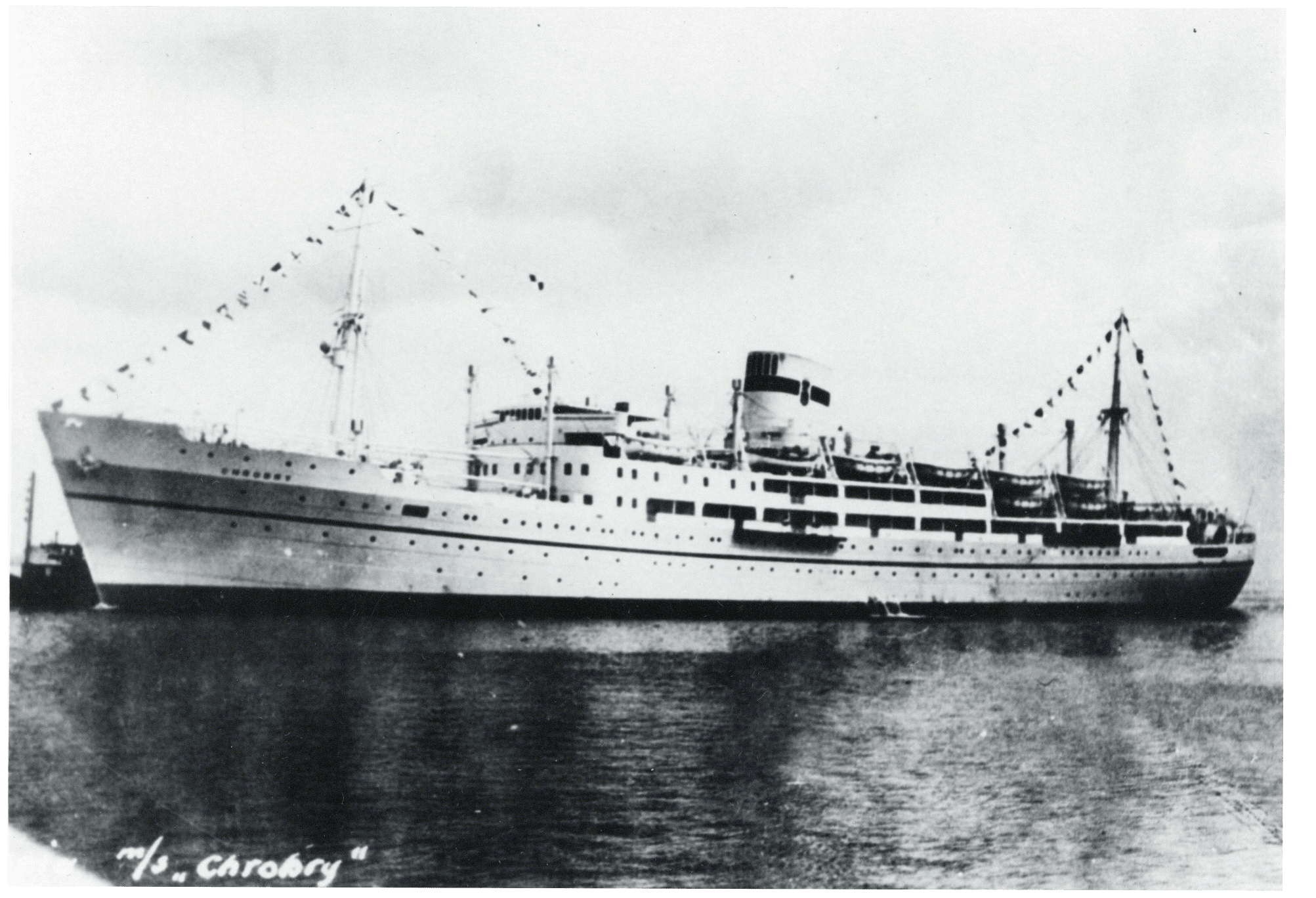
- 963 men on SS Chrobry arrive Firth of Clyde, Glasgow, February 8
- 174 men on SS Duchess of Richmond arrive Liverpool, February 12
Second recruits, summer 1940
- 205 men on RMS Antonio arrive Liverpool, July 14
- 203 men on SS Duchess of Richmond arrive Liverpool on July 19
- 204 men on RMS Scythia arrive Liverpool on July 24
- 392 men on SS Ettrick, arrive Firth of Clyde, Glasgow on August 17
Final recruits, summer 1941
- 251 men on SS Mendoza arrive Liverpool on July 28
- 191 men on SS Svend Foyn arrive Liverpool on August 7

Look & Listen
CONVOY TO SCOTLAND
Angus Temple (NOFU #1379) of Sunnyside, Newfoundland, was among the NOFU recruits who sailed from St. John’s on the MS Chrobry in January 1940. His poem “Convoy to Scotland” is a tribute to the foresters with whom he travelled. It was included in his first published poetry collection, The Punt with the Brin-Bag Sail.
At the end of his six-month contract with the NOFU, Temple transferred to the British Army Pioneer Corps. He survived the war, settling afterward in Oldham, the hometown of his new English wife. Angus Temple died in 1998.
The video is a series of historic photographs and newspaper clippings illustrating the words of Angus Temple’s poem. It includes images of several towns the men came from, ships assembling in St. John’s and Halifax for the convoy trip across the Atlantic, arrival in a busy harbour, forestry camp buildings, and foresters at work and socializing.
Convoy to Scotland
Angus Temple
Come all you Newfoundlanders
Who sailed away with me
Way back in 1940
Across the briny sea.
And see if you can still recall
As I recall today,
The day we sailed from Newfoundland
To Scotland far away.
’Twas at the start of World War II
When England in distress,
Called out for Newfie lumberjacks
The bravest and the best.
It seems they needed wooden poles
To drive into the sand,
To build a sort of barricade
Should the Germans try to land.
The call for help was answered
And soon we made our way,
The young and old—the large and small
From every cove and bay.
We gathered at our starting points
Along the railroad track,
And once we got on board the train
There was no turning back.
From Port-aux-Basques to St. John’s town
We slowly made our way,
We sang and joked all through the night
And halfway through next day.
A thousand voices split the air
As we got off the train,
And stepped out into the fog and slush
And good old St. John’s rain.
I guess we had a mid-day meal
But what I can’t recall,
But being Newfoundlanders
I bet we ate it all.
We had to have a medical
And when we asked them why,
The doctor said we must be sure
That you are fit to die.
We got our passport photograph
And our five-dollar bill,
And as I have a Scottish name
I guess I’ve got mine still.
We went down to the dockside
As it was growing dark,
And for our journey overseas
Were ordered to embark.
We sailed out through the narrows
Beneath the darkening skies,
And our last look at Newfoundland
Was seen through misty eyes.
The ocean lay before us
With danger all around,
And yet not one downhearted man
Among us could be found.
For in the faith by which we lived
We trusted God’s right hand,
To guide us through the perils of the war
And bring us safe to land.
As we sat for our evening meal
Our journey had begun,
And through the night to Halifax
We made a steady run.
We waited for the convoy ships
That shortly we would join,
It took at least a day or two
To get them into line.
The waiting soon was over
And we were on our way,
Across the broad Atlantic
To Scotland far away.
For seventeen long days we sailed
With U-boats ever near,
But we were having so much fun
We had no time for fear.
At last we reached our journey’s end
And sailing up the Clyde,
With something new around each bend
Our joy we could not hide.
We shouted Newfie greetings
To every Scot we saw,
They shouted, “Go home loonies
Ye dinna look so braw.”
We spent a night in Gourock docks
But early the next day,
To our appointed lumber camps
By coach we made our way.
Before we left the dockside
Some newsmen from the press,
Came down to snap the lumberjacks
The biggest and the best.
We had some hefty fellows
Among our gallant crew,
We all tried hard to get a place
But they said ten will do.
We tried to stay together
With friends of childhood days,
But orders had been given
Which sent us different ways.
The order was a harsh one
And caused a lot of pain,
As life-long friends were parted
Never to meet again.
From Scotland South to Scotland North
The lumberjacks did go,
And with the axe and bucksaw
The Scottish pines laid low.
From early morn to nine at night
Our saws were never still,
We often turned a forest tall
Into a desert hill.
And when the day’s work ended
We didn’t go to bed,
We changed our clothes, got on our bikes
And went to town instead.
We found the Scottish people
So very like our own,
Big-hearted, kind and gentle
They made us feel at home.
But that was many years ago
And I am sure, like me
You’ll not forget the days we spent
Across the briny sea.
Good luck to all survivors
Wherever you may be,
Long may you live and still recall
That convoy trip with me.
Credits:
Produced by Ursula A. Kelly & Meghan C. Forsyth
Video by Diego Pani
“Convoy to Scotland” by Angus Temple
Narrated by Clar Doyle
Photos courtesy of The Rooms Provincial Archives Division, Eric and Gerri Beckett, Elmo Baird Family, Rhonda O’Keefe Arsenault, Geographical Magazine, National Archives of Canada, Joan Dyson, Archives and Special Collections (Memorial University Libraries)
Newspaper clippings courtesy of The Western Star, The Daily News
2023
Logos: Grand Falls-Windsor Heritage Society, Memorial University and Digital Museums Canada
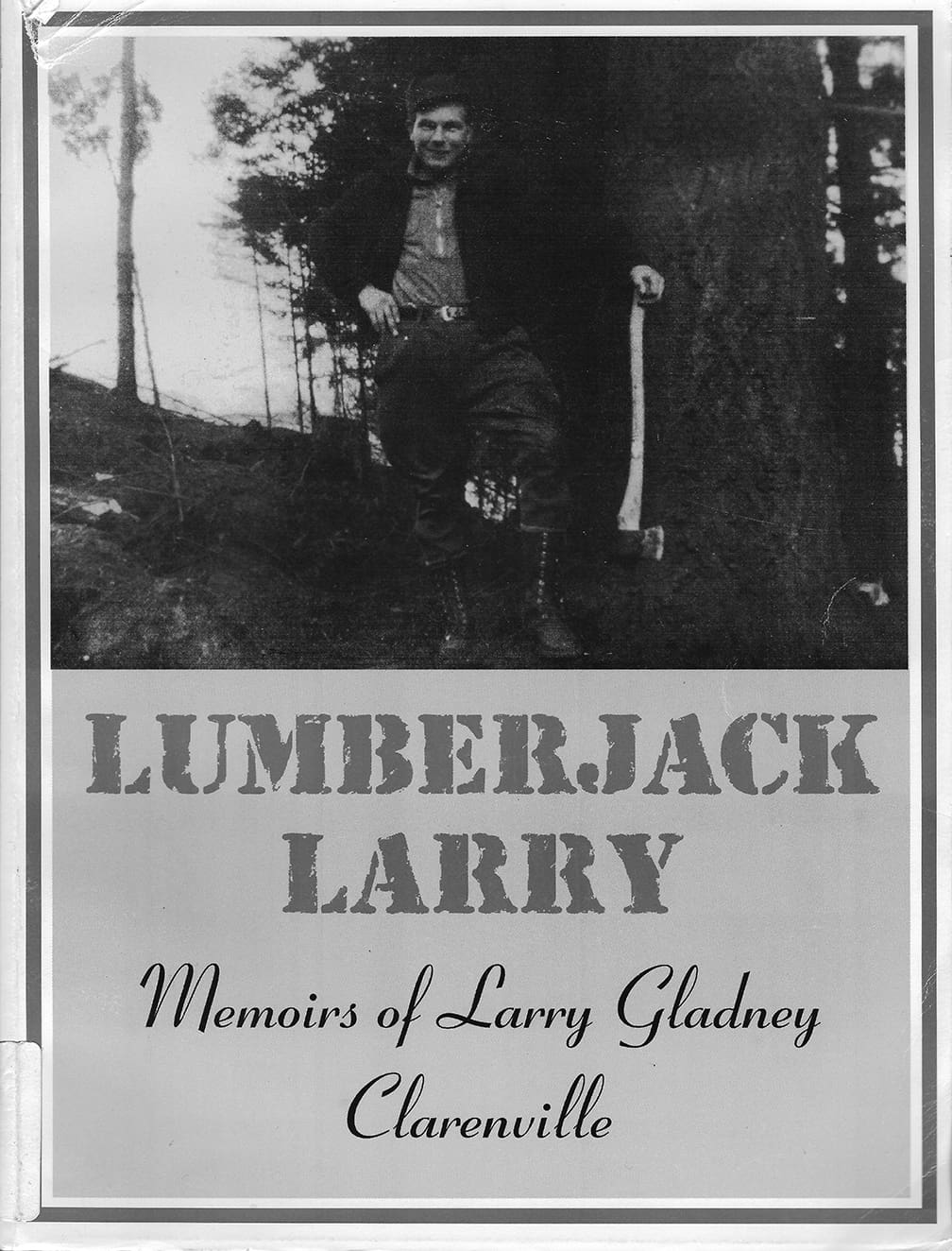
Portrait of a Forester
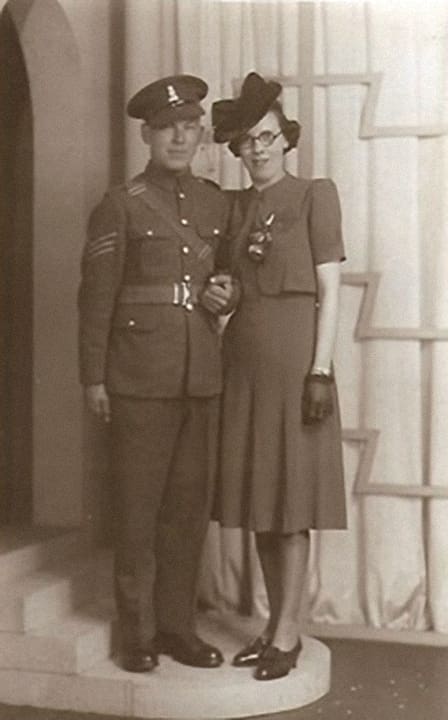
Brothers Lawrence (Larry, #1901) and Michael (#1900) Gladney enlisted in the NOFU together in 1939. Larry served overseas until the war ended, but Michael died in late 1940 of injuries sustained in an accident while loading logs at Loch Laggin.
Larry Gladney had worked at several logging operations, including the Labrador Development Company at Port Hope Simpson in the years before the war. In 1941, he married Jean MacPherson of Glasgow. They returned to Newfoundland after the war and lived in Clarenville. Gladney published his memoir Lumberjack Larry, which includes an account of his time overseas, in 1999. He died in 2007 at Clarenville.
OVERSEAS TRAVEL
By Larry Gladney
On the night of January 21st, 1940, a special train had gone to Bonavista to start picking up the men that were going overseas in the Forestry Unit. We had been given a big party in the Orange Hall, and most of the boys saw their favourite girl home that night with tears in their eyes. I went home with two kissing cousins, June and Norma Tilley. June gave me her Girl Guide pins and I still have them after all these years.
Somewhere around 2 a.m. the train left and we were on our way to join the ship that would take us somewhere in the British Isles. As we drove down Water Street, flags were flying and the street was lined with people wishing us “God Speed” at the Furness Withy Pier. We were given five dollars as an advance on our pay of fifty-two dollars a month. At least twenty-six dollars of it had to be signed to our next-of-kin in Newfoundland. A motor boat brought us out to the ship that was to take us, the MS Chrobry. She was from Poland and was the biggest passenger ship I had seen up to that time.
I was shown the room that I would be sharing with nine other fellows, and given the number of my lifeboat station and a slip telling me when and where meals would be served. We were also told the time the canteen would open, but as I didn’t drink and had no money, I had little interest in the canteen. I was interested in the ship and its crew. I learned from one of the Polish crew Chrobry had been built in Gdynai, Poland, and was only six months old. She had beaten the German blockade and went to England.
That night, the Governor, Sir Humphrey Walwyn, came aboard telling us how proud both he and our country was to see us going to help our Mother Country and he wished us “God Speed” on behalf of the people of Newfoundland.
On deck the next morning, we had to shovel about two feet of snow that had fallen overnight before we could sail. There was a storm of northeast wind as we sailed through the Narrows and headed to the Atlantic Ocean.

I was asked if I would go flashlight guard. There was one posted at the foot of all stairways leading to the deck in case we hit a mine or got torpedoed. I volunteered for the shift between Midnight and 4 a.m. We reached Halifax without incident. We loaded supplies, mail, and water. Next day, we sailed under escort in the convoy with the Empress of Australia, Empress of Britain, Monarch of Bermuda, and the Aquitania and consisting of the following warships escorting us from Halifax to the mid-Atlantic: the Ottawa, Restigouche, Fraser, St. Laurent, Valiant, Malaya Enterprise, and Hunter.
In mid-Atlantic, they came back and the following took over and protected us the rest of the way across: the Fury, Kingston, Diana, Kelvin, Fame, and Faulkner. The Commander of the convoy was on board HMS Valiant and the Vice-Commander was on board the Aquitania.
Captain F. H. Darchokovski of our ship, the Chrobry, told us one day that more food had been eaten on our ship than on any other in the convoy, even if there had been a thousand plates broken in the one roll.
The sea burst in a porthole over the night and another night it was so rough one of the other ships sidled into us and caused our cargo to shift. It didn’t take the crew long, with the help of lumberjacks, to get it all stowed and tied in place again.
The most discomforting thing about the trip, to my mind, was the drinking water, which was warm and tasted terrible. Every day, sometimes twice a day, we were given lifeboat drills. One day, as we neared the coast of Ireland, we were told there would be no more drills and if the signal was given by the whistle it would be for real.
Shortly after I had been in my berth, I heard the signal in the whistle that meant “man the lifeboats!” I had been asleep and when I woke there wasn’t a man to be seen. I said to myself, “What a shame for a nice ship like this to be going down.” I took my life jacket and blankets and ran to my station as I had been trained to do. I found it had been a false alarm, just to test us. We were steaming along by the coast and only the Empress of Australia was with us. We spent the night inside the boom at Greenock. The Chrobry was later bombed by German aircraft near Vestfiord, Norway. Colonel Faulker and all the senior officers were killed on her. I felt very sorry when I got the sad news that such a fine ship and some of their good crew went down.
Next morning, we were taken in tow by a tug up the Clyde River. I was having breakfast when the steward told me to hurry and go up on deck as we would soon be passing the largest ship in the world. I ran up and joined Gus Seaward, George Mills, and my brother, Michael, who were part way up the rigging. When we passed the Queen Elizabeth we were just level with her deck.
We were berthed by the tug in George V dock and disembarked. Three hundred and eighty of us got on a very strange train . . . . When the train stopped at Gourock, we were taken across Firth of Clyde by one of the Clyde ferries to Blairmore. We walked about five miles up the shore of Loch Long by road to Glenfinart Camps at Ardentinny. We were billeted in a set of camps that had been used as an instructional centre for the unemployed. They were a wonderful set of camps!
– excerpted from Lumberjack Larry, 1999
LISTEN
NOT A SHIP TO BE SEEN
John Nick Jeddore (NOFU #3361), a Mi’kmaw man from Conne River, joined the final group of NOFU volunteers in the summer of 1941. In later years, as a respected Elder of the Miawpukek First Nation, he shared memories of his experiences in the NOFU in his memoir, Moccasin Tracks.
[After travelling with other volunteers by coastal boat, the Baccalieu, from Conne River to North Sydney and by rail to Montreal], we left Montreal by bus, went down the St. Lawrence River and boarded the Mendoza and then sailed to Halifax to await the convoy: 93 ships in all. The crossing was awful. . . . It was 31 days from the time we left [Conne River] until we reached England.
Halfway across . . . the Mendoza strayed from the convoy in thick fog. The next morning there was not a ship to be seen. We piled on speed and after a day we caught up, only to find lifeboats bottom up and some half-sunk. The convoy had come under attack while we were astray.
A few days later we arrived in Liverpool, which had been beat to hell by German bombs. There were shattered buildings and sunken ships everywhere. I later found out that the Mendoza was sunk by a U-boat early in 1942, while transporting troops from South Africa.
– excerpted from Moccasin Tracks, 2015


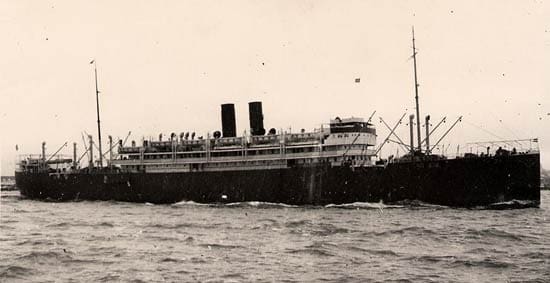
ENROUTE WE STRUCK AN ICEBERG
Young Christopher Roberts (NOFU #3475) of Sally’s Cove was among the last group of NOFU volunteers to travel overseas. He recorded his experiences in an essay included in a booklet of short memoirs by senior residents of Rocky Harbour, NL.
At the age of fourteen I went into the woods near Deer Lake cutting pulpwood. Then came World War Two. After lying about my age, I managed to get accepted for the Newfoundland Overseas Forestry Unit in Scotland.
To go overseas, we first went to Halifax and from there on an old Norwegian whaling ship through the North Atlantic. Enroute we struck an iceberg that left a gash about ten feet long amidships. The seas were running high and the ship was taking on a lot of water. We were ordered to our lifeboat stations, with my job being to lower the lifeboat.
With the seas running so high, it looked too dangerous to lower the boats. In about an hour we were in calmer water, the hole was above the water line, and the ship’s bo’sun repaired the gash with wooden wedges and cement. We then continued our journey to Liverpool, England. The trip from Halifax to Liverpool took seventeen days. I was in Scotland until the end of the war.
– excerpted from “Sally’s Cove” by Christopher Roberts, published in Looking Back, 1998
LISTEN
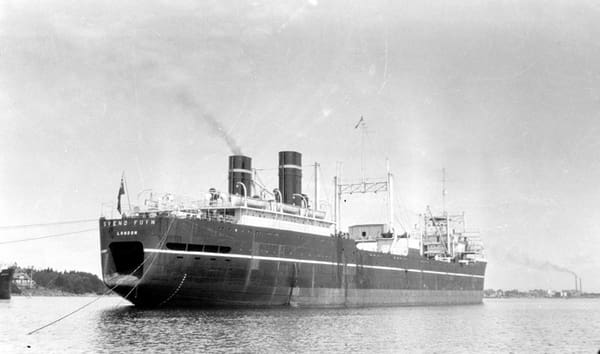
by a German U-boat on October 7, 1941.
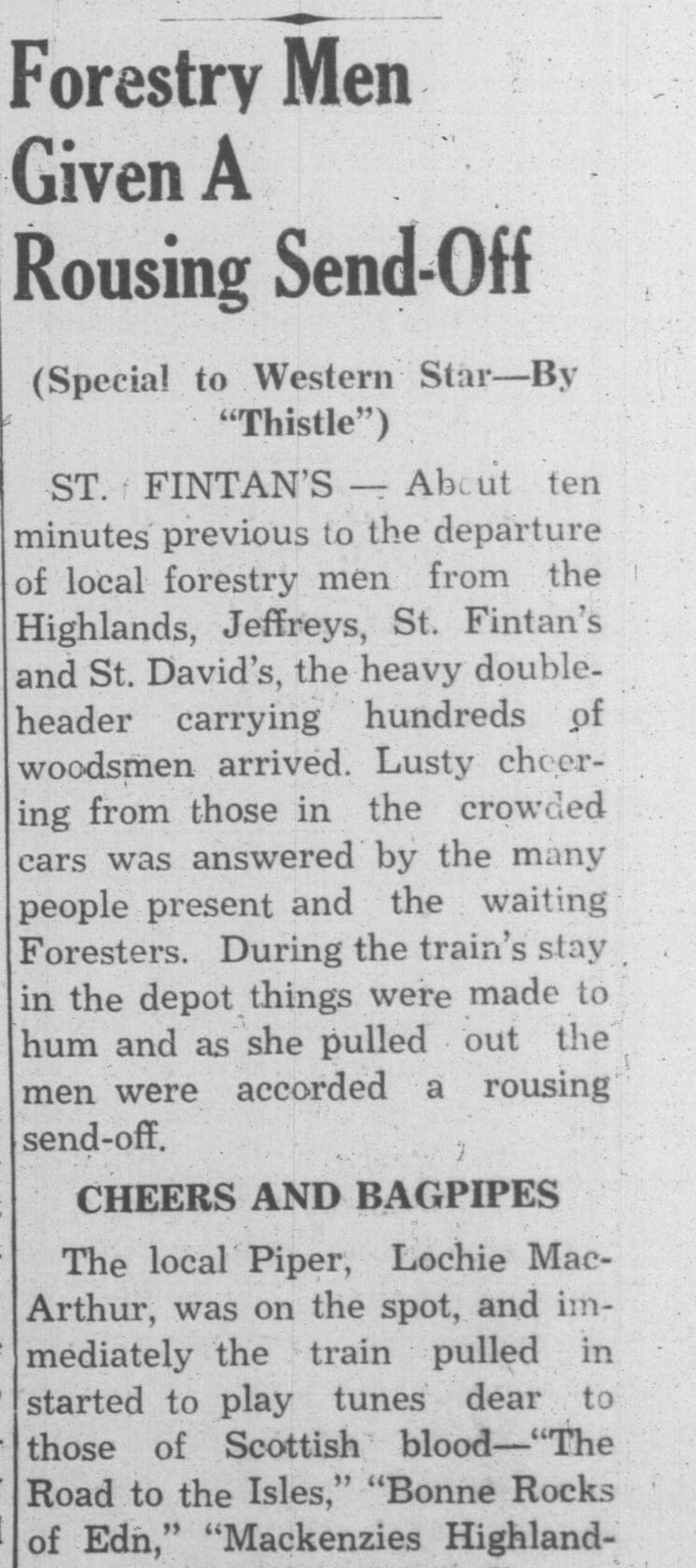
Forestry Men Given A Rousing Send-Off
(Special to Western Star—By “Thistle”)
St. Fintan’s – About ten minutes previous to the departure of local forestry men from the Highlands, Jeffreys, St. Fintan’s and St. David’s, the heavy double-header carrying hundreds of woodsmen arrived. Lusty cheering from those in the crowded cars was answered by the many people present and the waiting Foresters. During the train’s stay in the depot things were made to hum and as she pulled out the men were accorded a rousing send-off.
Cheers and Bagpipes
The local Piper, Lochie MacArthur, was on the spot, and immediately the train pulled in started to play tunes dear to those of Scottish blood—“The Road to the Isles,” “Bonne Rocks of Edn,” “Mackenzies Highland-. . . .