

SECOND WORLD WAR
Hard Work and Danger
1: How Big Is That? (CONSIDER)
In the introduction to “Hard Work and Danger,” the authors note that by the end of 1944, the NOFU had harvested 31,501,421 cubic feet (2,283,470 cubic metres) of round timber (630,000 cords).
Create a scale drawing or scale model that helps to illustrate how much space this much round timber would occupy. Consider using a pictograph to show comparisons.
2: Our First Winter (VISUAL ART)
Using the description provided by Captain Jack Turner in his article “The Newfoundland Forestry Unit,” create a piece of visual art that reflects the experiences of members of the NOFU during their first winter in the UK. Possible visual forms include painting, collage, and comic art.
3: Garron Ponies (IMAGINE)
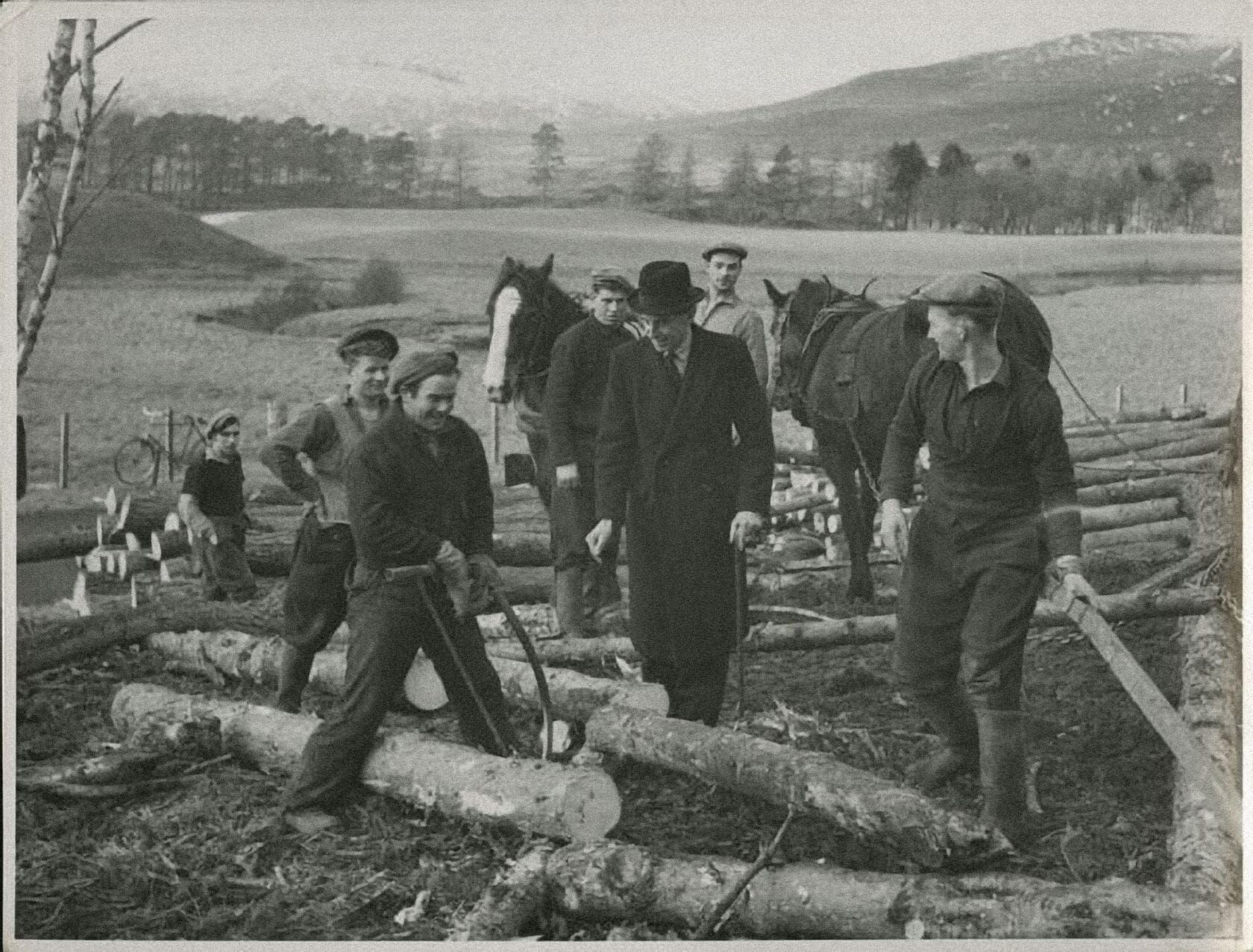
This photograph provides insight into how our world and ways of life are shaped by technology.
Study the image. What observations can you make about the sources of energy used by the members of the NOFU during their time overseas?
In the image, all the energy to do the work shown is “organic”—either human-powered or animal-powered. Although chainsaws existed at this time, these workers did not use them because they were not the compact, versatile tools they are today.
If you were doing the NOFU’s tasks today, what sources of energy would you use?
Write a narrative of what your way of life would be like without non-organic sources of energy. In other words, what would your typical day involve if you didn’t have easy access to electricity or other forms of mechanical energy (gasoline engines, for example).
4: Occupational Health & Safety (PERSUASIVE WRITING)
In many countries today, “safety first” is a common expectation in schools, homes, and workplaces. Many high school students even take courses in occupational health and safety (OHS).
Examine the images captioned as in the list below. What safety concerns do you see in them? Record your findings.
- NOFU members building their camp at Taymount, Perthshire, Scotland, 1941.
- Two NOFU members felling a tree.
- Two NOFU foresters with axes, ca. 1940.
- On his official 1941 visit, Commissioner Penson (centre) watched NOFU members prepare logs that would be hauled by Garron ponies.
- Two NOFU members demonstrate for Commissioner Penson how they saw lumber to size.
There were many accidents on NOFU work sites and some men were killed. Imagine that an accident occurred in one of the settings listed above. Write a letter to your government representative (your federal Member of Parliament, for example, or your provincial Member of the House of Assembly), outlining what happened and propose a measure or measures that would reduce the likelihood of such mishaps and losses occurring in the future.
5: Lumberjills (TIMELINE)
The First and Second World Wars changed the lives of women in many—and long-lasting—ways.
Research an aspect of how women’s lived experiences changed in the 20th century (such as their legal rights, suffrage, wage equity). Present your findings as a timeline. Use images and text to communicate your ideas.
* The significance of an event can be understood in terms of magnitude, scope, and duration. For example, something is said to be significant if:
- it has deep consequences (magnitude)
- it involves many people (scope)
- it lasts for a long period of time (duration)
6: Today, It’s the Same (ACTIVE CITIZENSHIP)
“When we do not receive letters from home we feel rather down-hearted, and the very moment we have an attack of the ‘Blues,’ along comes the postman with a cheery smile upon his face and passes us a parcel from the W.P.A. and involuntarily we say, ‘God bless the W.P.A., for they have not forgotten us, even if others have’. . . .”
– (excerpt from “A Thank-you to the Women’s Patriotic Association” [Letter to the Editor from R. Travers, NOFU #3164]. The Western Star, April 3, 1942)
Thousands of soldiers serve with Canadian Forces throughout the world today. Like the members of the NOFU during the Second World War, there are times when some of these soldiers miss home.
Contact your local Canadian Legion or Canadian Forces office to find out what you and your class/group might do to show your support for the contributions these individuals are making.